
A Sacramento-area electrical and HVAC contractor could not explain how technician bonuses were calculated, and the pay had nothing to do with who actually generated revenue. Here is how a tiered commission plan, synced from ServiceTitan, turned a confusing spreadsheet into pay a technician can predict.
Here is a moment almost every service business owner will recognize. You are sitting with your operations lead, looking at a technician's revenue for the pay period, and the number on the screen is $24,091. Good period. Then you try to explain, out loud, exactly how that number turns into the bonus on the technician's check, and you cannot do it. Is it a flat ten percent? No, that would be too much. Is it four percent? Maybe. You built the plan, and even you are not sure how it pays.
That was the reality for a small electrical and HVAC contractor in the Sacramento area, a shop with about ten people on the payroll and four field technicians running calls. The owner was not lazy or disorganized. He was doing what almost everyone does when a business grows faster than its back office: he had layered a bonus idea on top of a spiff idea on top of an hourly base, year after year, until the compensation system had quietly become something nobody could reconstruct from memory, including the person who created it.
The technicians felt it too, just from the other side. When a pay plan is a black box, the people living inside it stop trusting it. A technician who has a genuinely strong two weeks, closing big jobs and keeping customers happy, wants to see that effort show up somewhere on the check. If the bonus feels random, arriving in amounts nobody can predict or explain, it stops being an incentive at all. It becomes a small mystery that lands every couple of weeks, appreciated but not motivating, because you cannot chase a target you cannot see.
The real problem was not the amount, it was the fog
It is worth being precise about what was actually broken here, because it is easy to misdiagnose. The owner was not underpaying anyone. In some periods he was arguably paying out more than he realized, which is its own kind of problem. The real issue was that pay had come completely unhooked from performance in any way a person could follow. The technician who generated the most revenue and the technician who generated the least were both getting bonuses that looked, from the outside, roughly similar and equally unexplainable.
Think about what that does to a team over time. Your best producer, the one bringing in real revenue and holding up your average ticket, has no way to see that they are your best producer in their pay. Your slower technician has no signal that anything needs to change. Both of them are getting a check that says, in effect, performance does not translate here. That is the single most expensive message a pay plan can send, because it eventually pushes your strongest people to go find a shop where it does translate.
None of this showed up as a crisis. It showed up as a quiet drag: an owner spending time he did not have trying to reverse-engineer his own payroll, technicians who could not tell you what they needed to do to earn more, and a compensation structure that had grown by accident instead of design. The fix was not to pay more or pay less. It was to make the whole thing legible, to build a plan where a technician could look at exactly one number and know what it meant for their pay.
One metric, four tiers, and a floor that means something
Working with ShareWillow and pulling job and revenue data directly from ServiceTitan, the shop rebuilt technician pay around a single, visible number: attributed revenue, the revenue tied to the work a technician actually completed and sold. Everything else hangs off that.
The core of the plan is a tiered commission. Below a set revenue floor for the period, the commission is simply zero. Cross into the first band and commission starts at two percent. Keep climbing and the rate steps up: three percent, then four percent, then five percent once attributed revenue clears the top threshold near twenty thousand dollars for the period. The tiers are not decoration. They are the whole point. A flat percentage pays the same rate whether a technician has a great period or a mediocre one. A tiered rate says, plainly, that the more revenue you drive, the harder each dollar works for you, and it draws that line where a genuinely strong period begins.
The floor matters just as much as the ceiling. Setting a real revenue threshold before any commission kicks in keeps the plan honest. It ties the bonus to production instead of turning it into an automatic add-on that everyone expects regardless of output. In practice, that floor is what separates a strong period from an ordinary one, and it is what makes the top tier feel earned rather than handed out.
The owner did not need a bigger bonus pool. He needed a plan where a technician could look at one number, attributed revenue, and know exactly what it meant for their pay. That clarity was the entire fix.
On top of the commission, the plan layers in the smaller levers that shape day-to-day behavior. There is a ten dollar bonus for every membership sold, which turns a technician into a genuine extension of the sales effort. There is a tiered bonus for five-star reviews, more for hitting ten in a period than for hitting five, so customer experience shows up in pay too. There is an average-ticket bonus, fifty dollars when the period's average ticket lands in a healthy band and seventy-five dollars above it, which rewards selling the right work, not just more work.
And then there is the one that protects everything else: a fifty dollar deduction for every callback. A revenue-driven plan, left unchecked, can quietly encourage speed over quality, because the fastest path to more revenue is sometimes a rushed job. The callback penalty is the counterweight. It puts a real, visible cost on work that has to be redone, so the incentive to produce never tips over into an incentive to cut corners.
One more design choice made the commission fairer than a raw revenue race would have been: the top commission tier carries an overtime qualifier. To earn at the highest rate, a technician's overtime has to stay within a reasonable cap. That keeps the plan rewarding efficient, well-run revenue rather than simply rewarding whoever clocked the most hours. It is a small rule with a big effect, because it aligns the technician's incentive with the shop's actual margin instead of just its top line.
Because all of it, revenue, hours, memberships, reviews, callbacks, tickets, syncs automatically from ServiceTitan, none of it runs on a spreadsheet somebody re-keys at midnight before payroll. The technician sees the same numbers the owner sees, pulled from the same source, which is exactly what turns a black box back into something a person can trust.
Profit sharing
made simple.
Give your team a stake in the company’s success. ShareWillow helps you create and manage profit-sharing programs that motivate employees and drive business results.
What one real pay period looked like
The clearest way to see the plan working is to look at a single, real two-week period once the new structure was live, because it shows the tiers doing exactly what they were built to do: pay differently for different production.
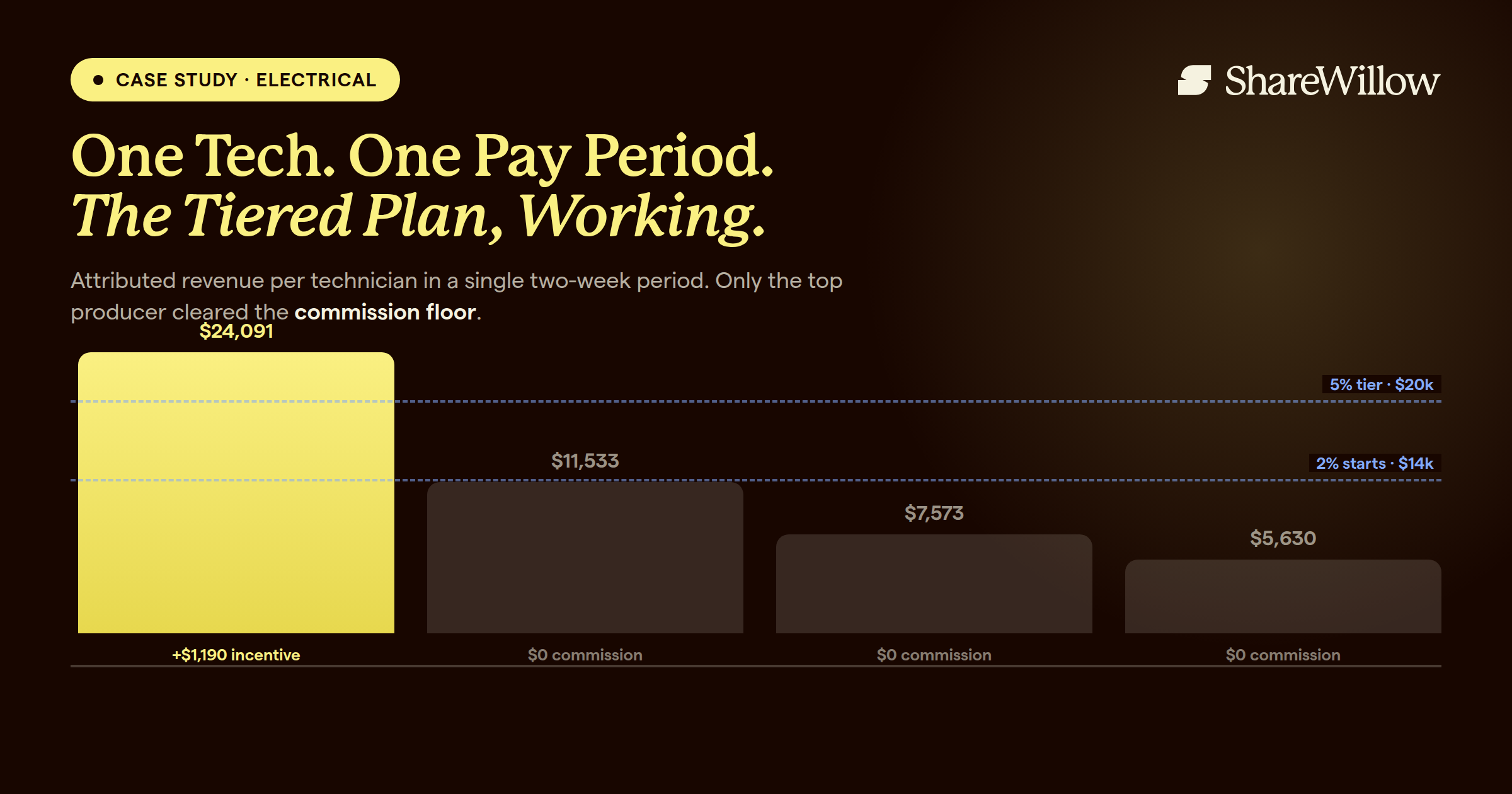
In that period, the shop's top-producing technician generated a little over twenty-four thousand dollars in attributed revenue. That cleared the top commission tier, and under the new plan it translated into roughly $1,190 in incentive pay on top of the technician's hourly base for those two weeks. That figure is not a hand-wave. It is a five percent commission on the revenue over the top threshold, plus a ten dollar membership bonus and a seventy-five dollar average-ticket bonus, with a small adjustment netted out. A technician can follow that math line by line, which is the entire difference from the old system.
Now look at the same period for the other three technicians. Their attributed revenue came in at roughly $11,500, $7,600, and $5,600. All below the commission floor. So their commission for that period was zero, though a couple of them still earned the average-ticket bonus where they qualified. That spread, one technician earning nearly $1,200 in incentive and three earning little to none, is not a flaw in the plan. It is the plan. It would be a flaw if the numbers had come out flat, because that is precisely the fog the shop was trying to clear.
The plan has now run for five straight two-week periods on this structure, each one calculated automatically and paid out against the same visible rules. That consistency is its own kind of result. A pay plan earns trust by behaving the same way every period, and by paying the technician exactly what the published tiers say they earned, without a surprise and without a manual correction.
What changed most is not really a number. It is that the owner can now answer the question he could not answer before. Ask him how a technician's revenue turns into their bonus, and he can walk you through it: here is the floor, here is the tier they landed in, here is the rate, here are the add-ons, here is the callback line. The technicians can run the same walk-through on their own check. The mystery is gone, and what replaced it is a target everyone can actually see.
It is worth sitting with why that clarity matters as much as the dollars. A technician who cannot predict their bonus treats it as luck, and you cannot build effort on luck. A technician who can see that clearing the next revenue tier is worth a specific, knowable jump in pay has a reason to push for one more sold job before the period closes. The tiered structure does not just distribute money more fairly; it hands every technician a lever they can actually pull, and it tells them exactly what pulling it is worth. That is the difference between a bonus that happens to a technician and a bonus a technician goes out and earns, and it is the whole reason the shop rebuilt the plan the way it did.
What this looks like for your shop
If you cannot explain your own bonus math in one sitting, your technicians almost certainly cannot either, and that fog is costing you more than any single payout. A few principles from this rebuild carry over to almost any service business.
- Anchor the plan to one number. Pick the metric that actually drives your business, attributed revenue here, and build the whole plan so a technician can trace their pay back to it. If it takes a spreadsheet and twenty minutes to explain, it is too complicated to motivate anyone.
- Use tiers, not a flat rate. A flat percentage pays the same whether someone has a great period or a quiet one. Tiers reward the climb, and a real floor before the first tier keeps the bonus tied to genuine production.
- Protect quality with a real deduction. A callback penalty is what keeps a revenue-driven plan from quietly rewarding rushed work. Without it, you are paying for speed and hoping for quality.
- Reward the right work, not just more work. An average-ticket bonus and a membership spiff push technicians toward the jobs that actually help your margin, instead of just chasing raw revenue.
- Sync it, do not re-key it. When the numbers pull straight from ServiceTitan, the technician trusts the check because it comes from the same place their jobs do. A plan that depends on manual entry breaks exactly when it matters most, on payday.
You do not need a bigger bonus budget to fix a plan like this. You need a plan people can see. ShareWillow helps electrical, HVAC, and plumbing shops build tiered, transparent commission plans straight from the job data they already have, based on what we have learned from over 200 service businesses.
Related reading
- Five Pay Plans, One Standard: How an 18-Person Electrical Contractor Unified Its Sales Commission Plan
- How a Small Electrical Company Rebuilt Commission to Keep Its Best Installers
- Incentives, Commissions, and Bonuses: What’s the Difference and Why It Matters
- Companies with Profit Sharing: Who They Are & What They Offer
Conclusion
When a technician can look at one number and know exactly what it means for their paycheck, the whole plan starts working.
Create incentives
that
drive results
You shouldn't need complex equity plans to align your team. ShareWillow makes it simple to create transparent profit-sharing programs that motivate employees and grow your business.

Incentive plans to help
small businesses thrive.
.png)
"I was able to leverage the knowledge of the ShareWillow team to learn how other companies were designing their bonus plans. The template was extremely helpful."

Brian Tustin
Owner, First Rate Movers
