
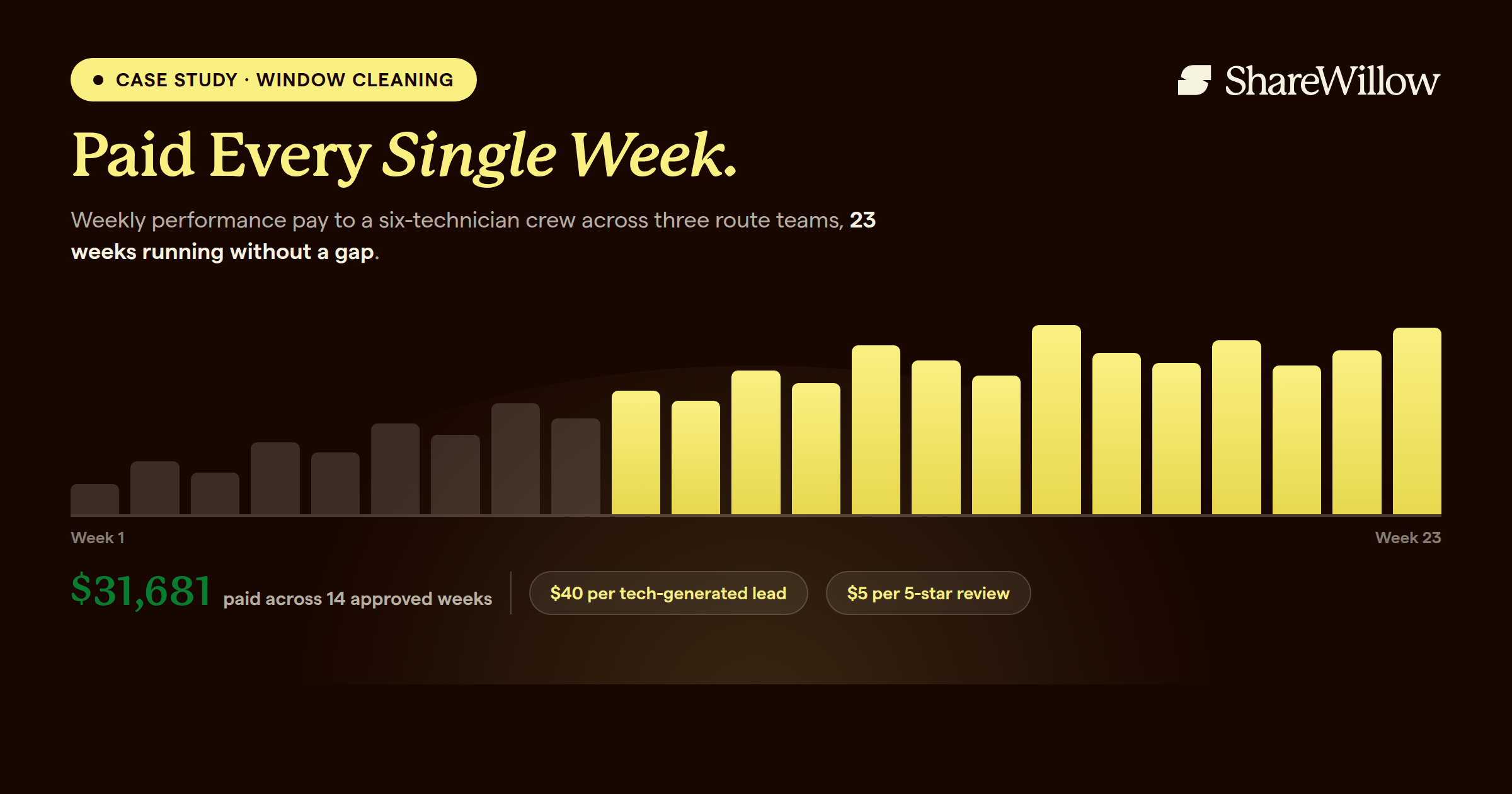
A window-cleaning company running three route teams paid everyone the same way no matter how much revenue their route brought in, and rewarded none of the things that actually grow a route. Here is how a weekly performance-pay plan changed that, and has run without a single gap for 23 weeks.
Route-based home service has a rhythm that is different from big-ticket trades, and most pay plans ignore it. There is no single sixteen-thousand-dollar install to build a bonus around. Instead there are dozens of smaller jobs a week, a steady stream of houses and storefronts, and a hundred tiny moments where a technician either does the little extra thing or does not. Mentions the second-story windows that need a touch-up. Asks the happy customer for a review. Notices the neighbor watching and hands them a card. Those moments are where a route business actually grows, and they are exactly the moments a flat paycheck is blind to.
Consider a window-cleaning company running three route teams, six technicians in all, on hourly pay that ranged from the high teens to about thirty dollars an hour depending on experience. The pay was fair in the narrow sense that everyone got their hourly rate. It was also completely disconnected from the thing the business runs on. A technician whose route brought in strong revenue and a technician who coasted took home the same structure. The person who generated a lead that turned into a new recurring customer got nothing extra for it. The person who earned a glowing five-star review that will pull in the next three customers got nothing extra for that either.
In a route business, that disconnect is especially expensive, because the whole model depends on those small, repeatable wins compounding. A single lead becomes a recurring account. A single five-star review becomes social proof that books the next job. A flat hourly plan treats all of that as invisible, which means the people best positioned to grow the business, the technicians standing at the customer's house every week, have no reason built into their pay to actually do it.
Why flat pay quietly caps a route business
The trouble with paying everyone a straight hourly rate is not that it is unfair in the moment. It is that it silently sets a ceiling on the business. Growth in a route company comes from two places: keeping the customers you have happy enough to stay and refer, and adding new stops to the routes you already run. Both of those depend heavily on technician behavior, and neither of them is something you can order into existence with a memo. You get them by making them worth the technician's while.
When the pay plan says nothing about leads, the leads a technician could generate mostly do not happen. Not out of laziness, but out of simple economics. Handing a card to a curious neighbor, following up on a storefront that admired the work, mentioning the add-on service, all of that takes initiative, and initiative flows toward where it is rewarded. If the pay plan is silent on it, the technician's energy reasonably goes toward finishing the route and going home, which is the only thing the pay plan actually recognizes.
The same logic applies to reviews and to the small quality touches that keep customers loyal. These are not things you can meaningfully mandate. A technician can technically comply with a review request policy while putting zero warmth into it, and customers can tell. What you want is for the technician to genuinely care whether the customer is delighted, and the most reliable way to make someone care is to give them a real, personal stake in the outcome. Flat pay gives them none. It asks for growth behaviors while paying only for attendance, and then owners wonder why the routes are not expanding.
A weekly plan that pays for the whole job, not just the hours
Working with ShareWillow, the company built a performance-pay plan that kept a solid hourly foundation and then layered real, visible upside on top of it, tuned to the actual rhythm of route work. Instead of a bonus that resolves once a month, this plan runs weekly, on the same cadence as the work itself, so the connection between what a technician does and what they earn stays tight and immediate.
The foundation is still the hourly floor, so nobody trades a stable paycheck for a gamble. On top of that sits commission on the revenue and sales a technician's work generates, which finally hooks pay to the size of the route a technician is running and growing. But the most interesting parts are the smaller spiffs, because they are aimed precisely at the growth behaviors flat pay was ignoring.
Every lead a technician generates is worth forty dollars. That single line changes the math on the curious neighbor and the admiring storefront. A technician who used to have no reason to chase those now has forty reasons, per lead, and in a route business a generated lead often becomes a recurring account worth far more than that over its lifetime. Every five-star review is worth five dollars, which turns the review ask from a chore into a small, repeatable win the technician actually wants. There are hourly adders for the honest, unglamorous parts of the job too, touch-up work, vehicle maintenance, team meetings, so the time that keeps the operation running does not go unpaid or unrewarded.
Flat pay asks a technician to grow the route while rewarding only the hours. This plan flips it: forty dollars a lead, five dollars a review, commission on the revenue you drive. Suddenly the growth behaviors have a price, and the price is worth chasing.
The plan is organized around the company's three route teams, so technicians see their performance in the context of the crew they actually run with rather than lost in one undifferentiated list. That team structure matters in route work, where crews often move together and a team's shared habits, punctuality, quality, customer rapport, drive results as much as any individual does. Building the plan around the teams that already exist made it feel like a natural extension of how the company operates, not a foreign system bolted on top.
None of this depends on a manager tallying leads and reviews by hand at the end of the week. The inputs feed the plan automatically, which is what makes a weekly cadence actually sustainable. A monthly plan can survive some manual bookkeeping. A weekly plan cannot; if calculating it is a chore, it will slip, and a performance plan that pays late or inconsistently loses the technicians' trust fast. Automating the inputs is what lets the plan keep its promise week after week, which turns out to be the single most important thing it does.
Profit sharing
made simple.
Give your team a stake in the company’s success. ShareWillow helps you create and manage profit-sharing programs that motivate employees and drive business results.
Twenty-three weeks, and not a single one skipped
The most telling number in this story is not a dollar figure. It is a count: twenty-three. Since the plan went live in early spring, it has computed and run performance pay for twenty-three consecutive weekly periods, every single week, without a gap. In a small route business, that consistency is genuinely hard to pull off, and it is the clearest possible evidence that the plan is not a nice idea sitting in a document but a living part of how the company pays its people.
Of those twenty-three weeks, fourteen have been formally approved and locked, and across those approved weeks the plan has paid out roughly $31,681 in performance-based pay to the six-technician crew. Across the full run of computed weeks, the figure is higher still. The weekly amounts vary, as they should in a plan that actually tracks performance, ranging from a few hundred dollars in a quiet week to well over four thousand in a strong one. That variation is the plan working. A flat number every week would mean the performance link was cosmetic; the fact that the weeks differ is proof that the plan is measuring something real and paying accordingly.
It is worth being precise about what that money represents. This is a total-pay plan, so those figures include the hourly foundation as well as the commission and spiffs layered on top. The point is not that the crew is suddenly earning tens of thousands in pure bonus. The point is that a meaningful, performance-linked slice now rides on top of a stable base, paid on the same weekly rhythm as the work, and that the whole system has proven it can run reliably, week in and week out, for nearly half a year.
The behavioral levers are where the long-term payoff lives. Forty dollars a lead and five dollars a review may sound small next to a commission line, but in a route business those are the seeds of growth, and now they are being planted on purpose instead of by accident. Every lead a technician generates because the plan made it worth their while is a potential recurring account. Every review earned is a little more social proof pulling in the next customer. The revenue those behaviors create compounds quietly, week after week, on top of the immediate pay the plan hands out.
Twenty-three weeks in, the plan has already cleared the bar that most incentive programs never do: it has become routine. Nobody is wondering whether it will run this week. It runs. The technicians know the wins are counted and the pay will land, and that reliability is what turns a pay plan from an announcement into a habit.
There is a lesson in that consistency for any owner who has watched a well-intentioned incentive quietly die. Most plans do not fail with a bang. They fail because one week gets busy, the numbers do not get tallied, the payout slips, and the technicians quietly learn that the plan is not really load-bearing. After that, no amount of enthusiasm brings the trust back. What protected this company from that fate was not discipline or willpower; it was that the plan calculates itself from data the business already captures, so a busy week never becomes a skipped week. Twenty-three weeks without a gap is not a story about a motivated team remembering to do math. It is a story about taking the math off the team's plate entirely, so the only thing left for them to focus on is the work that earns the pay.
What this means for your route business
If you run routes and pay flat hourly, the lesson here is not that hourly pay is wrong. It is that hourly pay alone leaves your growth behaviors completely unrewarded, and in a route business those behaviors are the entire growth engine. A few principles carry directly.
- Pay on the rhythm of the work. Route wins are small and weekly. A weekly plan keeps the link between action and reward tight, where a monthly cycle lets it go slack.
- Put a real price on leads. Forty dollars a lead turns every curious neighbor and admiring storefront into a reason for the technician to act. In a recurring-revenue business, that is one of the highest-return dollars you can spend.
- Reward reviews directly. A small, per-review spiff turns the review ask from a policy nobody follows into a win technicians actually want to earn.
- Keep the hourly floor. Layering upside on top of a stable base, rather than replacing it, is what makes technicians embrace the plan instead of fearing it.
- Automate it or it will slip. A weekly plan only survives if the inputs feed it automatically. Twenty-three weeks without a gap is a software achievement as much as a compensation one.
Flat hourly pay quietly caps what a route business can become. A plan that pays for leads, reviews, and revenue, on the same weekly rhythm as the work, lifts the ceiling. ShareWillow helps route-based home service companies build weekly performance-pay plans from the data they already collect, based on what we have learned from over 200 service businesses.
Related reading
Conclusion
In a route business, the wins are small and weekly; a pay plan that pays on the same rhythm is what makes them add up.
Create incentives
that
drive results
You shouldn't need complex equity plans to align your team. ShareWillow makes it simple to create transparent profit-sharing programs that motivate employees and grow your business.

Incentive plans to help
small businesses thrive.
.png)
"I was able to leverage the knowledge of the ShareWillow team to learn how other companies were designing their bonus plans. The template was extremely helpful."

Brian Tustin
Owner, First Rate Movers
