
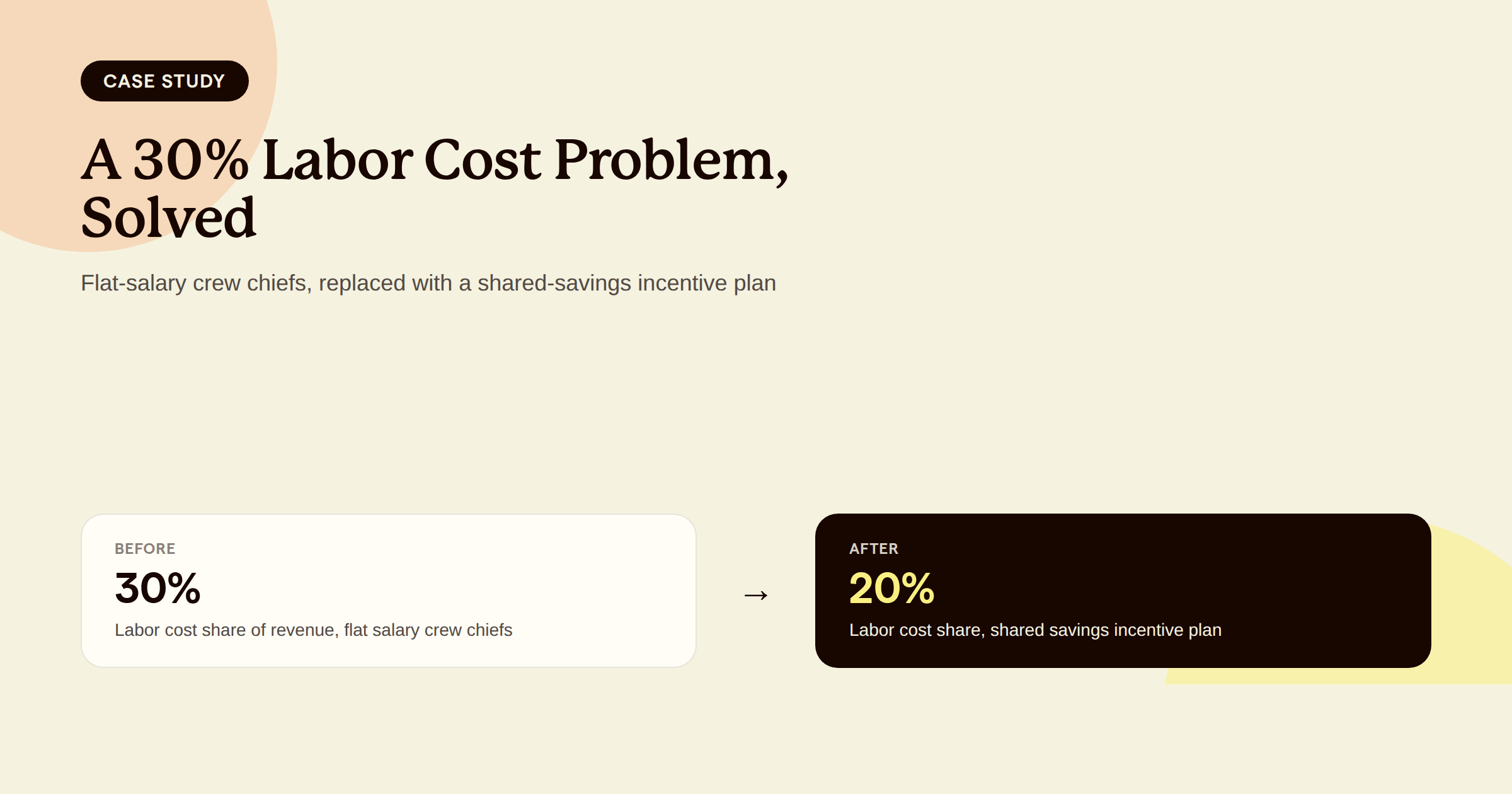
A Colorado home services company had crew chiefs on flat salary and direct labor running at 30% of revenue against a 20% target. Here is how role-by-role incentive plans changed both the pay and the behavior behind it.
Ask most home services owners how they pay their crew chiefs and you'll usually hear the same answer: a flat salary. It's simple, it's predictable, and it feels fair on paper. The problem is that a flat salary doesn't know the difference between a crew that finishes a job in six efficient hours and a crew that stretches the same job into nine. The paycheck is identical either way, so eventually the incentive to hustle just isn't there anymore, not because anyone's lazy, but because the pay structure never asked for it.
That's roughly where a home services company in Colorado, running inspection, maintenance, and repair crews out of a single office, found itself. The team included an owner, an inspector who also handled estimating, two crew chiefs, a handful of field technicians, a salesperson, an office admin, and a regional territory manager covering a second market. On paper, everyone had a role. In practice, almost nobody's pay had anything to do with how efficiently the work actually got done.
A 30% labor problem hiding behind a busy schedule
The clearest sign something was off showed up in a single sentence from an early operations review: direct labor had come in at 30% of revenue the previous month, against a target of 20%. That's a ten-point gap, and in a labor-heavy business, ten points is the difference between a comfortable margin and a business that's working hard just to stay even.
The root cause wasn't a mystery once you looked at how pay actually worked. Crew chiefs were salaried, so a job that ran long cost the company money in wasted hours, but it didn't cost the crew chief anything personally. There was no structure connecting "get the job done efficiently" to "take home more." The inspector, who also functioned as the primary estimator and closer, was in a similar spot: flat salary, no meaningful upside tied to how much work they actually brought in the door. Good instincts and a strong work ethic were doing the job that a pay structure should have been doing instead.
None of this was unique to this one company. It's the default state for a huge share of home service businesses that started small, hired people they trusted, put them on a fair hourly or salaried rate, and never revisited the question as the business grew. The trouble is that "fair" and "aligned with the business" aren't always the same thing, and the gap between them tends to widen quietly, one slightly-too-long job at a time, until a labor percentage review makes it impossible to ignore.
There's also a trust issue buried in flat pay that doesn't show up on a spreadsheet. When a crew chief knows their paycheck won't move no matter how the job goes, they're not being lazy by taking the slower path; they're responding rationally to the incentives actually in front of them. Blaming the person for that is easy and usually wrong. The more useful question, and the one this company eventually asked, is why the pay structure never gave anyone a reason to move faster in the first place. Fixing that starts with treating compensation as a design problem, not a personnel problem.
Building pay plans around the roles that actually existed
Rather than force one incentive template onto every role, the company built four distinct structures, one for each type of work, all pulling data from the same job management system so nothing had to be tracked twice.
For field technicians, the plan centered on a labor-budget-savings pool. Using a conservative burden rate of $33 an hour and a 20% target labor rate, the system calculates the gap between budgeted labor and actual labor on each job, and splits the savings fifty-fifty between the company and the crew, with a secondary revenue-per-hour target of $200 an hour layered on top. Run a job efficiently and the crew shares directly in the dollars that efficiency created. Run it long, and there's simply less pool to share, no penalty, no drama, just a direct line between effort and outcome.
Crew chiefs got a monthly bonus pool of up to $400, but it isn't handed out automatically. It's gated on hitting at least 80% "efficient jobs" for the month, a threshold that keeps the bonus tied to consistency rather than one lucky week. That gate turned out to matter more than the dollar amount. A capped, threshold-based bonus gave crew chiefs a specific, achievable target to manage toward, instead of a vague expectation to "keep things moving."
"Salaried structure for crew chief misaligns incentives for job efficiency." That was the plain-language diagnosis that kicked off the redesign, and it's a sentence a lot of home service owners would recognize in their own operation if they looked closely enough.
The inspector's plan moved from flat salary to a tiered commission, five and a half to six percent depending on volume, structured against a base of forty thousand dollars with a target of sixty thousand in total comp. The goal wasn't to replace their income with commission risk; it was to give someone whose whole job is finding and closing new work an income that actually reflects how much new work they find and close.
And for the territory manager running a second market, the plan went a step further: an eight percent profit share on that territory's performance. That's a meaningfully different kind of incentive than a per-job bonus. It puts someone in the position of an owner-operator for their slice of the business, which is exactly the mindset a company wants from whoever's running a market the founder isn't in every day.
Getting the mechanics right took real back-and-forth. Job-level revenue and hours needed to be pulled cleanly from the field management system, technician assignment on estimates needed to be accurate before commission could calculate correctly, and the team had to decide, deliberately, whether pay should be based on the date a job was created, the date it was completed, or the date it was paid. Small decisions like that sound bureaucratic, but they're exactly the kind of detail that determines whether a technician trusts the number on their statement or spends every pay period questioning it.
One exchange from an early build session captures how granular this got. The owner wanted a salesperson's commission structured around break points, base pay up to a certain volume, a bump at one threshold, another bump further up, all calculated monthly rather than per job so a slow week wouldn't tank a strong month's average. Working that out live, on a call, adjusting the percentage until the math actually matched what the owner had in his head, took longer than either side expected. That's normal. Most owners carry a rough sense of what "fair" should look like, but translating that gut feeling into a rate table that a system can calculate automatically, every period, without a human double-checking it, is where a plan either becomes real or stays a nice idea in a spreadsheet nobody trusts.
Profit sharing
made simple.
Give your team a stake in the company’s success. ShareWillow helps you create and manage profit-sharing programs that motivate employees and drive business results.
What actually showed up in the numbers
It would be easy to promise a dramatic before-and-after here, and it's worth being honest instead: this plan is still in its early, active rollout, and the full swing from 30% labor back to the 20% target hasn't been confirmed as a closed-out result yet. What has shown up, clearly and repeatedly, are two things that matter just as much in the meantime.
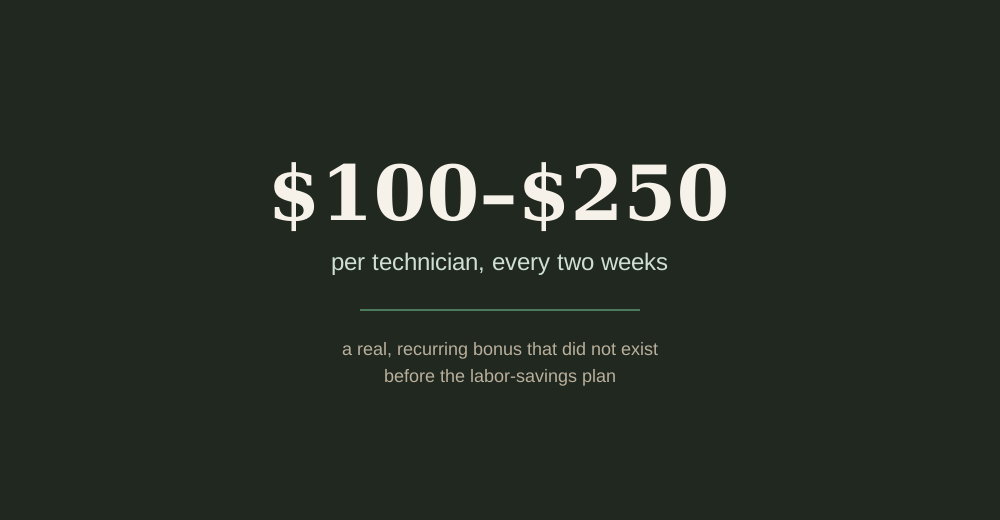
First, the payouts are real and they're landing in technicians' hands. In a typical two-week pay period under the new plan, field technicians have been earning somewhere between $100 and $250 in labor-savings bonus, on top of their regular pay. That's not a hypothetical projection modeled off historical data; it's what actually got paid out. There have been slower stretches, weeks with fewer eligible jobs where the bonus dropped closer to zero, which the owner and the ShareWillow team were both upfront about rather than smoothing over. A plan that pays out consistently every single period regardless of performance isn't really an incentive plan, it's just a raise with extra steps.
Second, and maybe more telling, is what the owner noticed in the field without anyone asking him to look for it. Job time clock-ins, which directly feed the labor-savings calculation, started coming in noticeably more accurate once technicians understood their pay was tied to them. In his own words, watching the crew's habits shift: "everybody seems to be doing it a lot better now." That's a small, unglamorous behavior change, logging time correctly, but it's exactly the kind of behavior change that an incentive plan is supposed to produce. You don't get accurate labor data by asking nicely for it in a staff meeting. You get it by making accuracy the thing that determines whether someone's bonus check is right.
What this means if your crew is on flat salary today
A lot of home service and facility service businesses are sitting exactly where this company was: good people, fair pay, and zero structural connection between how efficiently a job gets done and what anyone takes home for doing it. A few things from this rollout are worth borrowing directly.
- Start with the labor percentage, not the org chart. The clearest signal something needs to change usually isn't a complaint, it's a number. If direct labor is running well above your target percentage of revenue, that's your starting point, not a vague sense that "the crews could be faster."
- Match the incentive to the role, not a template. A field technician, a crew chief, an inspector, and a territory manager all influence profit in different ways. A single company-wide bonus formula usually ends up rewarding the wrong behavior for at least one of those roles.
- Gate bonuses on a real threshold. An 80% efficient-jobs requirement for the crew-chief bonus meant the payout tracked consistency, not a single good month propping up a string of bad ones.
- Watch for behavior change, not just the dollar outcome. More accurate time tracking is a leading indicator. The margin improvement follows from it, not the other way around.
- Be honest about where you are in the rollout. A new incentive plan doesn't flip a switch on day one. Real payout data and real behavior change during the ramp-up period are worth paying attention to even before the annual numbers are finalized.
If your team is still running on flat salaries with no link to job efficiency, that gap is costing you more than it looks like on a single month's P&L. ShareWillow helps home service and facility teams design incentive plans role by role, built on the job data you're already collecting, based on what we've learned from over 200 service businesses.
Related reading
- From Zero Incentive Pay to a Real Commission Plan: A Small Field Service Story
- The 20% Productivity Gap Between Two Install Crews Nobody Could See, Until the Clock Told the Truth
- HVAC Profit Margins 101: Benchmarks and Proven Ways to Boost Your Bottom Line
- 7 Profit Sharing Plan Examples for Your Small Business
Conclusion
A flat salary can't tell the difference between an efficient job and a slow one; a good incentive plan can, and that difference shows up on the P&L.
Create incentives
that
drive results
You shouldn't need complex equity plans to align your team. ShareWillow makes it simple to create transparent profit-sharing programs that motivate employees and grow your business.

Incentive plans to help
small businesses thrive.
.png)
"I was able to leverage the knowledge of the ShareWillow team to learn how other companies were designing their bonus plans. The template was extremely helpful."

Brian Tustin
Owner, First Rate Movers
