
A four-person pool cleaning and maintenance company paid everyone straight hourly with no bonus of any kind. Here is how a tiered commission plan changed retention, upsells, and one very real pay period.
Most incentive plan stories start with a broken bonus structure that needs fixing. This one starts somewhere simpler: no incentive structure at all. A small pool cleaning and maintenance company running four technicians, two of them full-time and two working three days a week, paid everyone straight hourly wages. No commission, no spiffs, no bonus of any kind, for anyone, ever.
That's not unusual for a small field service business. When you're running four trucks and wearing every hat yourself, adding a commission structure can feel like one more complicated system on top of an already full plate. The problem is what that simplicity quietly costs you. The owner had two specific worries keeping him up at night: he was struggling to retain good technicians because there was no financial upside to staying, and he had no real way to motivate the team to bring in new customers or flag repair opportunities while they were already standing at a customer's pool.
The upsell that was sitting right in front of the truck
Here's the part that made the gap especially frustrating: the opportunity was already there. A pool maintenance visit puts a technician face to face with the customer's equipment on a regular schedule, which is about as good a vantage point as you'll get for spotting a failing pump, a cracked filter housing, or a heater that's about to need replacing. But without any financial reason to flag it, upsell conversations just weren't happening consistently. Technicians weren't untrained or uninterested; they simply had zero stake in whether a repair got sold or not, so pointing it out took a back seat to finishing the route on time.
Retention was the other half of the problem, and it's the half that tends to cost owners the most in the long run. A technician who's good at the job, reliable, and trusted by customers is genuinely hard to replace. Paying that person the exact same hourly rate as someone doing the bare minimum doesn't punish the bare-minimum performer, it just quietly signals to your best person that there's no financial reason to stay once a better-paying option shows up down the road.
The fix didn't need to be complicated. It needed to exist.
It's worth pausing on why so many small service businesses land in exactly this spot. When you're running four trucks, payroll is usually the one system you set up once, early, and then never touch again unless someone quits or the minimum wage changes. There's no dedicated HR person weighing whether the pay structure still matches the business. The owner is the technician, the dispatcher, the salesperson, and the accountant, often all in the same afternoon, and "build a commission plan" tends to lose out to whatever fire is burning that week. That's not a criticism; it's just how small operations actually run. The cost of that delay is invisible until you start looking for it, which is exactly what happened here.
There's a version of this story where the owner waits another two or three years, loses a strong technician to a competitor offering performance pay, and only then decides it's time to build something. Getting ahead of that, while the team was still small enough that a first incentive plan could be simple, turned out to matter more than any single feature in the plan itself.
Building the plan tier by tier
Working with ShareWillow and pulling job and revenue data directly from Skimmer, the pool industry's field management software, the company built a technician commission plan with a few distinct pieces stacked on top of the base hourly rate.
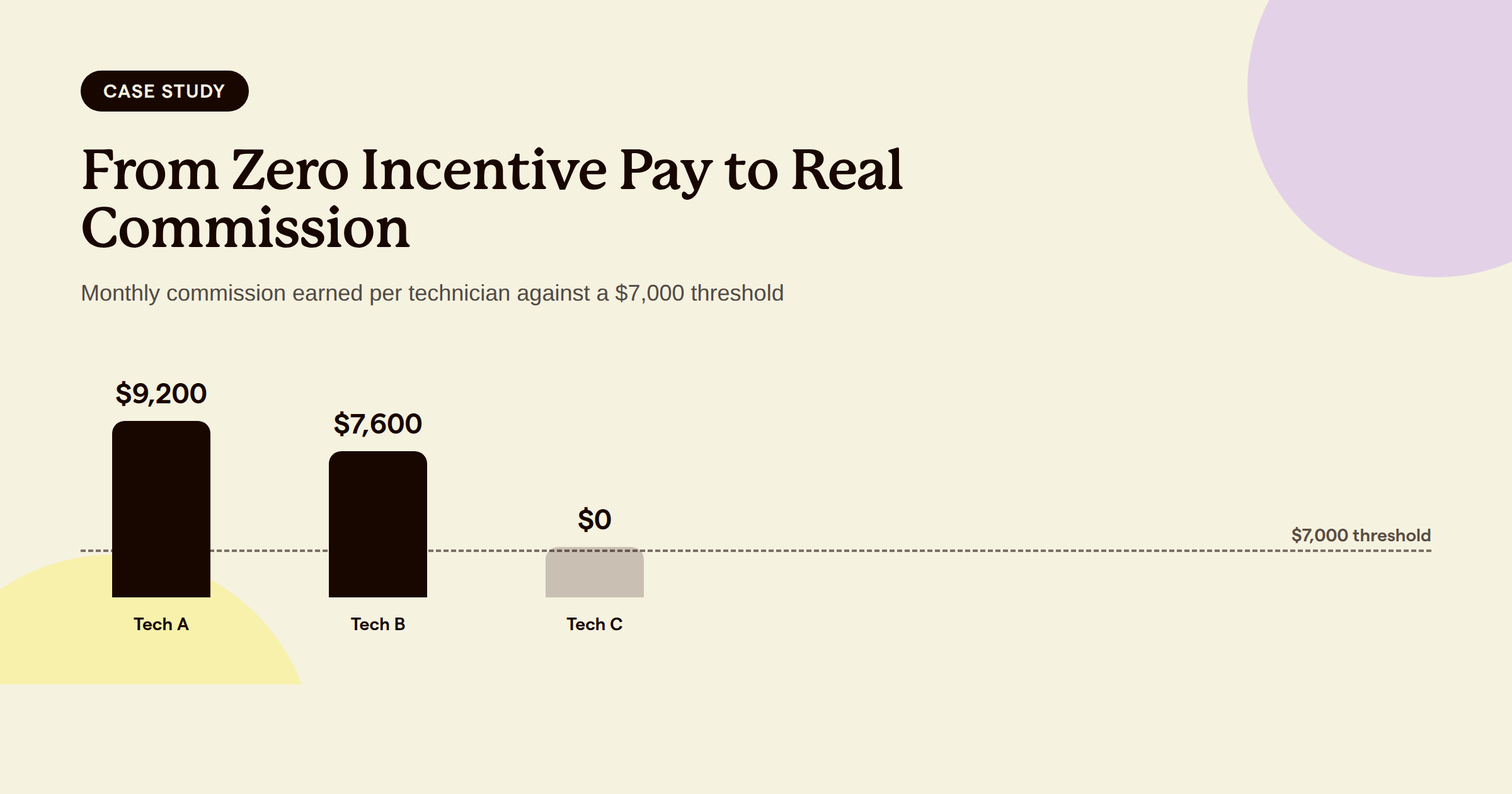
The core of it was a tiered commission on completed maintenance revenue. Hit a two-week revenue threshold of roughly $7,000 and commission kicks in starting around 1.5%, climbing through higher tiers as revenue climbs past $10,000 and beyond. Fall short of that $7,000 minimum, and the maintenance commission for that period is zero. That's a real floor, not a formality; it exists specifically so the bonus stays tied to actual production instead of becoming an entitlement everyone expects regardless of output.
On top of maintenance revenue, technicians earn a straight 10% commission on repair and upsell work, which is where that face-to-face equipment visibility finally started paying off. A failing pump or a cracked housing spotted during a routine visit isn't just good customer service anymore; it's a direct commission opportunity, which changes how likely a technician is to mention it in the first place. A $100 bonus for every new membership sold works the same way, turning a technician into a genuine extension of the sales team instead of someone whose only job is to show up and clean.
To keep quality from slipping as technicians chased revenue, the plan includes a $20 deduction for callbacks, jobs that have to be redone because something wasn't handled right the first time. And to reward the smaller, unglamorous parts of the job that don't show up on a revenue report, weekly piece-rate bonuses, ten dollars for checking vehicle fluid levels, twenty dollars for keeping the truck clean, give technicians a way to earn even during a slower week.
"Struggle to retain employees due to insufficient financial incentives" and "unclear how to motivate technicians to acquire new pool customers." Two sentences from the very first conversation, and both of them solved by the same plan.
One more detail mattered as much as the commission math itself: the two part-time technicians, working three days a week instead of five, got their own separate, lower tier structure rather than being held to the same thresholds as the full-time crew. It's an easy thing to overlook when you're building a plan quickly, but holding someone working three days a week to a five-day revenue target isn't an incentive, it's just a bonus they can never realistically reach. Fixing that kept the plan credible for the whole team, not just the technicians putting in the most hours.
Data quality turned out to be the unglamorous work behind all of it. The revenue tiers only mean something if the underlying job records are accurate, and early on, some repair line items were coming through the Skimmer export at zero dollars even when a real repair had been completed and invoiced separately. Sorting that out meant going invoice by invoice for a stretch, confirming which zero-dollar entries were legitimate no-charge visits and which ones were simply missing their price. It's not the kind of work that makes it into a highlight reel, but a commission plan built on bad data erodes trust faster than having no plan at all, so getting the inputs right came before anything else got rolled out to the team.
Profit sharing
made simple.
Give your team a stake in the company’s success. ShareWillow helps you create and manage profit-sharing programs that motivate employees and drive business results.
What one real pay period looked like
This company's plan is young, so instead of a full-year before-and-after, the clearest evidence is a single, real pay period that shows the plan doing exactly what it was designed to do: pay differently for different performance.
One technician, on the schedule full-time, brought in $11,000 in maintenance revenue over the two-week period and landed in the top commission tier as a result, plus a small additional $6.25 from the fluid-inspection and vehicle-cleaning piece-rate bonuses. Another full-time technician had an equally strong period, also clearing $10,000 in maintenance revenue and earning into the higher tiers. A third technician, working the same structure, came in under the $7,000 minimum that period and received no maintenance commission at all, though he still qualified for the smaller piece-rate bonuses tied to basic job standards.
That spread, one technician landing at $11,000, another over $10,000, a third earning zero commission on maintenance, is the whole point of a tiered plan. It's not a flaw that the numbers came out uneven. It would be a flaw if they hadn't.
What's most telling, though, is the owner's reaction. Reviewing the payout with his ShareWillow rep, his first instinct wasn't "this is too small to matter." It was concern that the top-tier payouts might be too generous, and a request to spread the tiers out further, moving the top threshold up toward $15,000, so that reaching the top level required a genuinely exceptional two weeks rather than just a good one. That's a business owner actively tuning a working incentive system, not tolerating a broken one. Going from an environment where nobody earned a dollar beyond their hourly rate to one where an owner is fine-tuning how generous the top tier should be is a meaningful shift in a short amount of time, even before there's a full year of data to point to.
It's worth naming what didn't happen here too, because it's just as instructive. The owner didn't respond to a generous payout by quietly clawing it back or feeling burned for having offered too much. He treated it as useful information about where the tiers should sit going forward, and made the adjustment transparently, on the next call, with the plan still very much in place. That's the difference between an incentive plan that survives its first surprising month and one that gets quietly shelved the first time a payout feels bigger than expected.
What this looks like for a small crew starting from zero
If your team is still on straight hourly pay with no incentive structure at all, the lesson here isn't that you need something elaborate to start. It's that you need something real.
- Set a floor that means something. A $7,000 threshold before commission kicks in isn't there to punish anyone; it keeps the bonus tied to genuine production instead of becoming an automatic add-on nobody has to earn.
- Pay for the behavior you actually want. A straight commission on repair and upsell revenue turned routine maintenance visits into real sales opportunities, because the technician standing at the pool finally had a reason to say something.
- Don't punish part-time schedules with full-time targets. Separate tiers for technicians working fewer days kept the plan fair and believable for the whole team, not just the highest earners.
- Protect quality with a real deduction. A callback penalty keeps a revenue-driven plan from quietly encouraging rushed or careless work.
- Expect to tune it. Watching real payouts land and adjusting tiers up or down from there is a normal, healthy part of running an incentive plan, not a sign it was built wrong the first time.
Zero incentive pay is easy to default to when you're small. It's also one of the more expensive habits a growing field service business can carry, in turnover, in missed upsells, and in top performers who never had a reason to become top performers in the first place. ShareWillow helps small service teams build a real, tiered commission plan from the job data they already have, based on what we've learned from over 200 service businesses.
Related reading
- The 20% Productivity Gap Between Two Install Crews Nobody Could See, Until the Clock Told the Truth
- The Duplicate Commission Line That Had a Sales Team Chasing Money They Had Already Been Paid
- Incentives, Commissions, and Bonuses: What’s the Difference and Why It Matters
- Companies with Profit Sharing: Who They Are & What They Offer
Conclusion
Zero incentive pay feels simple right up until your best technician realizes there is no financial reason to stay.
Create incentives
that
drive results
You shouldn't need complex equity plans to align your team. ShareWillow makes it simple to create transparent profit-sharing programs that motivate employees and grow your business.

Incentive plans to help
small businesses thrive.
.png)
"I was able to leverage the knowledge of the ShareWillow team to learn how other companies were designing their bonus plans. The template was extremely helpful."

Brian Tustin
Owner, First Rate Movers
