
A multi-trade HVAC, electrical, and plumbing company had HVAC labor payouts eating almost 60% of revenue. Here is how a redesigned, ServiceTitan-synced incentive plan brought that number down without cutting anyone's pay.
Every service business owner has had this moment. You pull up the P&L, you look at labor as a percentage of revenue, and the number is higher than it was last quarter, even though the crews were busier than ever. You didn't give anyone a raise. Nobody's hourly rate changed. So where did the money go?
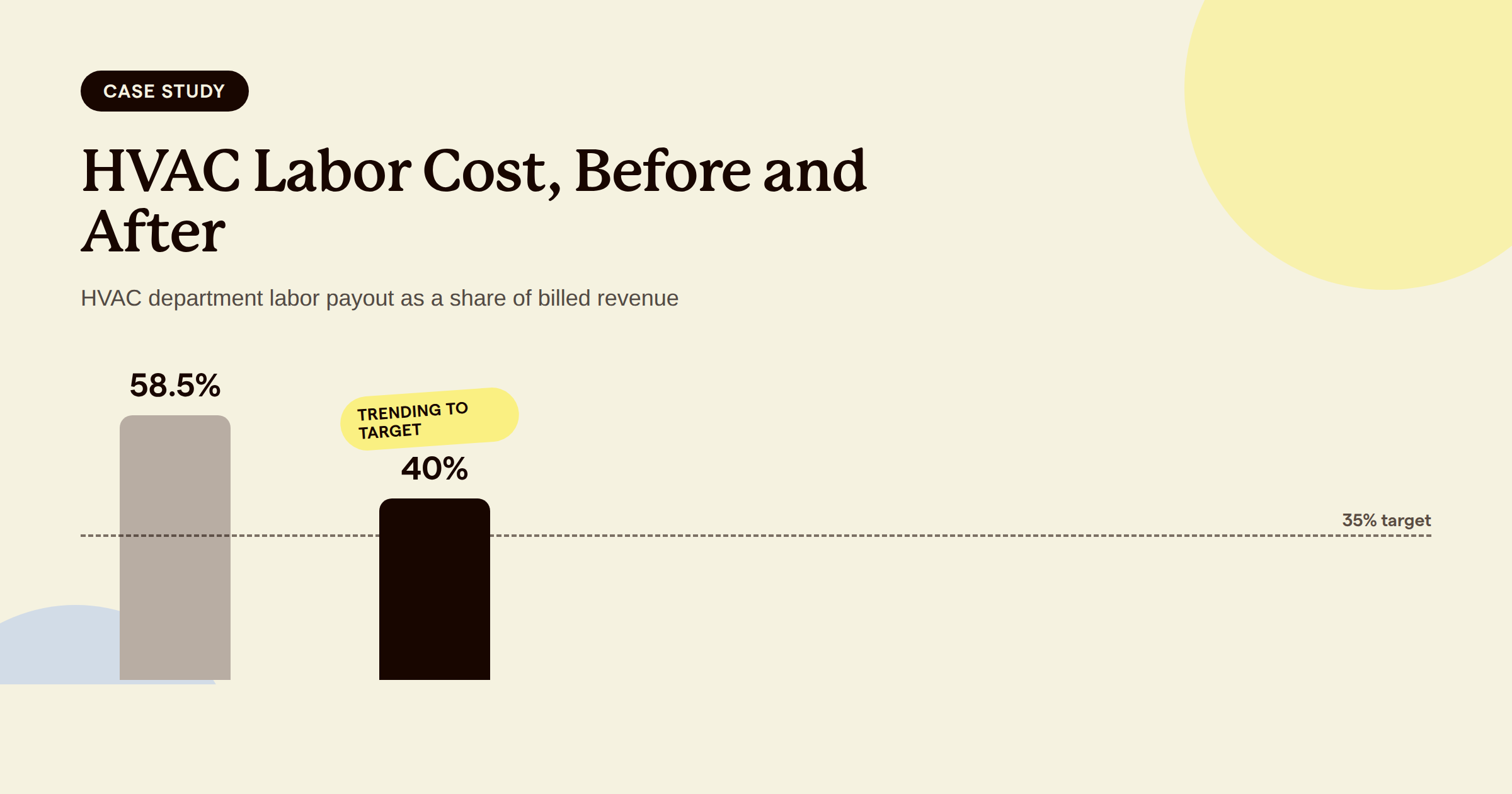
For one multi-trade home services company running HVAC, electrical, and plumbing crews, that number had crept all the way up to 58.5% for the HVAC department. Nearly six out of every ten dollars the HVAC team billed was going straight back out in labor, before trucks, parts, insurance, or overhead. A healthy target for that number is closer to 35%. The gap wasn't a rounding error; it was a structural problem with how technicians got paid.
The pay plan that grew faster than the business
Like a lot of shops that have been around for a while, this company's compensation system had grown by addition, not by design. Someone added a spiff a few years back to push a slow product line. Someone else layered in a bonus for a specific job type. Over time, technicians ended up on what the operations team called "dual commissions," essentially getting paid twice for overlapping parts of the same job, with spiffs that were never tied to sold hours in the first place.
The result was exactly what you'd expect: some technicians were quietly overpaid relative to what they actually produced, and others, often newer or slower-selling techs doing perfectly good work, were underpaid relative to theirs. Neither group had a clean, honest picture of how their paycheck connected to their performance. And because the plan wasn't built to scale, every time the company added technicians or opened a new department, someone had to hand-patch the compensation structure again.
The company's leadership described themselves, accurately, as "a people company." Their whole strategy was built around developing their team and building internal systems that made the business run on trust and clarity rather than tribal knowledge. A pay plan that quietly shortchanged some people and overpaid others was working directly against that goal, even if nobody had designed it that way on purpose.
There was also a harder problem underneath the numbers: how do you pay someone who sells the job fairly, when a different technician ends up performing it? In a multi-trade shop, that handoff happens constantly. Get it wrong and you either discourage your best closers from selling work they won't personally complete, or you discourage your best installers from taking handed-off jobs because the split feels unfair. Nobody had solved that cleanly, and it was becoming a bigger issue as the company grew.
None of this showed up as a single dramatic event. It showed up slowly, the way most compensation problems do: a technician quietly asking why a coworker on similar jobs seemed to be taking home more, a manager spending an extra hour every pay period trying to explain a bonus calculation nobody could fully reconstruct, revenue goals that existed at the company level and the department level but were never actually broken down to the individual technician. Each piece was small. Together, they added up to a business that was growing in top-line revenue while its most important cost, labor, grew right along with it instead of shrinking as a share of the pie the way a maturing operation should expect.
Rebuilding the plan around one clear number
Rather than patching the old system again, the company worked with ShareWillow to rebuild technician pay from the ground up, department by department. The new structure kept things simple at the base and let performance do the rest of the work.
Every technician started with a guaranteed minimum, a 3% commission on completed revenue, so nobody's floor dropped and nobody had to worry about a bad week wiping out their paycheck. From there, pay escalated in tiers tied to a single, unambiguous number: sold hours. Cross a threshold, roughly 13.82 sold hours in a pay period, for example, and the commission rate stepped up to 4%. Keep climbing and the rate kept climbing with it. No stacked spiffs, no separate bonus programs pulling in different directions, just one number everyone could see and one rate table everyone could check for themselves.
The same structure was mirrored across HVAC, plumbing, and electrical, with the specific thresholds and rates tuned to each department's numbers. That mattered more than it might sound like on paper. A plumbing job and an HVAC install don't produce revenue the same way, so a one-size-fits-all commission rate would have either overpaid one department or underpaid another. Building separate, parallel plans meant every department got a structure that actually fit how their work got done, while still following the same underlying logic the whole company could understand.
"Current compensation system is outdated and not performance-based, leading to some technicians being overpaid while others are underpaid." That was the diagnosis going in. The fix wasn't a pay cut disguised as a bonus plan; it was a plan where pay finally matched production.
The office and CSR team got their own incentive structure too, which is easy to skip when a company is focused on field pay but matters just as much. Dispatchers and customer service reps don't swing a wrench, but they absolutely influence booking rates, cancellation rates, and the number of jobs that hit the schedule in the first place. Leaving them out of the incentive conversation sends the message that only the people on trucks matter, which is exactly the wrong message for a company that calls itself people-first.
On top of the commission structure, the company layered in a points-based rewards system. Memberships sold and five-star reviews earned get converted into points automatically, synced daily from ServiceTitan, so recognition isn't something that happens once a quarter in a meeting room. It happens in near real time, and it's visible. A new customizable dashboard let managers build combined leaderboards, grouping by department or by tier, so a plumbing tech could see how they stacked up against other plumbers instead of getting lost in a company-wide list dominated by a different trade.
None of this ran on manual spreadsheets pieced together at the end of the month. Every input, sold hours, completed revenue, reviews, memberships, pulled automatically from ServiceTitan. That automation turned out to matter as much as the plan design itself; when technicians can see their own numbers update daily instead of waiting for a surprise on payday, trust in the system goes up fast.
There was one more design choice that made the whole thing easier to defend in the field: keeping a manual entry option open for roles that ServiceTitan simply doesn't track well. Certain positions in the shop couldn't be pulled automatically, so rather than leaving those employees out of the incentive plan entirely, the team added a separate tracking sheet with a weekly cutoff, so any points earned outside the automated system still fed into the same balance everyone else saw. It's a small detail, but it's the kind of detail that decides whether an incentive plan feels fair to the whole team or just to the people whose jobs happen to fit neatly into the software.
Profit sharing
made simple.
Give your team a stake in the company’s success. ShareWillow helps you create and manage profit-sharing programs that motivate employees and drive business results.
What actually moved
The most important number in this story is the labor percentage. Under the old plan, HVAC labor payout was running at 58.5% of revenue, a level that quietly eats profit no matter how full the schedule looks. After the new plan rolled out, that figure has been trending down toward roughly 40%, moving the department closer to its 35% target. That's not a rounding improvement; it's the difference between a department that's technically busy and one that's actually profitable.
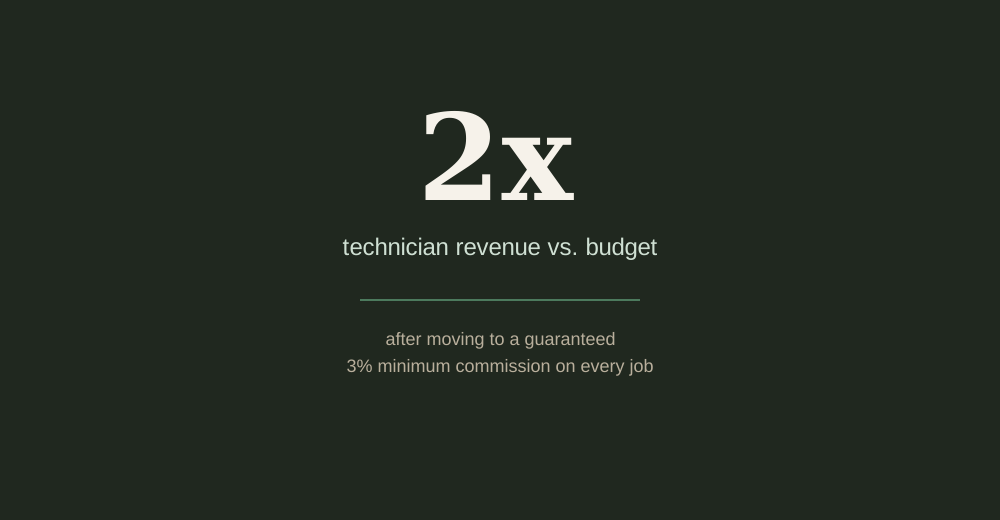
At the same time, technician revenue performance moved in the other direction, up. With a guaranteed 3% minimum on every completed job and no ceiling on what a technician could earn by climbing the sold-hours tiers, technician revenue came in at roughly double what had been budgeted. That's the part that's easy to miss if you only look at the labor percentage: pay didn't come down because people made less. It came down because production went up faster than payroll did, which is the only version of "controlling labor cost" that doesn't quietly punish your best people.
It's worth being straightforward about where this stands: the plan has been live long enough to show a clear trend, not a fully closed-out annual result. The company is still tuning details, adjusting how manual point entries get tracked for roles that don't show up cleanly in ServiceTitan, making sure employees marked inactive actually sync as inactive across systems. That kind of ongoing tuning isn't a sign the plan failed; it's what a real, adopted incentive program looks like six months in, as opposed to a plan that got built once and never touched again.
The other thing worth saying plainly: a plan like this only works if leadership is willing to keep checking it. Nobody gets a pay structure perfectly right on the first try, and the operations reviews that caught the sync issues and the missing employees are exactly what kept the plan credible instead of letting small errors quietly erode trust in the numbers. If you're building something similar, budget time for that ongoing maintenance from day one rather than treating launch as the finish line.
What other HVAC and home service owners can take from this
You don't need three trades and a custom dashboard to apply the same thinking to your own shop. A few principles carried the weight here, and they'll carry weight in a five-truck company just as much as a fifty-truck one.
- Anchor the plan to one number, not five. Stacked spiffs and side bonuses feel generous when you add them one at a time, but together they become impossible for anyone, including you, to explain or predict. Pick the metric that actually drives profit, in this case sold hours, and build the plan around it.
- Guarantee a floor before you build the upside. A base commission that never disappears protects technicians from a slow week and makes the whole plan feel fair, which matters just as much as the math.
- Don't leave the office out. Booking rates and cancellation rates are decided at the front desk as much as in the field. An incentive plan that only touches technicians is only solving half the problem.
- Automate the inputs. A plan that depends on someone manually re-keying numbers from ServiceTitan into a spreadsheet every two weeks will eventually break, usually right when someone's paycheck is on the line. Sync it daily and let the system do the math.
- Make progress visible, not quarterly. A dashboard technicians can check on their own phone changes behavior faster than a meeting once a month ever will.
Building an incentive plan doesn't have to mean months of spreadsheet wrangling or guessing at commission rates. ShareWillow is the simplest platform for designing, launching, and managing performance pay for HVAC, plumbing, and electrical teams, built from what we've learned helping over 200 service businesses build theirs.
Related reading
- A Family HVAC Shop Put Its Bonuses on a Leaderboard. Payouts Nearly Tripled in a Month.
- The Hidden Payroll Bug That Was Quietly Costing HVAC Technicians Real Money
- HVAC Profit Margins 101: Benchmarks and Proven Ways to Boost Your Bottom Line
- 9 Bonus Structure Examples Employees and Employers Love
- Electrical Labor Cost Percentage: How a 20-Tech Multi-Trade Company Is Turning $40K a Month in Overtime Into Growth
- HVAC Technician Sales Goals: How a 7-Tech Company Set Revenue Targets From Hourly Pay Instead of a Flat Commission
Conclusion
If your labor percentage keeps climbing no matter how busy you get, the pay plan is usually the first place to look.
Create incentives
that
drive results
You shouldn't need complex equity plans to align your team. ShareWillow makes it simple to create transparent profit-sharing programs that motivate employees and grow your business.

Incentive plans to help
small businesses thrive.
.png)
"I was able to leverage the knowledge of the ShareWillow team to learn how other companies were designing their bonus plans. The template was extremely helpful."

Brian Tustin
Owner, First Rate Movers
