
A family-run HVAC company in Pennsylvania paid spiffs its technicians could not see or predict. Here is how putting the numbers on a live leaderboard turned a quiet bonus program into one technicians actually chased, with monthly incentive pay climbing from about $2,000 to nearly $5,700 in a single month.
Most incentive plans do not fail because the money is too small. They fail because nobody can see them. The bonus gets calculated somewhere in the back office, appears on a check every so often, and disappears again. The technician has no idea, on a Tuesday, whether they are having a good month or a quiet one. By the time the number lands, the two weeks that produced it are long gone, and there is nothing left to do about it except cash the check.
That was the situation at a family-run HVAC company in Pennsylvania, a shop running a service crew of four technicians plus the office staff who keep the whole thing moving. They already believed in paying for performance. They had spiffs for memberships, incentives around reviews, the usual well-intentioned pieces. What they did not have was any way for a technician to see those pieces adding up in real time. The incentives existed, but they lived in a spreadsheet the technicians never looked at, which meant that for all practical purposes, they may as well not have existed at all.
You can feel the difference immediately if you have ever worked a job with a visible target versus a hidden one. When the number is up on a board and everyone can see it, the last hour of the day feels different. You push for the review, you mention the membership, you take the extra call, because you can watch it move you up the list. When the number is invisible, all of that upside quietly evaporates. The technician does good work out of professionalism, not because the pay plan is pulling them forward, because the pay plan is not visible enough to pull anyone anywhere.
The hidden cost of an invisible bonus
The owners of this shop describe themselves, accurately, as a people-first business. Their whole approach is built on developing their team and running the company on trust and clarity rather than pressure. So it bothered them that their own incentive program was working against that value without anyone quite noticing. A bonus nobody can see is not a motivator, it is a secret, and secrets are the opposite of the transparency they were trying to build.
There was a recognition gap underneath the pay gap, too. In a lot of shops, the moment a technician earns a five-star review or sells a membership passes without any acknowledgment at all. It gets logged, maybe, and rolled into a payout weeks later. The technician never gets the small hit of being seen doing something well, in the moment, in front of their peers. That recognition is a huge part of what makes an incentive plan actually change behavior, and it was being lost entirely to the lag between the work and the payout.
And because the numbers were not visible, the office team, the CSRs and dispatchers who genuinely influence booking rates and customer experience, were essentially outside the incentive conversation altogether. When only the back office can see the scoreboard, the people who could benefit most from a little visible competition never get to play. The shop was sitting on a program with real money attached to it, and almost none of that money was doing the one job an incentive is supposed to do: change what happens on an ordinary workday.
Putting the numbers where the team could see them
Working with ShareWillow, the shop kept the underlying idea of their program but changed the thing that actually mattered: they made it visible. Every technician got a live view of where they stood, updated as the data synced in, so the incentive stopped being a mystery that resolved on payday and became a running scoreboard the team could check any day of the week.
The service technicians moved onto a clean, bonus-only monthly plan sitting on top of their regular pay. The structure itself is deliberately simple, because a plan people are supposed to watch and chase has to be a plan they can understand at a glance. Memberships sold, five-star reviews earned, and the performance metrics that matter to the shop feed into a monthly payout, and, crucially, into a leaderboard that turns those metrics into something with a little friendly heat behind it.
The money was never really the problem. The problem was that a technician could not see it moving. Put the same numbers on a board the whole team can watch, and a quiet program turns into something people actually chase.
The leaderboard is the part that changed the feel of the whole thing. A dashboard the team can pull up and see, in near real time, who is where on reviews, on memberships, on the metrics that drive the bonus, does something a delayed payout never can. It creates the small, daily moments of recognition that were getting lost before. A technician who lands a five-star review sees it register. A technician sitting just behind the leader has a reason to push for one more before the month closes. Recognition stops being an occasional thing that happens in a meeting and becomes a constant, ambient part of the workday.
They layered a monthly review-focused contest on top, which sharpened the effect further. A contest only works if people can see the standings, and now they could. The shop also built incentive structure around the office and CSR side of the house, so the people booking the jobs and shaping the customer experience were finally part of the same visible system as the technicians on the trucks, instead of watching from outside it.
One detail worth calling out, because it speaks to how the shop thinks: they had run a separate, smaller incentive pool for their CSRs previously and taken it all the way through to completion, paying it out cleanly over its full run. This was not a company that starts programs and abandons them. They had already proven they would follow an incentive through to the end. What they were missing was not follow-through, it was visibility, and that is exactly what the new setup added.
Because the metrics sync in automatically rather than being hand-tallied, the leaderboard stays current without anyone babysitting it. That matters more than it sounds. A scoreboard that updates on its own is a scoreboard people trust and check. A scoreboard someone has to update by hand is a scoreboard that goes stale, and a stale scoreboard is worse than none at all, because it quietly teaches the team that the numbers are not really being watched.
Profit sharing
made simple.
Give your team a stake in the company’s success. ShareWillow helps you create and manage profit-sharing programs that motivate employees and drive business results.
What happened once the team could see it
The clearest signal that visibility was doing the work shows up in the payouts themselves, over the first two confirmed months on the new plan.
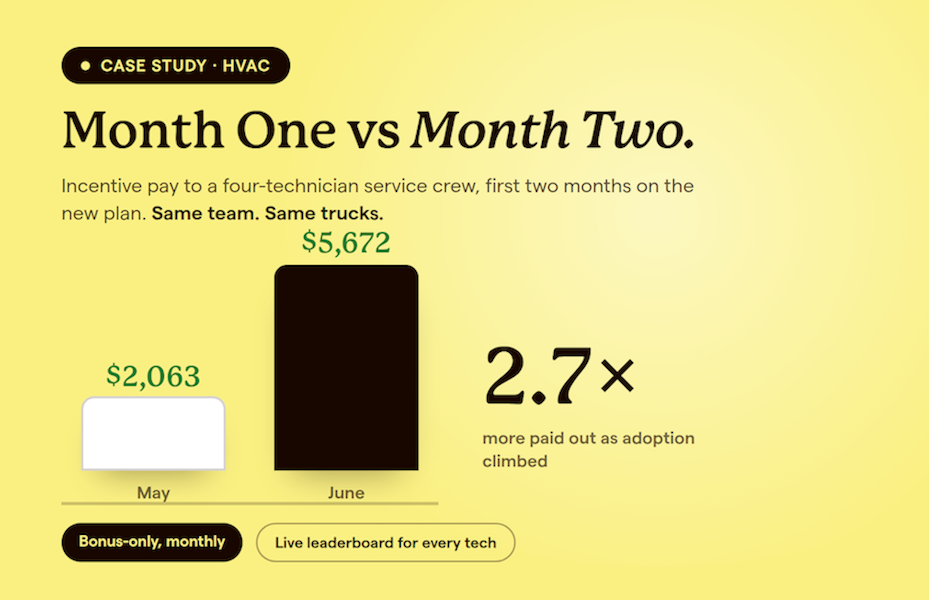
In the first month, the service technician plan paid out about $2,060 in incentive pay across the crew. That is a real, in-hand number, bonus money on top of regular pay, not a projection. In the very next month, that figure climbed to roughly $5,670. Nearly a two-and-a-half to three times jump, month over month, with the same four technicians, the same trucks, and the same underlying metrics. Nothing about the work changed. What changed was that the team could finally see the board, and behavior followed the visibility.
That ramp is the whole story in one number. A plan that pays out flat every month regardless of effort is not really an incentive, it is a stipend with extra steps. A plan where the payout climbs sharply as the team leans into it is a plan that is actually pulling behavior forward. The jump from about $2,000 to nearly $5,700 is what adoption looks like when you can measure it: technicians chasing reviews and memberships they used to let slide, because now they can watch each one move them up the list.
It is worth being honest about where this sits. Two confirmed months is an early, encouraging trend, not a closed-out annual result, and the shop is still tuning the details as more of its plans come fully online. But the direction is unambiguous, and it matches exactly what you would predict: make the incentive visible, and the incentive starts working. The earlier CSR pool the shop ran to completion adds a second, quieter data point, proof that when this team commits to a program, they see it through.
The deeper change is cultural, and it is the one the owners cared about most. Recognition now happens close to the moment it is earned, not weeks later on a pay stub. A technician who does something well gets to see it land. That is precisely the people-first environment the shop was trying to build, and it turned out that the fastest route to it was not a speech or a policy. It was a scoreboard.
There is a compounding effect worth watching for, too, and this shop is starting to see the early edge of it. When technicians can see the board, the competition tends to lift the whole crew rather than just the leader. The technician in second place pushes to catch first. The technician in fourth does not want to be visibly last, so they close the gap. Over a few months, the floor of the whole team rises, not because anyone was scolded into it, but because the standings made everyone a little more aware of the small opportunities they used to let pass. That is the quiet, durable payoff of visibility: it does not just reward your best person, it pulls your middle up. And because the office team is on the same system, the lift is not confined to the trucks. A CSR who can see their booking numbers next to the team's has the same reason to push that a technician does, which means the improvement compounds across the whole customer journey instead of stopping at the field.
What this means for your shop
If you already run spiffs or bonuses but your technicians could not tell you, right now, where they stand this month, you have the same hidden-bonus problem this shop had. A few things from their rollout translate directly.
- Visibility is the feature, not a nice-to-have. A bonus a technician cannot see in real time can only reward them after the fact. Put the numbers on a live board and the same dollars start changing behavior during the month, when it still matters.
- Recognition works best in the moment. A five-star review that registers on a dashboard the day it comes in does more for morale than the same review buried in a payout three weeks later.
- Keep the chased plan simple. A leaderboard only motivates if people can understand what moves them up it. Save the complexity for plans people do not have to watch daily.
- Do not leave the office out. CSRs and dispatchers shape booking and customer experience every day. Putting them on the same visible system as the field turns your whole team into participants instead of spectators.
- Automate the scoreboard. A leaderboard that updates itself gets trusted and checked. One that depends on manual updates goes stale, and a stale board quietly signals that nobody is really watching.
You may already have the right incentives. The question is whether your team can see them. ShareWillow helps HVAC and home service shops turn hidden spiffs into live, visible plans and leaderboards, built on the job data you already collect, drawing on what we have learned from over 200 service businesses.
Related reading
Conclusion
A bonus a technician cannot see is just a surprise; a bonus they can watch climb all week is a goal.
Create incentives
that
drive results
You shouldn't need complex equity plans to align your team. ShareWillow makes it simple to create transparent profit-sharing programs that motivate employees and grow your business.

Incentive plans to help
small businesses thrive.
.png)
"I was able to leverage the knowledge of the ShareWillow team to learn how other companies were designing their bonus plans. The template was extremely helpful."

Brian Tustin
Owner, First Rate Movers
