
A fire protection and life safety contractor had no formal incentive plan at all, and worried that any production-based pay would end up rewarding technicians for parts costs they never controlled. A 'greater of hourly or production' model, with parts stripped out and a clear helper split, gave techs a plan worth trusting.
Starting from zero, and worried about getting it wrong
A small fire protection and life safety systems contractor came to the table with no incentive plan at all. Every technician was paid hourly, full stop, with no mechanism to reward the tech who closed out three strong jobs in a week any differently than the tech who spent the same week on slower, more routine work. That is a common starting point for a lot of specialty trade contractors, and it is not automatically a problem. Plenty of shops run hourly-only and do fine. The owners here wanted more than "fine," but they were also unusually careful about not building a plan that looked fair on paper and fell apart the first time someone actually worked through the math.
It is also worth naming why a shop with no incentive plan at all is not automatically behind. An hourly-only shop that pays reliably and treats technicians well is a perfectly reasonable starting point, and rushing into a poorly designed incentive plan is worse than staying hourly a while longer. The value in waiting, in this case, was that the plan that eventually launched solved real problems instead of just adding a bonus on top of an unexamined structure.
The specific worry that came up early, and kept coming up, was parts. If a technician's incentive pay is based on the production value of the jobs they complete, and a chunk of that production number is really just the cost of the fire suppression parts and materials installed rather than the technician's own labor and skill, then the plan quietly rewards a tech for the job having expensive parts on it, not for the tech doing good work. One of the owners put it plainly: that is not something a technician should get credit for, because installing the parts a job specifies is simply part of doing the job, not a measure of how well they did it.
The second worry was about fairness between technicians on the same job. Fire protection and alarm work is rarely a solo effort. A lead technician and a helper often show up to the same site, and any incentive plan that does not account for that will either overpay the helper for work they did not really drive, or fail to pay the lead technician for carrying the harder half of the job. And the third worry was punctuality. The owners wanted to reward technicians who consistently started their day on time, but they were quick to point out that judging punctuality against scheduled appointment times would not work, since that is simply not how their dispatching operates day to day.
None of these three concerns were reasons to avoid building a plan. They were the exact list of things the plan needed to get right before it could go live, and they are the same three questions worth asking at almost any specialty construction or life safety contractor before rolling out performance pay for the first time.
Whichever pays more: hourly or a clean production number
The plan that came out of those conversations gives each technician the greater of two numbers every pay period: their standard hourly rate with overtime, or 20% of their production for that period, with the cost of parts and materials stripped out of the production number before the percentage is calculated. That single design choice answered the parts concern directly. A tech is never credited for a job simply having expensive materials on it, only for the labor and value they actually contributed, and on a slower week the hourly floor means nobody's pay ever drops below what they would have made anyway.
Run through an example, and the design makes sense immediately. A technician earning $18 an hour who is credited with $11,000 in production over a pay period comes out meaningfully ahead under the 20% production calculation compared to straight hourly pay for the same hours. That gap is exactly the incentive at work: a technician who is genuinely productive sees it reflected in their paycheck without anyone needing to negotiate a raise or argue about it after the fact. A technician having a slower stretch simply falls back to the hourly guarantee, which is the whole point of a "greater of" structure instead of a straight commission plan that could leave someone exposed on a rough week.
For teams that wanted something a little simpler to start with, a second option sits alongside the greater-of model: straight hourly pay with a smaller 1 to 3% incentive layered on top, calculated the same way with parts excluded. It is a gentler introduction to performance pay for a technician or a team that is not ready for a structure where a full percentage of production is on the table, while still keeping the core promise that installing required parts is never treated as a personal achievement.
Building this on top of ServiceTitan data rather than a shared spreadsheet also matters more than it might seem. Production credit, parts costs, and hours worked all live in the field service system already. Pulling the calculation directly from that source means the numbers a technician sees in their paycheck are the same numbers dispatch and the office are looking at, instead of a manually maintained sheet that drifts out of sync the moment someone forgets to update a row.
Profit sharing
made simple.
Give your team a stake in the company’s success. ShareWillow helps you create and manage profit-sharing programs that motivate employees and drive business results.
Splitting credit fairly, and rewarding the mornings that actually matter
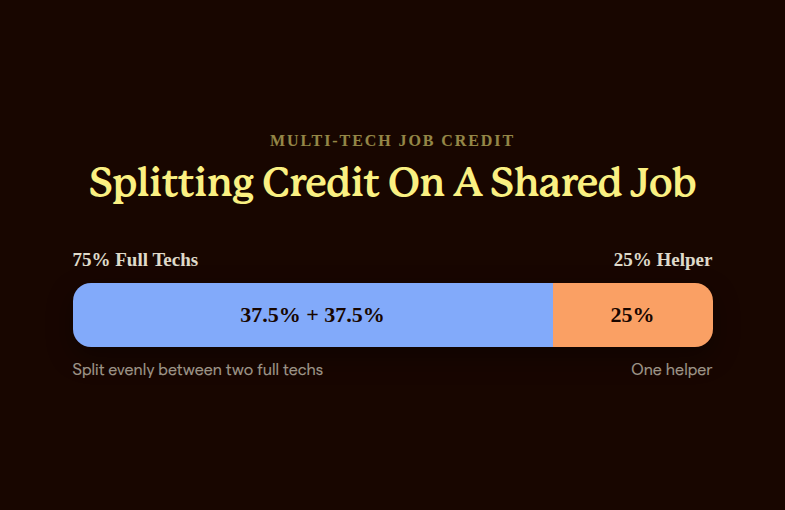
The multi-technician question got its own clean rule. When a job is completed by two full technicians plus a helper, the production credit for that job splits 75% between the two full technicians, evenly at 37.5% each, with the remaining 25% going to the helper. That structure recognizes that a helper is contributing real value to the job without pretending they are carrying the same load as a lead technician, and it removes the ambiguity that shows up on every crew-based job when nobody has agreed in advance how credit gets divided.
It is worth noting how deliberately narrow that split rule is. It does not try to account for every possible crew configuration a fire protection company might run. It solves the specific, common case the company actually sees, two full techs and a helper, cleanly and predictably. A plan that tries to anticipate every hypothetical staffing combination in advance usually ends up more confusing than one that nails the common case and gets refined later if a genuinely new situation comes up.
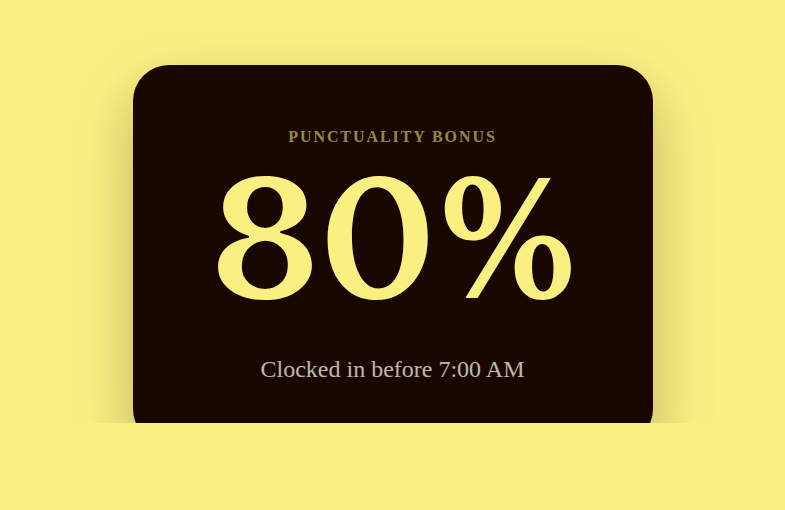
Punctuality worked the same way the owners insisted it had to: instead of comparing arrival time to a scheduled appointment window that does not reflect how the business actually dispatches jobs, the bonus is tied to a technician's real first clock-in of the day. Clock in before 7:00 in the morning on at least 80% of the days in a given week, and the punctuality bonus kicks in. It is a small piece of the overall plan, but it is a good example of matching an incentive to the data a company can actually measure honestly, rather than forcing a metric that sounds good on a slide but does not hold up against how the operation really runs.
What makes this particular buildout worth paying attention to is less any single number and more the sequencing. The owners did not start by picking a percentage and working backward. They started by naming exactly what could go wrong with a naive production-based plan, parts getting miscredited, multi-tech jobs creating disputes, punctuality getting measured against a schedule that does not exist in practice, and then built the plan to specifically close each of those gaps before it ever reached a technician's paycheck. That is the difference between a performance pay plan employees trust from day one and one that generates a string of "wait, that's not fair" conversations in its first month.
If you are building performance pay for a specialty trade for the first time, whether that is fire protection, low-voltage, or another specialty construction trade where jobs involve real material costs and mixed crews, the parts question and the crew-split question are worth resolving before you announce a percentage to anyone. ShareWillow's platform pulls job, labor, and materials data directly from the field service system a company already runs on, so the "greater of hourly or production" math, the multi-tech split, and the clock-in-based punctuality bonus all calculate automatically instead of living in a manager's head or a spreadsheet that only one person understands.
Related reading
Conclusion
A performance pay plan only earns trust if it is built to close the specific ways it could feel unfair before anyone ever sees a paycheck, not after.
Create incentives
that
drive results
You shouldn't need complex equity plans to align your team. ShareWillow makes it simple to create transparent profit-sharing programs that motivate employees and grow your business.

Incentive plans to help
small businesses thrive.
.png)
"I was able to leverage the knowledge of the ShareWillow team to learn how other companies were designing their bonus plans. The template was extremely helpful."

Brian Tustin
Owner, First Rate Movers
