
A multi-trade home services company had HVAC labor cost running at 58.5% of revenue thanks to an uncapped commission plan. Here's how a tiered, hours-linked redesign cut it to 40% while technicians doubled their sold revenue.
Most multi-trade home services companies do not set out to build a broken pay plan. They build one piece at a time, usually under pressure, usually to solve whatever problem is loudest that quarter. A tech leaves, so you sweeten the spiff. A competitor starts poaching, so you add another bonus on top. Nobody sits down and designs the whole thing on purpose. It just accumulates.
That is roughly what happened at a multi-department home services company running HVAC, plumbing, and electrical divisions under one roof, all dispatched and tracked through ServiceTitan. By the time their operations lead sat down with ShareWillow to actually look at the numbers, the HVAC side of the business had a compensation plan that was, in his own words, quietly eating the business alive.
A Spiff Plan With No Ceiling and No Anchor
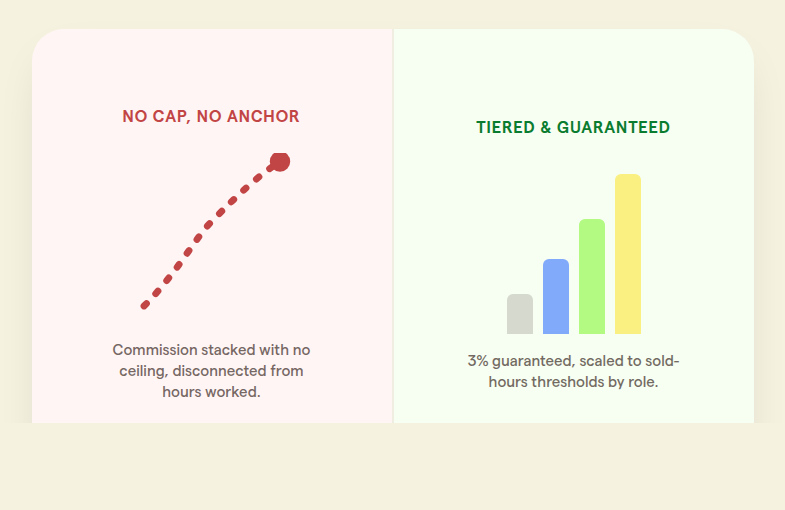
The HVAC comp plan had grown into something nobody had actually designed: technicians earned uncapped commission, sometimes called a spiff, on more or less everything they sold. There was no cap, and more importantly, the payout was not tied to sold hours or any other measure of actual output. A tech could sell aggressively all month and the commission would simply keep stacking, on top of another commission structure layered underneath it.
The result showed up in the one number that matters most to an owner running a service business: labor cost as a percentage of revenue. Industry targets for HVAC labor typically sit somewhere around 35%. This company's HVAC division was running at 58.5% of revenue, nearly double where it needed to be.
Here is the part that made it hard to touch. The techs were not doing anything wrong. They were working the plan exactly as written, and they were making excellent money doing it. That created a real fear on the ownership side: if you fix the math, do you lose your best people?
"It was so high before because they're getting spiffed on everything that they would sell, and it was not tied to any sold hours. They were making so much money, obviously, at 58 and a half percent, that we probably would have lost all of our HVAC technicians."
That is the tension almost every owner in this position has felt at some point. A plan that pays too much is still a plan people have built their household budget around. You cannot just yank it. You have to redesign it so the incentive to sell stays intact while the math underneath it stops bleeding the company dry.
Redesigning the Plan Without Blowing Up Morale
Instead of ripping out the HVAC plan and starting from a blank page, ShareWillow's team rebuilt it to mirror the structure that was already working well on the plumbing and electrical side of the business: a tiered commission plan with a guaranteed minimum incentive, in this case 3% of everything sold, tied to sold-hours thresholds rather than left floating free.
That single change did two things at once. It gave every technician a guaranteed floor they could count on, so nobody felt like the rug had been pulled out. And it linked the payout to a real measure of productive work, sold hours, so the company's labor cost and the technicians' incentive to sell were finally pulling in the same direction instead of fighting each other.
This is the same principle behind ShareWillow's broader approach to incentive plan design: a good plan is not just generous or stingy, it is aligned. The company wants more revenue at a healthy margin. The technician wants a bigger check. A well-built plan makes both of those true from the same number.
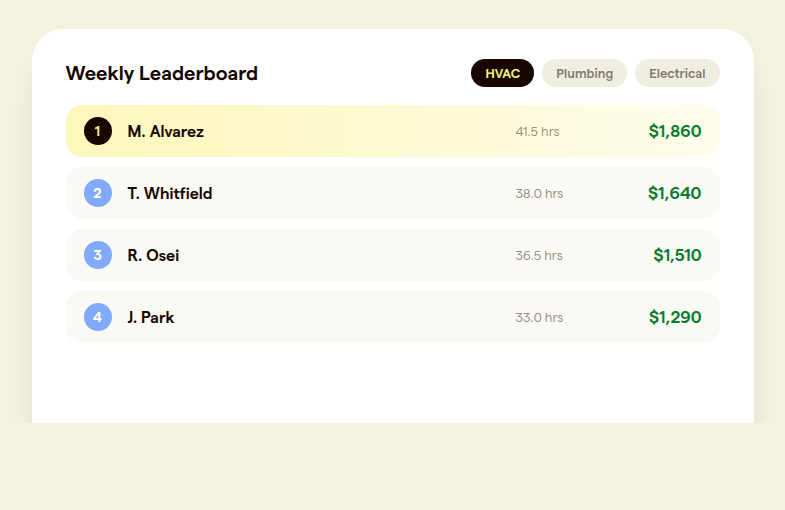
Alongside the redesigned HVAC plan, the team also built a unified, account-level reporting dashboard pulling data automatically from ServiceTitan across all six of the company's active incentive plans, covering memberships sold, five-star reviews, and sold hours in one place instead of six separate spreadsheets. On top of that dashboard sits a customizable leaderboard, refreshed by Thursday night so the team can check their standing heading into the weekend.
The Moment the New Math Almost Felt Too Good
There is a small, honest detail from the rollout that says more about how careful this process has to be than any polished case study language could. Early in testing the new plan, the operations lead ran the payout numbers and got a figure that looked suspiciously low.
"I got really, really excited for a second because it's only paying out like $5,000. I was like, Mike, we did it... He was like, no, that's wrong."
The number was wrong, not because the new plan design was flawed, but because a piece of the calculation had not been wired up correctly yet. It is a small moment, but it is a useful reminder for any owner rebuilding a comp plan: the first number you see after a redesign is rarely the real number. Reconciliation, testing against historical payroll, and a second set of eyes matter just as much as the plan design itself.
What "Tiered and Guaranteed" Actually Means in Practice
It helps to be specific about what changed under the hood, because the phrase "tiered commission plan" gets used loosely and can mean very different things depending on who is building it. In this case, the redesign kept the incentive percentage simple, a guaranteed 3% on everything sold, but made that guarantee conditional on hitting sold-hours thresholds that scaled with the technician's role and tenure.
A tech who is only booking a handful of billable hours in a week is not going to hit the same threshold as a tech running a full schedule, and the plan does not pretend otherwise. That is the piece that had been missing from the old uncapped structure. Selling a lot of add-ons while barely clocking billable hours used to be just as profitable, for the technician, as selling the same amount while working a full week. The new structure closes that gap without punishing anyone for it. It simply rewards the combination the business actually needs: hours worked and dollars sold, together.
The mechanics matter less than the principle behind them. A guaranteed incentive gives technicians certainty. A threshold tied to real output gives the business protection. Put those two pieces together and you get a plan that survives contact with a slow month instead of quietly overpaying or underpaying depending on how the calendar falls.
Why Facility Managers and Multi-Trade Owners Should Care About This Specific Fix
If you run a single-trade shop, it is tempting to read a story like this and file it under "not my problem," since the account here ran HVAC, plumbing, and electrical divisions at once. But the underlying issue, an incentive plan that grew piece by piece instead of being designed on purpose, shows up just as often in single-trade businesses. It just shows up as one uncapped spiff line instead of six overlapping plans.
Facility managers overseeing in-house maintenance teams run into a close cousin of this problem constantly: a bonus program built around whatever seemed fair three years ago, never revisited, quietly drifting out of alignment with what the budget can actually support. The fix is the same regardless of trade or team size. Look at what percentage of revenue (or budget, for an internal team) the incentive plan is actually consuming today, compare it to what a healthy target looks like for your specific type of work, and rebuild the structure around real thresholds instead of a flat, uncapped number.
Profit sharing
made simple.
Give your team a stake in the company’s success. ShareWillow helps you create and manage profit-sharing programs that motivate employees and drive business results.
Where the Numbers Landed
Once the tiered, hours-linked structure was live and the reporting was reconciled properly, the HVAC division's labor cost came down from 58.5% to roughly 40% of revenue, a dramatic correction toward a healthy range without technicians feeling like anything had been taken away from them.
And this is the part that tends to surprise owners who assume tightening a comp plan means techs will sell less: technicians did not pull back. They doubled their budgeted revenue, because the guaranteed 3% incentive gave them a direct, reliable reason to keep pushing, instead of chasing an uncapped number that was disconnected from any specific target.
"They doubled their budgeted revenue because they're getting at least 3% of everything. So it incentivizes them to do their job."
That is the outcome a well-designed incentive plan is supposed to produce. Not less selling in exchange for lower cost, but more selling that happens to cost the business less per dollar earned, because the plan finally rewards the behavior the company actually needs.
Office Staff Were Not Forgotten Either
One easy mistake with incentive plans is designing them entirely around field technicians and forgetting the people who support them. This company's rebuild included a points-based incentive for office staff covering memberships booked and five-star reviews generated, metrics that live outside ServiceTitan's default field-technician reporting but matter just as much to the business's health.
If your team runs more than one trade under a single roof, this is worth sitting with. A plan that only rewards the people turning wrenches will always leave a gap somewhere else in the org chart, and that gap tends to show up later as turnover or quiet resentment. Building comp plans for HVAC teams, plumbing crews, and electricians alongside the office staff who support them, on the same platform, keeps everyone pulling the same direction, no matter which trade badge is on the truck.
It also means the six separate plans this company runs, one per trade for field technicians plus the office incentive layered on top, all pull from the same reconciled data instead of six disconnected spreadsheets living in six different inboxes. That single source of truth is part of what made it possible to catch small errors in the payout math quickly, before they turned into a bigger mess at payroll time. It is the same idea behind ShareWillow's approach to plan reporting and automation more broadly: the plan design matters, but so does trusting the numbers it produces every single pay period.
What Other Multi-Trade Owners Can Take From This
This story is not really about HVAC specifically. It is about what happens when a comp plan grows organically instead of by design, and what it takes to fix it without losing your best people in the process.
- An uncapped incentive disconnected from output is a labor cost problem waiting to surface. If commission is not tied to hours, sold volume, or margin, it will drift upward until someone finally runs the percentage and gets a shock.
- You do not have to choose between fair pay and healthy margins. Tying a guaranteed incentive to sold hours let this company cut labor cost by roughly 18.5 percentage points while technicians doubled their sales.
- Reconcile against historical payroll before you trust the new numbers. The "too good to be true" result usually is, at least until it has been checked.
- Do not build the plan around one trade in isolation. If your company runs multiple divisions or has office staff supporting the field, the incentive structure should reach everyone whose work moves the business forward.
If your own comp plan grew the same way, one urgent fix layered on another, it is worth an honest look at what percentage of revenue it is actually costing you today. Sometimes the fix is not less generosity. It is better aim.
Related reading
Conclusion
One uncapped commission line was quietly costing 18 points of margin. A tiered, hours-linked redesign got it back, and technicians sold more, not less.
Create incentives
that
drive results
You shouldn't need complex equity plans to align your team. ShareWillow makes it simple to create transparent profit-sharing programs that motivate employees and grow your business.

Incentive plans to help
small businesses thrive.
.png)
"I was able to leverage the knowledge of the ShareWillow team to learn how other companies were designing their bonus plans. The template was extremely helpful."

Brian Tustin
Owner, First Rate Movers
