A small home services company built a fair-looking tiered commission plan, then found almost nobody on the crew could clear the first threshold. A two-number fix turned one technician's month into a $3,000 bonus.
Zero dollars. That was the bonus most of the technicians at a small home services company were taking home most months, even though the plan sitting underneath their pay looked reasonable on paper. The company runs plumbing and HVAC service calls out of one location, with about half a dozen field technicians and a tiered commission structure built on top of ServiceTitan data: a revenue tier, a sold hours performance modifier, and an attendance-based deduction layered on top. Nothing about the design was careless. It just turned out that the thresholds separating a real bonus from nothing at all were set high enough that almost nobody could clear them.
That is a specific kind of failure, and it is an easy one to miss from the outside. A plan that never pays anyone looks broken immediately. A plan that pays a small handful of top performers while quietly shutting out everyone else can run for months looking functional, because the top performers keep earning and nobody in the office is checking whether the middle of the roster is clearing the bar. The owner here was checking, and did not like what he saw. Most months, most of the crew was landing under the line, not because they were underperforming, but because the line itself was drawn too high.
Lowering The Bar Without Lowering The Bar
The instinct in a situation like this is to loosen the plan across the board, which usually means giving up real money for work that was never actually reaching the standard the plan was supposed to reward. That is not what happened here. Working with ShareWillow, the owner and the team recalibrated two specific thresholds inside the existing tiered structure, rather than rebuilding the plan from scratch.
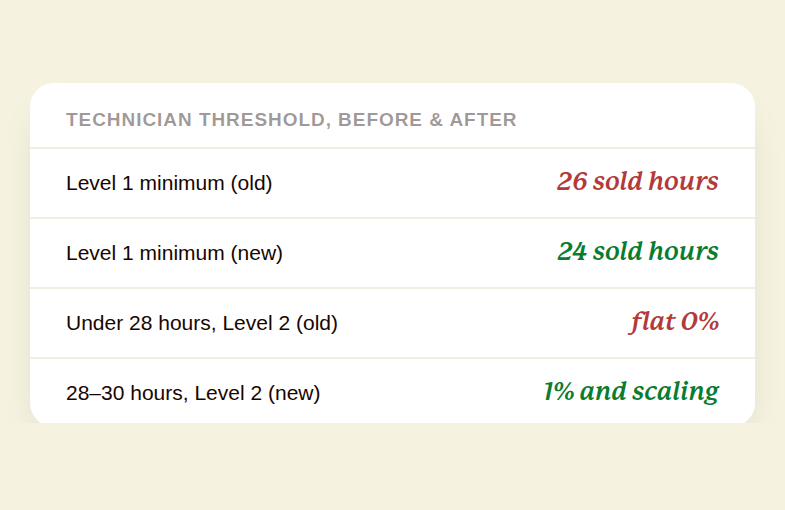
The Level 1 minimum, the sold hours a technician needed to clear before any bonus math applied at all, came down from 26 sold hours to 24. The Level 2 tier saw a sharper fix: technicians under 28 sold hours had been earning a flat 0 percent, a real cliff edge in the plan rather than a gradual ramp. That band was rebuilt so that 28 to 30 sold hours now earns 1 percent, scaling up from there toward the plan's higher commission tiers. An attendance-based deduction stayed in place on top of all of it, structured so the first missed session in a period is free and each one after that trims 25 percent off the earned bonus, keeping the incentive tied to actually showing up for the work.
None of this loosened what counted as strong performance. A technician still had to sell real, billable hours to see real money. What changed was where the plan stopped counting a technician's work as invisible. As the owner put it while walking through the new numbers, the goal was simple: give the crew a nugget where they could hit something for once, instead of watching the bar sit just out of reach every single month.
There is a reason thresholds like these tend to drift too high in the first place. Most owners build a commission plan around what a strong month looks like for their best technician, then apply that same bar to everyone. It feels fair on a spreadsheet. In practice, a threshold calibrated to a top performer's typical output is, almost by definition, a threshold most of the roster will not clear in a normal month. That is not a flaw unique to this company. It is a natural side effect of designing a plan around the number an owner is proudest of, rather than the distribution of numbers the whole crew actually produces.
Getting the ServiceTitan side of this right also mattered more than it might sound. Sold hours, revenue tiers, and attendance all have to be pulled consistently from the same underlying job and timecard data for a threshold change like this to mean anything. Move a threshold by two hours without first confirming the hours themselves are being counted correctly, and an owner can just as easily talk himself into a change that looks generous on paper but still excludes the same technicians it did before. Here, the recalibration only happened after the underlying sold-hours and attendance figures had already been validated against the company's own ServiceTitan account, so the two-hour and one-percent adjustments were changes to the actual plan, not just changes to a number nobody had checked.
One Month, One Technician, Three Thousand Dollars
The clearest proof the recalibration worked showed up almost immediately in one technician's numbers. This particular tech does not run installs. He sells, full stop, moving from call to call and closing work for other people to complete. Under the old thresholds, that kind of pure-selling role was exactly the profile most likely to get squeezed by a bar set too high, since his bonus depended entirely on clearing sold hours and revenue tiers with no install commission to fall back on. Under the recalibrated plan, he closed roughly $100,000 in sold revenue in a single month and earned a $3,000 bonus on top of his base pay.
The owner's own reaction is worth repeating, because it captures something plans like this are supposed to do and often do not: he still makes a pretty good bonus for not touching a wrench, and that is a great bonus. Handing a technician a check that size for one month of selling is not a small event for a company this size. It is the kind of number that gets talked about on the shop floor, and talked about accurately, because it reflects real, verifiable revenue rather than a subjective call from the office.
That $3,000 did not stand alone. Across the full team for that pay period, the plan paid out roughly $4,000 combined: the top seller's $3,000, a second technician earning around $500, and a smaller shared pool of about $65 tied to membership sales and customer reviews. None of those numbers are enormous on their own, but together they describe a plan that is finally reaching past its single best performer and into the rest of the crew, which is exactly the gap the recalibration was built to close.
Checking The Math Against A Competitor
What makes this story more convincing than a single good month is that the owner did not just accept the new numbers. He checked them. Mid-conversation, he pulled up figures from a competing commission platform his shop had used before, a tool called Streamline, and compared what similar technicians earned there against what ShareWillow was now producing.
The comparison held up. On that other platform, technicians with a similar sold-hours profile typically earned in the range of $2,000 to $3,000 on $50,000 to $70,000 of revenue. The technician in this story earned $3,000 on roughly $100,000, a comparable or even slightly more conservative payout relative to revenue than the benchmark he was checking against, despite the higher volume. For an owner deciding whether to trust a newly recalibrated plan with real payroll dollars, that kind of independent cross-check matters more than any internal report could. The math was not just internally consistent. It held up next to a tool built by someone else entirely.
That comparison also answered a quieter worry that sits underneath most threshold changes: the fear of overcorrecting. Lowering a bar that was clearly set too high can feel risky in the moment, since nobody wants to swing from a plan that pays too little straight into one that pays out more than the business can support. Checking the new numbers against an outside benchmark, on a platform with no stake in making ShareWillow look good, gave the owner a way to confirm the fix solved the real problem, techs earning nothing, without creating a new one, the plan paying more than the work actually justified.
The attendance rule stayed untouched through all of this, and that matters. It would have been easy to soften the attendance deduction at the same time as the sold-hours thresholds, bundling every generous change into one announcement. The team left it alone on purpose. The thresholds were a design problem, calibrated against the wrong benchmark. Attendance was working as intended. Fixing the first without touching the second kept the message to the crew narrow and honest: the plan was recalibrated because the bar was wrong, not because the whole system needed to get easier.
Profit sharing
made simple.
Give your team a stake in the company’s success. ShareWillow helps you create and manage profit-sharing programs that motivate employees and drive business results.
Why A Threshold Problem Is So Easy To Miss
It is worth naming why this kind of issue survives so long inside otherwise well-run companies. A commission plan with a threshold problem does not throw an error. Payroll still runs. The top performer still gets paid, often generously, and that success is visible enough to mask what is happening to everyone below them. Nobody sees a rejected bonus the way they see a broken invoice or a missed appointment. It just quietly does not happen, month after month, until an owner sits down and actually counts how many people cleared the bar versus how many did not.
That is also why the fix here did not require a new plan, new metrics, or a bigger commission percentage. It required someone to look at the distribution of outcomes, not just the headline number, and ask whether a threshold built to reward strong performance had drifted into a threshold that mostly rewarded one or two people. Small companies are especially exposed to this. With only half a dozen technicians, a single threshold set two hours too high can functionally exclude a third of the roster, and there is no large team size to average the problem away.
It is worth being honest about what one strong pay period does and does not prove. A $3,000 bonus on $100,000 in sold work is a real number from a real month, not a projection, but a single month is still a single month. Sales volume moves with the seasons, the size of the job mix, and plain luck in what comes through the phone lines. The point of this story is not that every technician at every shop should expect a $3,000 check. It is that a plan built around thresholds nobody is clearing is not a compensation problem so much as a measurement problem, and measurement problems are fixable once someone actually goes looking for them.
Where This Goes From Here
The company is now watching whether the $4,000 pay period holds as a floor or turns out to be a strong month inside a wider range, the same honest question worth asking of any single data point. What is already clear is that the fix did not require inventing new incentives. It required checking two numbers, 26 and 28, and admitting they were set wrong. For an owner running a similar HVAC or plumbing incentive plan and wondering why payouts feel concentrated in one or two names every month, the fastest way to find out is to look at how many people on the roster actually clear the current thresholds, not just how much the top earner is making. Shops that want that answered for them can start with a free incentive plan audit, and companies curious about how threshold-based commission tiers are actually configured and tracked can look at ShareWillow's product features directly.
Related reading
Conclusion
After lowering two commission thresholds that were quietly locking out most of the crew, this home services company posted a $3,000 individual bonus and a $4,000 team payout in a single pay period.
Create incentives
that
drive results
You shouldn't need complex equity plans to align your team. ShareWillow makes it simple to create transparent profit-sharing programs that motivate employees and grow your business.

Incentive plans to help
small businesses thrive.
.png)
"I was able to leverage the knowledge of the ShareWillow team to learn how other companies were designing their bonus plans. The template was extremely helpful."

Brian Tustin
Owner, First Rate Movers