
A family-owned HVAC company with a dozen field techs had commission math nobody could trace, callback jobs with no clear owner, and a review count quietly inflated by 20%. The fix was a ServiceTitan-integrated commission plan built to hand top installers up to $10,000 a year in extra pay.
Ask most HVAC owners why a good technician left, and the honest ones will tell you it was rarely just about the base wage. It was about whether the pay felt fair, whether it felt earned, and whether the technician could actually see the connection between the work they did and the number that showed up on their check. A family-owned HVAC company running a dozen field technicians and a small customer service team ran into all three of those problems at once, and none of them were obvious until someone went looking.
The company was not struggling. Jobs were getting booked, installs were getting done, and reviews were coming in. But underneath a functioning business were three quiet leaks that, left alone, would have made it harder and harder to keep the technicians and CSRs who mattered most.
The Callback Problem Nobody Could Trace
The first leak was structural. When an installation needed a callback, a return trip to fix or finish something after the original job, there was no reliable way to trace that callback back to the technician who did the original work. On the surface that might sound like a minor bookkeeping gap. In practice, it meant the company had no clean way to hold installation quality accountable through pay. A technician who consistently needed callbacks looked, on paper, identical to one who didn't. Commission structures built to reward clean, high-quality installs cannot do their job if the data feeding them cannot answer a basic question: whose job was this, really?
That gap matters more in HVAC installation work than almost anywhere else in a field service business. Installs are big-ticket, high-consequence jobs. A callback is not just an inconvenience, it is a signal, and a business that cannot connect that signal back to an individual technician is flying blind on exactly the kind of quality issue that incentive pay is supposed to help solve.
The Review Count That Was Quietly Wrong by 20%
The second leak was more subtle, and arguably more corrosive, because it touched money directly. Part of the company's incentive structure rewarded technicians and the business as a whole for five-star reviews, a common and reasonable way to tie pay to customer satisfaction. The trouble was in how those reviews were being counted. The metric feeding the incentive program was including internal reviews, feedback collected through the company's own channels, alongside genuine public reviews from platforms like Google and Facebook.
That inflated the review count by roughly 20%, which sounds almost innocuous until you consider what it actually means: a meaningful chunk of the number driving real payouts was not reflecting real, public-facing customer sentiment. It was reflecting an internal process that had nothing to do with what a prospective customer would actually see when they searched the company's name. An incentive plan is only as trustworthy as the data behind it, and a 20% inflation on a customer satisfaction metric is not a rounding error. It is a plan quietly rewarding the wrong thing.
Technicians eventually feel this kind of gap even when they cannot name it precisely. If the review number driving part of their pay does not match what they intuitively know about their own customer interactions, trust erodes. And once trust in the metric erodes, the metric stops motivating the behavior it was designed to encourage.
A CSR Team With No Real Incentive Structure of Its Own
The third gap sat outside the technician pay structure entirely. The company's customer service representatives, the people answering calls, booking jobs, and often making the first impression a prospective customer ever had of the business, had no incentive plan built around their specific role. Field technicians had commission. CSRs largely did not, despite being just as central to whether a call turned into a booked, revenue-generating job.
That is a common blind spot in field service businesses. Owners intuitively understand that the person swinging the wrench needs a performance incentive. It is easy to overlook that the person on the phone, deciding in real time how to handle an inbound call or whether to push for an outbound booking, is making decisions with just as much revenue impact, often with less recognition and less pay tied to how well they do it.
Building a Commission Plan the Data Could Actually Support
Fixing all three problems started with the same underlying move: connecting the incentive structure directly to the company's field service data instead of leaving it to run on assumptions or manual tracking. Once installation jobs, callbacks, review sources, and CSR call activity were all flowing from the same system, each problem had a clean, specific fix.
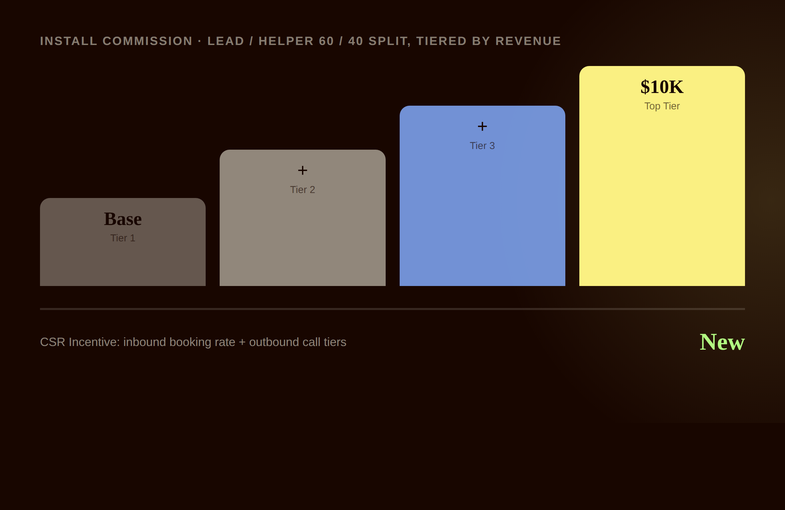
For installation commission, the company moved to a structure built around a 60/40 split between the lead technician and the helper on a job, with tiered rates that scale up as a technician clears defined revenue thresholds. That structure does two things well. It reflects the real division of labor and responsibility on an install, where the lead technician typically carries more of the technical decision-making and accountability, and it gives every technician a visible path to a higher commission rate as they generate more revenue, rather than a flat percentage that never moves regardless of performance.
Because callback jobs are now traceable to the original installing technician, quality has a real mechanism to connect to pay, rather than sitting as a separate, disconnected conversation that only comes up when a customer complains loudly enough to escalate.
Fixing the Review Metric at the Source
The review-count problem got a more surgical fix: filtering the metric feeding incentive pay down to genuine public review sources, Google and Facebook specifically, and excluding internal feedback collection from the number that drives payouts. That sounds like a small technical change, and mechanically it is. But the effect is significant. The number technicians see, and the number their pay is calculated against, now actually represents what a prospective customer encounters when they search for the business online. Internal feedback still has value as a coaching and quality tool. It simply no longer masquerades as a public review inside a pay calculation, which means the incentive is finally rewarding the thing it claims to reward.
This is a pattern worth any HVAC owner paying attention to: any time a metric feeding incentive pay is compiled from more than one data source, it is worth asking exactly what is in that number and whether every input actually belongs there. A 20% inflation is not always going to be obvious from the outside. It surfaces when someone actually goes looking at the sources feeding the calculation, not just the final number.
Giving the CSR Team Its Own Reason to Perform
The third fix built out an incentive structure specifically for the customer service team, tied to two things CSRs directly control: inbound booking rate, how often an inbound call actually converts into a booked job, and tiered outbound call volume, rewarding CSRs for proactively generating opportunities rather than only reacting to calls that come in. That gave the CSR role its own visible, structured connection between performance and pay, closing a gap that had quietly existed the entire time technicians had commission and CSRs did not.
It is a small thing to say out loud and a meaningful thing to actually build: the person answering the phone is running a business decision every single call. Giving that decision an incentive structure treats it with the seriousness it deserves.
Profit sharing
made simple.
Give your team a stake in the company’s success. ShareWillow helps you create and manage profit-sharing programs that motivate employees and drive business results.
What the New Plan Is Built to Put in Front of Top Performers
Once the commission structure, the review metric, and the CSR incentive were all rebuilt on accurate, traceable data, the company modeled what the new plan means for its best people. For a top installer, the tiered 60/40 structure is built to deliver up to $10,000 a year in additional bonus pay, roughly the equivalent of a $5-an-hour effective raise for a technician performing at that level. That is not a rounding-error incentive. It is real money, clearly tied to real performance, calculated automatically from the same job data the company already tracks.
Why This Is a Retention Story as Much as a Pay Story
It would be easy to read this as a story about commission percentages and leave it there. The more important story is what a plan like this does in a labor market where good HVAC technicians have options. Leadership at this company was explicit about the framing: this was not just a compensation adjustment, it was a retention tool, built specifically to give top performers a compelling, visible reason to stay rather than take a call from a competitor.
That framing matters because it changes what the plan is actually for. A commission structure designed only to control payroll costs and a commission structure designed to make your best people feel like leaving would be a mistake are not the same document, even if the percentages look similar on paper. This company built the second kind. The tiered structure specifically rewards the technicians already performing at the top of the business, giving them a widening gap between "good" and "great" pay as they hit higher revenue thresholds, precisely the group most likely to have other options and most expensive to lose.
The CSR incentive plan does similar work on the office side, in a role that is often treated as a fixed cost rather than a lever tied to performance-based pay. Giving the team answering the phones its own structured incentive is both a fairness correction and a retention move for a role that turns over quietly and often, usually without leadership fully connecting the dots between an unincentivized position and the churn on that team.
The Broader Lesson: Incentive Pay Only Works If the Data Underneath It Is Right
None of the three fixes here required the company to rethink whether incentive pay was the right approach. It already believed in performance-based pay. What it needed was for the systems calculating that pay to actually reflect reality: callbacks traced to the right technician, reviews counted from the sources that actually matter, and a CSR team measured on the specific behaviors that drive revenue.
That is the pattern worth taking away for any HVAC business running an incentive plan today. A commission structure can be well designed on paper and still fail to do its job if the data feeding it is incomplete, miscounted, or missing entire roles that deserve their own structure. Before assuming a pay plan needs a redesign, it is worth asking whether the plan is actually broken, or whether the numbers underneath it just are not telling the truth yet. For this HVAC company, fixing the truth of the numbers is what turned a standard commission plan into a real retention tool, one built to put up to $10,000 a year in front of the technicians the business can least afford to lose.
Related reading
- The Pay Plan Redesign That Dropped an HVAC Team's Labor Cost From 58.5% to 40%
- From Days to Minutes: How a California HVAC and Plumbing Company Automated Technician Bonus Payroll
- HVAC Commission Pay: How to Design a Plan That Drives Profit (Not Problems)
- Companies with Profit Sharing: Who They Are & What They Offer
- How to Pay HVAC Technicians: The Install Split That Ended Pay Disputes
Conclusion
A ServiceTitan-integrated install commission and CSR incentive plan gives this HVAC company's top performers a path to $10,000 a year in extra pay, and a real reason to stay.
Create incentives
that
drive results
You shouldn't need complex equity plans to align your team. ShareWillow makes it simple to create transparent profit-sharing programs that motivate employees and grow your business.

Incentive plans to help
small businesses thrive.
.png)
"I was able to leverage the knowledge of the ShareWillow team to learn how other companies were designing their bonus plans. The template was extremely helpful."

Brian Tustin
Owner, First Rate Movers
