
A two-location HVAC and plumbing company built its install-crew bonus pool around ServiceTitan job data, until a routine check showed one of its busiest pools calculating out to a flat zero. The technicians hadn't stopped earning it. The software just had no idea how to split a job between two installers.
A pool worth watching closely
A two-location HVAC and plumbing company had spent years building one of its install teams into a genuine profit center. Rather than pay a flat commission per job, the owner set up an incentive pool tied to install revenue, one that historically ran somewhere around $28,000 a quarter once the pool cleared a minimum revenue threshold of roughly $21,000. In an average month, that pool works out to something like $8,000 to $9,000 in incentive pay for the installers who earned it. That is not pocket-change money. It is a meaningful piece of how the company retains skilled install technicians in a trade where they can, and do, get poached by a competitor down the street.
Install work is also where crew-based pay gets genuinely hard to automate. A service call is almost always one technician, one job, one clean line from work performed to money earned. An install is frequently two people, sometimes more, working the same ticket together: one running the mechanical side, another handling ductwork or electrical tie-ins, both fully responsible for the job closing out correctly. Most field service software, ServiceTitan included, is built around tracking a job and its revenue. It is not built, out of the box, to answer the much harder question of how that revenue should split between two or three people who worked it as a team.
For a while, the owner handled that gap the way most owners do: by hand. He knew his crews, knew roughly how a given job typically got divided between his lead installer and a helper, and he reconciled the automated numbers against his own mental math before anything went out the door. That worked, in the sense that nobody got shorted, but it also meant the incentive system was never fully trusted to run on its own. Every pay period still needed a human gut-check before anyone believed the number.
That gut-check is exactly what caught the problem. During a routine operations review, the owner pulled up the calculated incentive for the install pool and the number came back at zero. Not low. Not off by a little. Zero, on a pool that in a normal month puts somewhere between $8,000 and $9,000 into installers' pockets. He knew immediately something was wrong, because he knew what that crew had been selling that period, and it was nowhere close to a quiet month.
Owners in growing HVAC and plumbing businesses tend to hit this exact wall at a predictable point: right around when a single installer becomes an install team. A one-person install crew can run on instinct and a simple commission percentage for years without any real problem, because there is never a question of who did the work. The moment a second body gets added to a ticket, whether that is a helper, an apprentice, or a second full installer, every incentive plan built for the solo era needs an explicit answer to a question it never had to ask before: how does credit get divided when a job took a team, not an individual.
Facility managers evaluating a mechanical contractor's crew, and business owners scaling up their own install division, run into the same fork in the road. It is easy to assume that whatever system tracked commissions cleanly for years of solo work will keep tracking them cleanly once the work becomes collaborative. That assumption is exactly what quietly produced a $0 payout here, on a pool that in a normal month moves $8,000 to $9,000 into technicians' pockets.
Why the number came back at zero
The root cause was almost boring, which is usually how these things go. ServiceTitan tracks the job and the revenue attached to it, but when more than one installer is assigned to that job, the system has no built-in source of truth for how to divide the credit between them. There is no default field that says "installer A gets 60%, installer B gets 40%" or any other split. Without that split defined somewhere, an automated calculation built to attribute revenue to individual technicians has nothing solid to divide, and rather than guess, it produced nothing at all for that pool during that period.
This is a specific and easy-to-miss failure mode for any HVAC or plumbing company running dedicated install crews rather than solo-technician visits. A single-tech service call is the easy case. The revenue belongs to one person, and almost any system gets that right without configuration. Multi-person install work is the hard case, and it is exactly the kind of work most incentive plans exist to protect, because installs are usually the highest-ticket, highest-margin jobs a company sells, and the installers doing that work are usually the hardest to replace.
It is also a failure mode that tends to hide rather than announce itself, because the two most common ways of guessing a split are both individually plausible and both wrong for different jobs. A system that defaults to crediting the technician who is listed first, or the one who happens to be marked as the primary tech on the ticket, will look correct on plenty of jobs where that assumption happens to match reality. It only breaks visibly on the jobs where the actual work was split more evenly, or where the helper did the harder half, and by then it has usually been quietly wrong for months without anyone noticing, because the total revenue attributed to the pool still looked roughly right even while the split inside it was off.
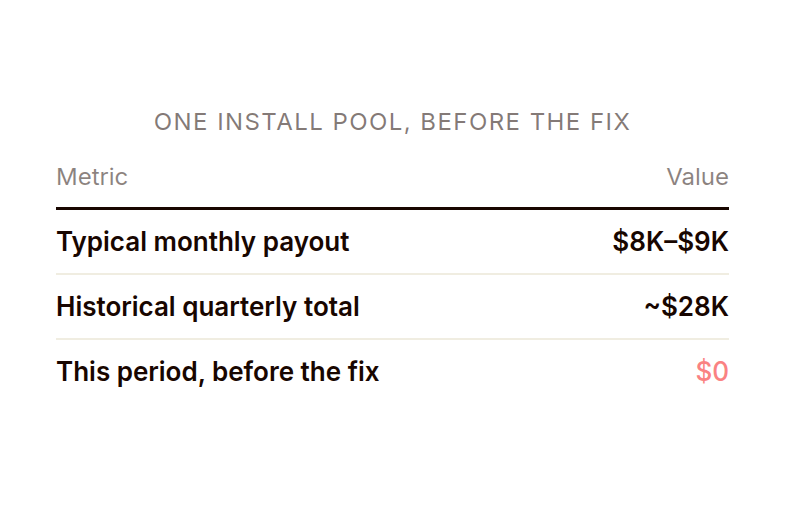
Put the pool's real numbers side by side and the size of the miss is obvious. A pool that clears roughly $21,000 in revenue before any payout kicks in, that has historically paid out close to $28,000 across a quarter, does not go to zero because business slowed down. It goes to zero because the calculation had no split rule to apply to a job two people worked together, and defaulted to nothing rather than guessing wrong in either technician's favor.
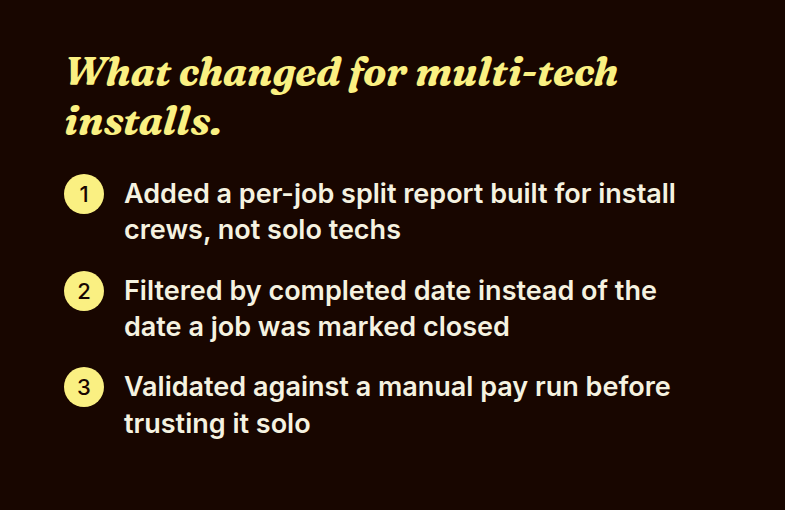
The fix was a custom backend report built specifically to calculate a per-job technician split for install crews, rather than leaning on a generic single-technician assumption. It also added completed-date filtering to the calculation, so a job's earnings landed in the correct pay period based on when the work was actually finished, rather than whatever date the job happened to be marked closed in the system, which can lag the real completion date by days or longer depending on how busy the office is that week.
The completed-date piece is easy to underestimate but matters just as much as the split itself. An install that wraps up on the last day of a pay period but does not get formally marked closed in the system until the following week can fall on the wrong side of a period boundary entirely, showing up in the next month's numbers instead of the one it was actually earned in. For a single technician, that is a minor timing annoyance that usually evens out. For a shared install pool with a hard minimum revenue threshold before any payout triggers, a handful of large jobs landing in the wrong period can be the difference between clearing that $21,000 floor and missing it, which turns a timing quirk into a real dollar difference for everyone counting on that pool.
Profit sharing
made simple.
Give your team a stake in the company’s success. ShareWillow helps you create and manage profit-sharing programs that motivate employees and drive business results.
Catching it before it reached a paycheck
The version of this story that matters is the one where nobody's paycheck is actually wrong, because the mistake got caught during a review instead of after a payroll run had already gone out. That is a lower-drama outcome than a technician calling the office asking why their bonus vanished, but it is the outcome every owner running an incentive plan should be aiming for. The whole point of building trust in an automated system is catching the zero before the crew ever sees it, not explaining it away afterward.
It is worth being honest about what did and did not happen here. This is not a story about a company discovering a hidden pot of extra profit. The $8,000 to $9,000 a month this pool typically pays out was always the company's money to pay, earned by installers doing real work. What was at risk was whether that money reached the people who earned it, on time, without a manual rescue every single period. Fixing the split logic did not create value out of nothing. It protected value that was already there from quietly leaking out through a gap in the software.
That distinction matters for any owner evaluating whether an automated incentive system is worth the setup effort. The value is not always a bigger number. Sometimes it is the same number, delivered reliably, without an owner having to personally audit every pay period forever because he is the only person who actually knows how the crews split their work. A system that requires the owner's memory as a permanent backstop has not really automated anything. It has just moved the manual step earlier in the process.
There is also a retention angle here that is easy to miss in the moment but shows up over a longer stretch of time. Skilled install technicians talk to each other, inside a shop and across the trade. A technician who gets shorted or delayed on a bonus once may let it go as a one-time glitch. A technician who watches it happen twice starts to wonder whether the incentive plan is something the company can actually be trusted to run correctly, which is a much harder problem to fix than any single payroll error, because it is a problem of confidence rather than arithmetic. Catching this before it ever touched a paycheck protected more than one pay period's worth of money. It protected the crew's baseline trust that the plan works the way it was described to them on day one.
Any HVAC or plumbing company running crew-based install work is worth auditing the same way this one got audited, ideally before real money is on the line rather than during a live pay period. Ask directly: when two technicians work the same install, does the incentive math know how to split it, or does it assume one person did all the work? If nobody can answer that question with confidence, it is worth finding out before the pool comes back at zero on a month it should not have. A platform built to calculate incentive pay directly from real job data can be configured to handle multi-technician splits explicitly, which is exactly the gap that would have otherwise kept shorting this HVAC install team every time more than one person's name was on a ticket.
Related reading
- How to Pay a Technician Who Works Both Install and Service
- The Pay Metric No One Could Actually Check
- HVAC Commission Pay: How to Design a Plan That Drives Profit (Not Problems)
- 7 Profit Sharing Plan Examples for Your Small Business
- HVAC Installer Bonus: How One Company Set $300 to $1,000 Awards by Job Type Before Its First Payout
Conclusion
An incentive plan for crew-based install work needs an explicit rule for splitting credit, or the software will invent one on its own, and it usually invents zero.
Create incentives
that
drive results
You shouldn't need complex equity plans to align your team. ShareWillow makes it simple to create transparent profit-sharing programs that motivate employees and grow your business.

Incentive plans to help
small businesses thrive.
.png)
"I was able to leverage the knowledge of the ShareWillow team to learn how other companies were designing their bonus plans. The template was extremely helpful."

Brian Tustin
Owner, First Rate Movers
