
HVAC technicians were pocketing flat spiffs on every unit sold, pushing labor cost to 58.5% of revenue. Here's how tying pay to sold work instead cut that to 40% and doubled technician revenue at the same time.
Ask any HVAC business owner what their labor cost should look like as a percentage of revenue, and most will land somewhere around 35%. Ask them what it actually is, and you often get a long pause. Flat bonuses, spiffs on equipment, overtime creep: these things pile up quietly, and by the time an owner pulls the real number, it can be ugly. The scary part isn't the number itself. It's that technicians are usually thrilled with the plan that's causing it, which makes fixing it feel like defusing a bomb.
That's exactly where a multi-trade home services company found itself. The business runs HVAC, plumbing, and other service lines, along with a membership and loyalty program built to keep customers coming back and a technician incentive program meant to reward good work. For years, HVAC technicians were paid a flat spiff, a fixed dollar amount, on every piece of equipment they sold. Sell a furnace, get a bonus. Sell an AC unit, get another bonus. It didn't matter whether that sale represented two hours of labor or eight, whether it matched budgeted hours, or whether the crew was overstaffed on the job. The bonus paid the same either way.
When "good pay" and "healthy business" stop lining up
Over time, that disconnect showed up exactly where you'd expect: in labor cost. HVAC labor cost crept up to 58.5% of revenue, nearly double the roughly 35% target considered healthy in the trade. As the owner put it, "It was so high before because they're getting spiffed on everything that they would sell, and it was not tied to any sold hours." The technicians weren't doing anything wrong. They were doing exactly what the pay plan rewarded: selling equipment, collecting the spiff, and moving on to the next job. The plan just wasn't rewarding the right thing.
Here's the part that makes this kind of fix genuinely hard: the technicians were making a lot of money. A flat spiff on every unit sold, with no ceiling and no tie to actual performance, is a great deal if you're the one collecting it. So the ownership team wasn't just staring down a bad number on a spreadsheet, they were staring down a real risk that touching the plan at all could tank morale and send their best HVAC techs out the door. "Ideally, we wanna be at 35%," the owner said, "but they were making so much money at 58 and a half percent that we probably would have lost all of our HVAC technicians."
That's the tension a lot of trades businesses run into with incentive pay. A plan can be generous to the team and still be quietly bad for the business, and the longer it runs, the more entrenched it gets. Technicians build their household budgets around what they're used to earning. Owners get nervous about touching something that, on the surface, looks like it's working, since nobody's complaining. But a labor cost of 58.5% isn't sustainable at any size, and pretending otherwise just delays a harder conversation later, usually after margins have already taken the hit.
What the company needed wasn't a pay cut dressed up as a restructure. It needed a plan that still let technicians earn well, but tied that pay to something the business could actually afford: real sold work, measured against real budgeted hours, not a flat kickback for every unit that left the truck. That meant rethinking the mechanics of the plan from the ground up, which is where incentive plan design that can calculate variable, rules-based bonuses automatically stops being a nice-to-have and becomes a requirement. Doing this kind of math by hand, unit by unit, tech by tech, every pay period, isn't realistic once a plan gets more sophisticated than a flat amount per sale.
Tying pay to sold work instead of flat spiffs
The fix ShareWillow built with the company centered on one structural change: instead of a flat dollar spiff per unit, technicians now earn a minimum incentive of at least 3% of the sold work they actually generate. Sell more, sell bigger jobs, sell jobs priced at real market value instead of discounted to hit a quota, and the payout moves with it. Nothing is capped at a flat number anymore, and nothing is disconnected from what the technician actually did on the job.
That sounds like a small mechanical change, but it flips the incentive completely. Under the old flat-spiff plan, a technician had no reason to care whether a sale was priced well or whether it matched the labor budget, the spiff paid the same regardless. Under a percentage-of-sold-work model, technicians are rewarded for the same things the business needs: accurate pricing, full-value sales, and work that lines up with what was actually budgeted. As the owner explained, "They doubled their budgeted revenue because they're getting at least 3% of everything, so it incentivized them to do their job." The plan didn't ask techs to sell less or work harder for less money. It asked them to sell the way the business needed them to sell, and then paid them well for doing it.
Making recognition visible, not just the paycheck
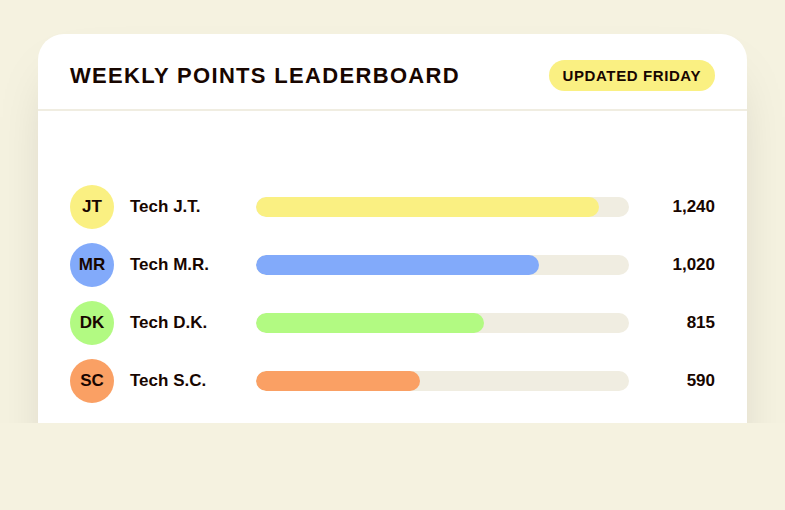
Pay structure was half the fix. The other half was making performance visible in near real time, which is where the company's membership program and review culture came into play. Alongside the new incentive structure, ShareWillow built a points-based system that converts two things technicians directly influence, membership plan sales and 5-star customer reviews, into a running points balance. A daily script pulls that activity straight out of ServiceTitan, converts it into points, and updates a leaderboard displayed on a TV in the shop.
The daily sync matters more than it might seem. A leaderboard that updates once a month, or worse, gets forgotten about entirely, turns into wallpaper. Nobody checks a number that never changes. But a board that refreshes every day creates a rhythm technicians actually build into their week. At this company, that rhythm settled on Fridays. "People aren't gonna be engaged with it if they don't see that it's getting updated," the owner said. "Every Friday, they're gonna know to check." That's a small operational detail with an outsized effect: the leaderboard works not because points exist, but because technicians trust the number on the screen is current.
This is also where the integration piece stops being a technical footnote and starts being the thing that makes the whole system usable. Without a direct pull from ServiceTitan, someone on the office staff would need to manually tally membership sales and reviews for every technician, every single day, just to keep the board honest. That's not a task anyone sustains for long. Automating it is what let the company run a daily leaderboard instead of a quarterly one, and it's a big part of why HVAC-specific incentive programs built around real job data tend to outperform generic bonus plans that rely on someone in the office pulling reports by hand.
Together, the two pieces reinforced each other. The percentage-of-sold-work model made the paycheck reflect real performance. The daily leaderboard made that performance visible and a little competitive, in a way flat spiffs never could, since there was nothing to compare when everyone got the same amount for the same unit regardless of how the rest of the shop was doing.
Neither piece would have worked as well on its own. A percentage-based bonus with no visibility into how it's tracking still feels abstract to a technician until the paycheck arrives. A leaderboard with no real money behind it is just a game. Put the two together, and a tech can look at the TV on a Friday afternoon, see where they stand on memberships and reviews, and connect that directly to a number that shows up tied to the sold work they closed that week. That's the kind of feedback loop a flat spiff plan, however generous, never gave anyone.
Profit sharing
made simple.
Give your team a stake in the company’s success. ShareWillow helps you create and manage profit-sharing programs that motivate employees and drive business results.
From 58.5% to about 40%, without losing the team
The results showed up fast. HVAC labor cost came down from 58.5% of revenue to roughly 40% per unit. That's still above the 35% target the ownership team is aiming for, and they're candid about that gap. But moving nearly 19 points in the right direction, on a metric that had been stuck at almost double a healthy level, is a real structural fix, not a rounding error. "I think we're gonna come in at about 40% per unit," the owner said. "So it's a huge improvement."
What makes this result worth paying attention to is what happened at the same time on the other side of the ledger. Technician revenue, measured against budget, roughly doubled. That's the detail that should reframe how a lot of owners think about fixing a bloated incentive plan. The assumption going in is usually that lowering labor cost means paying the team less, or asking them to accept a worse deal so the business can breathe. That's not what happened here. Technicians earned more relative to what was budgeted, because the plan paid them for hitting real numbers instead of collecting a flat amount no matter what they sold.
That combination, labor cost dropping while technician output climbs, is the real proof that the old plan was broken in the first place. A flat spiff wasn't buying the company loyalty or extra effort, it was just buying volume, disconnected from price, hours, or budget. Once pay was tied to sold work instead, technicians pushed harder on the metrics that actually mattered, and the business captured the upside of that instead of paying out flat bonuses regardless of the outcome. Getting there took more than flipping a formula on a spreadsheet. It took automated incentive tracking that could pull sold-hours and revenue data out of ServiceTitan every day and turn it into a bonus calculation nobody had to build by hand each pay period.
The bigger lesson for trades businesses
It's tempting to treat "pay the team well" and "run a healthy business" as opposite ends of a lever, where pulling one means giving up the other. This case argues against that framing. The problem was never that technicians earned too much. The problem was that what they earned had nothing to do with what the business actually needed from them. Fix that connection, and the incentive to overpay for the wrong behavior disappears, while the incentive to perform on the metrics that matter goes up. Nobody had to accept less for the business to get healthier.
The company still has room to close the last gap between 40% and its 35% target, and that kind of tightening tends to happen gradually as a new plan settles in and both sides get comfortable with how it pays out month over month. But the hard part, the part that actually risked the team walking out the door, is behind them. For any HVAC or multi-trade business staring at a labor cost number that doesn't match a healthy budget, the lesson isn't to cut pay across the board. It's to figure out what the current plan is actually rewarding, and rebuild it around the numbers that keep the business, and the technicians, on the same side of the ledger.
Related reading
- Flat for Years, Then $3 Million: How a Regional HVAC Company Broke Its Growth Plateau
- The Travel-Time Miscalculation That Was Quietly Overpaying an HVAC Team by $30,000 a Year
- HVAC Profit Margins 101: Benchmarks and Proven Ways to Boost Your Bottom Line
- Companies with Profit Sharing: Who They Are & What They Offer
Conclusion
Flat spiffs pushed HVAC labor cost to 58.5% of revenue; tying pay to sold work brought it to 40% and doubled technician revenue at once.
Create incentives
that
drive results
You shouldn't need complex equity plans to align your team. ShareWillow makes it simple to create transparent profit-sharing programs that motivate employees and grow your business.

Incentive plans to help
small businesses thrive.
.png)
"I was able to leverage the knowledge of the ShareWillow team to learn how other companies were designing their bonus plans. The template was extremely helpful."

Brian Tustin
Owner, First Rate Movers
