
A 24-person HVAC company had a technician splitting time between install and service, but their pay plan only supported one role at a time, so half his work never got credited fairly. ShareWillow built a hybrid plan pulling live ServiceTitan data instead, and the company's install team payouts grew 69% in three months, from $1,137 to $1,924.
The Technician Who Didn't Fit the Plan
Most incentive plans assume a technician works one job. You're either on the install team chasing change orders and system upgrades, or you're on the service team running maintenance calls and diagnosing breakdowns. The pay structure gets built around that assumption because it's simpler to administer and it matches how most of the org chart is drawn. For most of the crew it works fine. But almost every HVAC company eventually runs into the tech who doesn't sit neatly in either bucket, and until that gets fixed, that person is quietly getting shorted every single pay period without anyone quite noticing why.
That's exactly what was happening at a 24-person HVAC company running both install and service crews. One technician split his time genuinely between the two, some weeks doing replacement work on new systems, other weeks running service calls when the schedule needed him there and the dispatch board was thin. He wasn't a service tech who occasionally helped out on install, and he wasn't an install tech moonlighting on a handful of service tickets between bigger jobs. He was doing real, substantial, billable work in both roles, week after week, month after month, the kind of flexibility a lot of owners say they want out of their best people. Dispatchers leaned on him because he could go either direction depending on what the day needed, which made him more useful to the business, not less, even though the pay system treated that usefulness as a filing problem instead of a strength.
The problem was that the company's incentive software only supported single-role plans. A technician got enrolled in the install plan or the service plan, never both at the same time. So when it came time to decide where this tech belonged, the honest answer was "both," and the software simply had no way to say that. He got parked in whichever track made the most administrative sense at the time, and the work he did in the other role never showed up anywhere in the incentive calculation. Not partially credited, not pro-rated, not carried forward. Just gone, as if half his week hadn't happened.
"We had a tech splitting time between service and install, and there was no clean way to pay him fairly for either side," the operations lead said. That's not a small gap. Over months, it adds up to real money a technician earned and never saw, and it sends a quiet signal to everyone else on the crew watching how he gets paid: if you're flexible enough to cover two roles when the business needs it, the pay plan will punish you for it instead of rewarding the very versatility that makes you valuable.
There was a second issue layered on top of the first, and it made the fairness problem worse. The same company was assigning lead and install-job credit off a hard-coded priority list, ordered by hourly pay rate. Whoever ranked highest on the list got first crack at incoming leads and the commission credit that came with them, on the assumption that pay rate roughly tracked seniority and performance. The trouble was that the list hadn't been kept current. It still had technicians on it who no longer worked at the company at all. Leads and credit were sometimes routing to people who had already left months earlier, instead of to the techs actually on the truck doing the work. Nobody had built the list to fail this way on purpose. It had just been set up once, hard-coded into the workflow, and left alone while the roster around it kept changing, which is exactly how a lot of pay-plan problems start: not with a bad decision, but with a good decision nobody revisited.
Building a Plan for the Way Work Actually Happens
The fix wasn't to force a choice between install and service. It was to build a plan that reflected reality: this technician did meaningful work in both roles, so he needed to be enrolled in both plans at once, with each side tracked and paid on its own terms. ShareWillow built him a dedicated hybrid incentive plan that ran the install and service tracks simultaneously, crediting him for real production in each, instead of collapsing his work into a single track that only ever told half the story and left the rest of it uncounted.
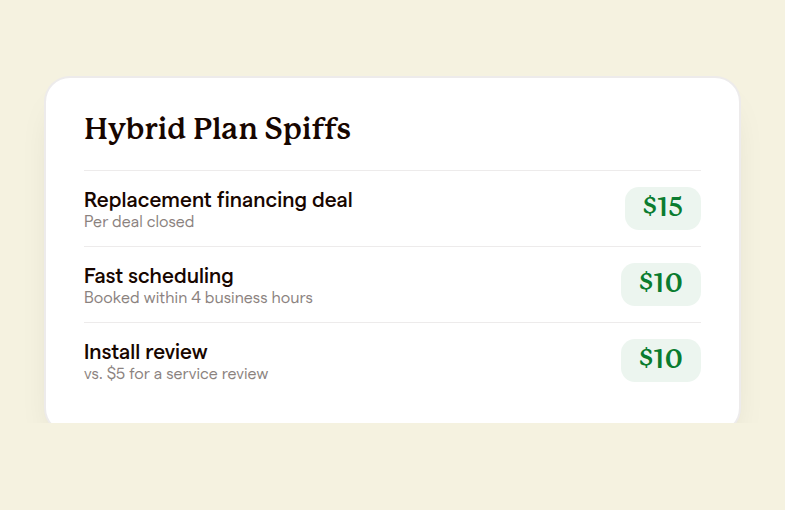
The plan pulled directly from the company's ServiceTitan data, so the numbers weren't a manual reconciliation project somebody had to rebuild in a spreadsheet every month. Role-specific spiffs got attached to the actual job types coming through the system: fifteen dollars per replacement-financing deal closed, and ten dollars per job scheduled within a four-business-hour window, a speed-to-schedule incentive built to reward getting customers on the calendar fast rather than letting a lead go cold overnight. Instead of one flat bonus applied to every review regardless of context, review pay split by job type too, ten dollars for an install review versus five dollars for a service review, because those two reviews don't represent the same amount of work, the same sales cycle, or the same ticket size, and paying them at a single flat rate never actually made sense in the first place. Pulling these numbers straight from ServiceTitan also meant nobody on the operations team had to sit down and manually tag which job belonged to which spiff each month. The system already knew whether a ticket was a replacement-financing close, a fast-scheduled install, or a service call, so the plan could simply read that data and pay accordingly, without adding a second job on top of everyone's actual job just to keep the incentive math honest.
To keep the hybrid plan tied to real activity rather than just enrollment on paper, the company added an eligibility qualifier: a technician needed at least five service calls in the period to stay eligible for the sales-side portion of the plan. That's a small detail with a real purpose behind it. Without a qualifier like that, a hybrid plan can quietly drift into a loophole where someone collects service-side incentives while barely doing any actual service work, which defeats the point of building a role-specific plan at all. With the qualifier in place, the incentive stays honest and tied to activity that genuinely happened during the period, not just a checkbox that got flipped once during setup and never revisited. It's a small mechanism, but it's the kind of detail that separates a pay plan people trust from one they quietly game, and trust is really the entire point of building an incentive plan at all.
The lead-routing problem got fixed at the same time, and it turned out to be just as important as the pay-plan redesign. The hard-coded, rate-ordered list got rebuilt so departed employees drop out of the rotation automatically the moment they leave, and credit now flows to the technicians who are actually on the job today, not to whoever happened to rank highest on a list nobody had bothered to touch in a year or more. "The old lead list was hard-coded by hourly rate and still had people on it who don't even work here anymore," the operations lead said. Between the hybrid plan and the corrected routing, the fix wasn't really a policy change so much as a plumbing fix: making the pay system finally match what was already true about how the crew worked and who was actually doing the jobs.
Profit sharing
made simple.
Give your team a stake in the company’s success. ShareWillow helps you create and manage profit-sharing programs that motivate employees and drive business results.
What Fixing the Plan Actually Did to Payouts
The real test of any pay-plan fix is whether it shows up in the numbers, and in this case it did. After this company rolled out ServiceTitan-driven incentive plans across its install team in spring 2026, confirmed monthly incentive payouts for that seven-person install team climbed from $1,137.07 in May to $1,489.81 in June, then to $1,923.98 in July. That's roughly a 69% increase in three months, and it isn't a projection, a forecast, or a modeled estimate built to make a case study look good. It's actual, confirmed payout data pulled straight from the company's own records, month over month, tech by tech. Three months isn't a long window, which is part of what makes the trend worth paying attention to. A seven-person install team doesn't add nearly seventy percent to its collective payout by accident, and it doesn't happen because seven people simply decided to work faster or sell harder in June and July. It happens because the plan stopped losing track of work it should have been paying for all along.
It's worth being precise about what that growth actually represents, because it's easy to misread. It isn't the company simply deciding to pay out more for the same work, and it isn't inflation in the incentive rates themselves. It's the incentive plan finally catching work it had been missing all along: replacement financing deals that used to go uncredited, fast scheduling that used to earn nothing extra, review types split by job instead of lumped into one flat rate, and hybrid technicians credited for both roles they were actually working the whole time. When a plan starts reflecting the real activity happening on the ground, the payout curve moves because the performance was already there, sitting in the job data, waiting to be counted correctly. The pay system had simply been blind to a meaningful chunk of it.
"Replacement financing pays $15, fast scheduling pays $10 a job, and install reviews now pay $10 versus $5 for service. The incentive finally matches the work," the operations lead said.
That's really the whole lesson here. Most HVAC and field service businesses don't have a pay problem so much as a pay-plan-resolution problem: the incentive structure is too coarse to see how work is actually distributed across a real crew doing real jobs. A single-role plan misses hybrid techs entirely, no matter how hard they work or how much value they create by covering both sides of the business. A stale priority list misroutes leads and commission credit to people who left the company months ago, while the tech who earned it watches someone else's name get the payout, which is about as fast a way to lose a good technician's trust as anything a company can do. Neither failure looks dramatic in isolation, and neither one shows up on a P&L line by itself, but both quietly cap what your best people can earn, and by extension, what your business gets back from them in effort and retention. If you're running a growing install and service operation, it's worth asking whether your current incentive pay platform can actually handle a technician who works two roles at once, or whether it's still forcing everyone into a single bucket the way this company's old setup did. The tools built specifically for HVAC businesses should be flexible enough to enroll someone in more than one plan simultaneously, pull straight from the job data you already have sitting in ServiceTitan, and route lead credit to the people actually doing the work today, not whoever happened to be on a list somebody built a year ago and never updated. Get that right, and the payout growth tends to take care of itself, because at that point you're finally paying for performance that was already happening under your roof the whole time.
Related reading
Conclusion
If your incentive plan can only picture one role per technician, it's already underpaying the people flexible enough to work two.
Create incentives
that
drive results
You shouldn't need complex equity plans to align your team. ShareWillow makes it simple to create transparent profit-sharing programs that motivate employees and grow your business.

Incentive plans to help
small businesses thrive.
.png)
"I was able to leverage the knowledge of the ShareWillow team to learn how other companies were designing their bonus plans. The template was extremely helpful."

Brian Tustin
Owner, First Rate Movers
