
A plumbing and drain-service company was one of the only shops in its book of business paying commission on inbound booked calls, a real perk for its office team. But crediting only one agent per booking was starting disputes every week and pushing staff toward gaming the system instead of just booking calls. Here is how switching to an equal group split, with built-in proration for absences, put the argument to rest.
Commission plans are easiest to design around work one person does alone. A technician runs a job, closes it, gets credit. The math gets harder the moment more than one person genuinely contributes to the same result, and it gets harder still when the software you are running on was never built to split credit at all, only to assign it to a single name.
Office and dispatch roles run into this constantly, and they tend to get overlooked in incentive design because most trades businesses build their pay plans around field labor first. A technician's hours, jobs closed, and revenue produced are all relatively easy to attribute to one person standing at one job site. A phone team answering a rotating stream of inbound calls, where a customer might talk to two or three different people before a job ever hits the schedule, does not fit that same clean, single-owner model. Most shops solve this by simply not incentivizing the phone team at all, which sidesteps the attribution problem but also leaves a real lever for growth untouched.
That is exactly the wall a plumbing and drain cleaning company ran into with its office team. The company runs a small inbound call-booking team, three customer service reps who answer incoming calls and get them on the schedule, alongside its field technicians. What made this team unusual is that the owner had built in a real perk most shops in the trades never offer their office staff: a commission on inbound booked call revenue. Book a call, get a piece of the resulting job. It is a genuinely good incentive, and one of the only examples of its kind in ShareWillow's own book of business.
One line in ServiceTitan, credited to whoever happens to be logged
The problem was not the incentive. It was the attribution underneath it. ServiceTitan logs a single agent against each booking, whoever is entered on that particular call record. In a real inbound-call workflow, that is rarely the full picture. One CSR might take the first call from a customer who is still deciding, gather the details, and pass it along. A second CSR might be the one who actually calls the customer back, answers their remaining questions, and gets the booking confirmed. ServiceTitan's system has no concept of that handoff. It credits whichever single name is attached to the record, regardless of how many people actually moved the call from inquiry to booked job.
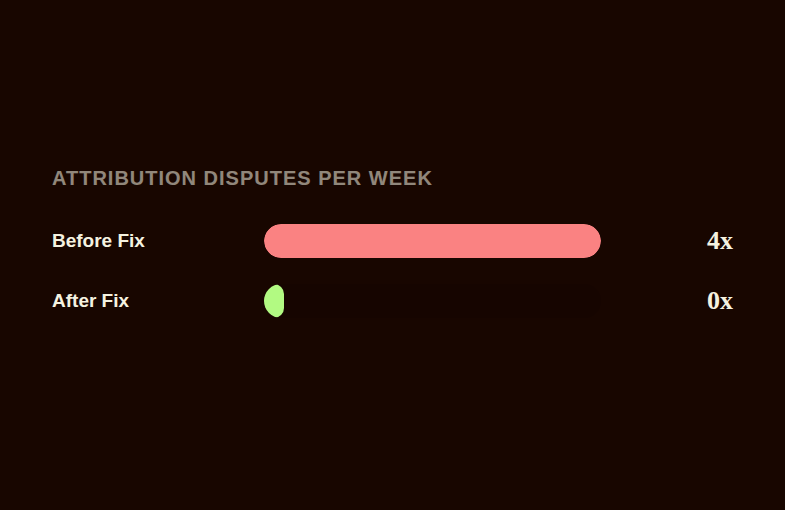
That mismatch started generating real disputes, several times a week according to the team, over who had actually "earned" a given booking's commission. Worse than the arguments themselves was what the team said it was doing to their behavior. Reps began paying closer attention to how ServiceTitan's attribution mechanics worked than to the actual goal of getting calls booked in the first place, adjusting who logged what and when in ways that had nothing to do with serving the customer better and everything to do with making sure the right name ended up on the record.
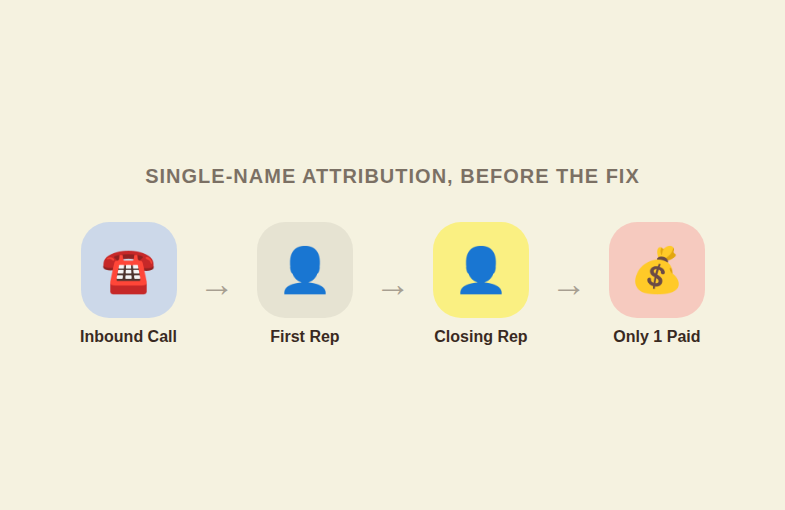
That is the quiet danger of a shared-credit role running on single-attribution software. The incentive itself was doing exactly what it was supposed to do: rewarding the team for booking more calls. The mechanism underneath it was rewarding something else entirely, whoever happened to be the last name in a field, and the team could feel the difference even before anyone put a name to the problem.
There was also a quieter cost building underneath the visible disputes. A three-person office team only works well if the three people trust each other and trust that the incentive in front of them is measuring something real. Every time a booking's credit landed on the "wrong" name, even by a small margin, it chipped away at that trust a little more. Left unaddressed long enough, a broken attribution model in a small, tight-knit office team does not just produce awkward pay-period conversations. It produces the kind of quiet resentment that eventually shows up in turnover, which is a far more expensive problem to fix than a commission formula.
Going back to a split, decided by the team itself
Working with ShareWillow, the company reversed course on individual attribution and moved the inbound booked revenue incentive back to an equal three-way split across the phone team. Every dollar of booked call revenue that qualifies for the incentive gets divided evenly across the three CSRs, rather than routed entirely to whichever name ServiceTitan happened to log. The decision was not handed down from the owner alone. It came out of a conversation with the team itself, on the call, about what would actually feel fair given how the work really gets done.
I don't want it to be like we're fighting with each other or arguing over who gets the revenue, because we're all working as a team.
That framing, offered by one of the CSRs during the discussion, captures why the individual-attribution model had been failing even before the numbers were formally reworked. The job itself is collaborative. A booking is rarely the product of one uninterrupted conversation with one rep; it is a relay, with different people picking up different parts of the handoff. A pay structure that pretends otherwise was always going to create friction, no matter how carefully the underlying software logged who touched what.
The owner added an important piece of nuance to the group-split decision: a team member out on a partial week, for vacation or PTO, should not be penalized by getting cut out of that week's split entirely. Genuine time off is a normal part of running a small office team, and the plan needed to account for it without punishing someone for taking earned leave. No-call, no-show situations, on the other hand, are handled differently, with the team flagging those exclusions directly to ShareWillow rather than baking an automatic penalty into the formula.
To make the partial-week logic actually work in practice, dynamic proration qualifiers were added, based on minimum hours or days worked in a given week. That way, a week with one CSR out does not simply split three ways as if everyone had been present the entire time; the math adjusts to reflect who was actually there and how much, without requiring anyone to manually recalculate a fair share by hand every time someone takes a day off.
It is worth pausing on why the owner drew the line where they did between PTO and no-call, no-show. Both situations mean a team member was not on the phones for part of a week, but the intent behind each is completely different. Vacation and approved time off are the company living up to its own policies. A no-show is a separate performance conversation entirely, one that should not be quietly absorbed into a commission formula as if it were routine. Building both distinctions into the plan up front, rather than deciding case by case after the fact, keeps the incentive fair without requiring the owner to relitigate the same judgment call every time it comes up.
Profit sharing
made simple.
Give your team a stake in the company’s success. ShareWillow helps you create and manage profit-sharing programs that motivate employees and drive business results.
What a settled attribution fight frees the team up to focus on
The most immediate result of the switch is what stopped happening. A dispute that had been surfacing multiple times a week, over whose name landed on a given booking, simply has nowhere left to attach itself. There is no longer a single winner to argue about, because the incentive was rebuilt to match how the work actually happens: as a team effort, split evenly among the people who did it.
With the attribution fight resolved, the same working session gave the team room to look at a different metric entirely: job completion rate. One CSR, referred to on the call as Carli, was shown hitting 57 percent completion that week, up from a tougher stretch the prior month but still below where the team wanted to land. The broader team discussion noted that recent pay periods, following a rough June, were the first in a while to see nearly everyone clear their performance-pay bar. That is a meaningfully different conversation than the one the team had been having before. Instead of relitigating who gets credit for a booking, the room was talking about how to help a specific rep improve a specific number, which is a far more productive use of a working session than an attribution dispute ever was.
What this means for your shop
Shared-credit roles are common in the trades, not just among office staff but among install crews, helper pairings, and any job where more than one person's effort shows up in a single result. A few lessons from this fix apply broadly.
- Match the pay structure to how the work actually happens. If a result routinely comes from more than one person's effort, a single-attribution incentive will eventually reward the wrong behavior, or the wrong person, regardless of how carefully the software logs things.
- Ask the team before rebuilding a shared incentive. The people doing the work every day usually know exactly where a pay structure is creating friction, and what a fair alternative looks like, faster than a policy written from the outside ever will.
- Build proration in from the start, not as an afterthought. An equal split only feels fair if it accounts for who was actually present. Dynamic qualifiers based on hours or days worked keep a group incentive honest without turning every absence into a manual recalculation.
- Separate genuine time off from no-shows. Treating PTO and unexcused absence the same way in a pay formula punishes people for taking leave they are entitled to. Handle the two situations differently, and be explicit about how.
- Watch what a broken incentive does to behavior, not just to disputes. The real cost here was not the arguments themselves. It was a team starting to optimize for software mechanics instead of the actual goal the incentive was built to encourage.
- Do not let attribution complexity talk you out of incentivizing office roles. It is tempting to leave phone and dispatch staff out of incentive pay entirely because their contribution is harder to isolate than a technician's. A group split solves that problem without requiring perfect individual attribution.
A commission plan for a shared role only works if it is built around how the work is actually shared. For plumbing companies running commission on inbound calls, dispatched jobs, or any result more than one person touches, single-name attribution is often the quiet source of a recurring fight. ShareWillow supports group splits with built-in proration, so a shared incentive can reward the whole team fairly, the same kind of structural fix behind how a duplicate commission line was confusing a home services sales team about money they had already been paid. See what a fair, team-based incentive plan would look like for your shop, based on what we have learned from over 200 service businesses.
Related reading
Conclusion
When more than one person genuinely earns the credit, splitting it evenly beats forcing the software to pick a single winner.
Create incentives
that
drive results
You shouldn't need complex equity plans to align your team. ShareWillow makes it simple to create transparent profit-sharing programs that motivate employees and grow your business.

Incentive plans to help
small businesses thrive.
.png)
"I was able to leverage the knowledge of the ShareWillow team to learn how other companies were designing their bonus plans. The template was extremely helpful."

Brian Tustin
Owner, First Rate Movers
