
A 12-plus technician pool service and construction company had revenue per hour ranging from $55 to $98 across its team, with nothing but a small flat award tying pay to performance. The fix was a tiered commission plan that pays technicians more as they close the gap toward a 90-per-hour target.
Pool service and construction is a strange business to run on flat pay, because the range between a slow technician and a fast, efficient one is enormous, and almost none of that range shows up anywhere except in the numbers nobody usually looks at closely. A growing pool service and construction company with more than a dozen field technicians ran headlong into exactly that problem. Two technicians could be doing what looked, on a schedule board, like the same job. One of them was generating close to double the revenue per hour of the other. And the company's incentive program had no real way to reward the difference.
That is not a small gap. It is the kind of gap that, left alone, quietly caps how fast a business can grow, because it means half the team is running at a fraction of the productivity the other half has already proven is possible on the exact same kind of job.
A Revenue-Per-Hour Spread From $55 to $98
When the company actually pulled the numbers, the spread was stark: revenue per hour across the technician team ranged from about $55 an hour on the low end to nearly $98 an hour on the high end. Same trade, same tools, same basic job types, and a technician on the strong end of that range was generating almost twice the revenue per hour of a technician on the weak end.
Gaps like that rarely come from one technician being twice as skilled as another. More often they come from a dozen small differences: how tightly a route is planned, how much idle time creeps into a day, how quickly a technician moves from one task to the next, how much unbillable "shop" time gets mixed into a day that should be revenue-generating. None of those differences are dramatic on their own. Stacked together across a full week, they add up to a technician at $55 an hour and a technician at $98 an hour doing what looks, from the office, like the same job.
The company's existing answer to this was a flat award, a fixed $115 bonus unconnected to how far above or below the team's benchmark a technician actually performed. A technician earning $98 an hour and a technician earning $55 an hour were both eligible for the same flat number if they hit whatever minimal bar triggered it. That is not an incentive structure calibrated to the size of the problem it is trying to solve. A flat award tells every technician the same thing regardless of where they actually sit on a $43-an-hour spread: close enough is close enough. For a business trying to close a productivity gap that large, that message works directly against the goal.
Two Time-Tracking Systems, One Distorted Number
The revenue-per-hour gap was not the only issue sitting underneath the numbers. The company had also been running technician time tracking across two different systems during a transition from one platform to another, and the two systems were not applying consistent logic to what counted as billable time versus non-revenue "shop" time, time spent at the shop rather than on a paying job site.
When shop time gets folded into the hours used to calculate revenue per hour, the metric stops measuring what it is supposed to measure. A technician who spends a chunk of the week on legitimate, necessary shop work, loading trucks, prepping equipment, handling maintenance, will show a lower revenue-per-hour number than a technician who spends that same time entirely on billable jobs, even if both technicians are working equally hard and equally efficiently while they are on a job site. That is not a fairness issue at the margins. It is a fairness issue at the center of the entire incentive structure, because it means the number determining who looks productive and who does not is partly an artifact of how time got logged rather than how the work actually got done.
Any pool service business considering a revenue-per-hour incentive needs to solve this problem before the incentive itself, not after. A commission plan built on top of a distorted metric does not fix unfairness. It automates it.
Why a Small Flat Bonus Cannot Close a Big Gap
It is worth sitting with why a $115 flat award, a perfectly reasonable-sounding number on its own, was never going to move a $55-to-$98 spread. A flat bonus does not scale with the size of the problem. It sends the same signal to every technician regardless of where they sit on the spectrum, which means it does almost nothing for the technician furthest from the target, the person the business most needs to move, and almost nothing extra for the technician closest to it, the person the business most wants to retain and reward for already getting there.
Incentive structures work when the size of the reward tracks the size of the gap you are actually trying to close. A flat number, no matter how well-intentioned, cannot do that. It treats a 10% gap and a 60% gap identically, which is precisely backwards from what a business trying to close a 60% gap actually needs.
Building a Commission Structure That Tracks the Actual Gap
The fix started with cleaning up the foundation: standardizing how time was tracked and classified, so revenue-per-hour calculations reflected real billable work rather than an artifact of which system logged which hours and how shop time got counted. Once that foundation was solid, the company could build a commission structure that actually meant something.
The new plan is a tiered revenue-per-hour commission structure, built around three benchmarks: 70, 80, and 90 dollars of revenue per hour. As a technician's revenue-per-hour performance clears each threshold, their commission rate steps up, moving from roughly 1% toward 5% at the top tier. Instead of one flat number available to everyone regardless of performance, technicians now have a visible ladder, and the size of the reward scales with how close they get to the top of it.
That structure does something the flat $115 award never could: it gives every technician, regardless of where they currently sit on the $55-to-$98 spread, a specific, visible next step. A technician at $60 an hour is not being asked to somehow leap to $98. They are being shown exactly what clearing the next threshold, 70, then 80, then 90, is worth to them in real commission dollars. That is a fundamentally different psychological proposition than a single flat bonus that treats every technician's starting point as identical when it plainly is not.
A Separate Plan for Construction Work
Pool construction jobs, larger builds and renovation projects that run on a defined budget rather than a per-hour service call, needed a different logic entirely, and the company built one. The construction incentive pays out based on how actual costs compare to the budgeted cost for a project, savings against budget, split among the crew according to time spent on the job.
That structure rewards exactly the behavior a construction business wants more of: crews that manage a project efficiently, avoid overruns, and finish under budget without cutting corners on quality. It is a different mechanism than the revenue-per-hour service plan because construction work has a different shape, project-based rather than call-based, but the underlying philosophy is the same. Pay should track the specific way a given type of work actually creates or destroys value, not a single generic formula applied uniformly across fundamentally different job types.
Why Two Different Formulas Beat One Generic One
It would have been simpler, on paper, to build one incentive formula and apply it everywhere. It also would have been wrong. Service calls and construction projects generate revenue on completely different timelines and through completely different mechanics. A revenue-per-hour metric makes sense for a technician running multiple service calls in a day. It makes much less sense applied to a multi-week construction crew working toward a single project budget.
Building two separate, purpose-fit incentive structures, rather than forcing one formula to awkwardly cover both, is part of what makes this plan credible to the technicians working under it. A commission structure that visibly does not fit the actual shape of the work reads as arbitrary, even when the underlying intent is good. A structure that matches the mechanics of the job it is paying for reads as fair, because it is.
Profit sharing
made simple.
Give your team a stake in the company’s success. ShareWillow helps you create and manage profit-sharing programs that motivate employees and drive business results.
The Target the New Plan Is Built to Hit
With the tiered service commission and the construction savings plan both in place, the company set a clear, company-wide benchmark for what success looks like: every dollar of payroll should generate roughly five dollars of revenue, a 20% labor cost target. That target gives the whole incentive structure a north star that ties directly back to the original $55-to-$98 revenue-per-hour spread. A technician consistently working near the top tier, at or above $90 an hour, is a technician whose pay-to-revenue ratio is squarely inside that 20% target. A technician still down near $55 an hour is a technician the new tiered structure is specifically designed to pull upward, threshold by threshold.
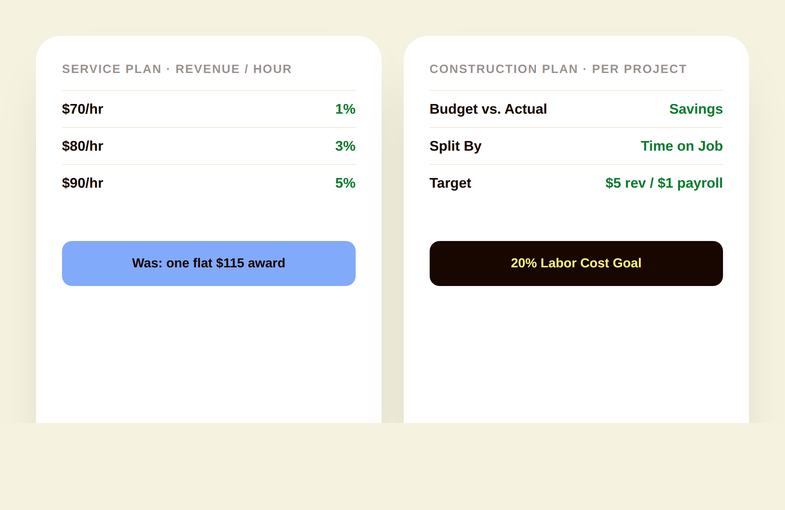
That is the real difference between this plan and the flat award it replaced. A $115 bonus was a number disconnected from any specific target. The tiered structure is built directly around the company's actual payroll-to-revenue goal, which means every technician's incentive is now pointed at the same underlying number the business itself is trying to hit. Pay and company strategy are no longer running on separate tracks.
What Pool Service and Construction Companies Should Take From This
If your pool service business has technicians running what look like similar jobs with wildly different revenue-per-hour outcomes, a flat bonus is very unlikely to be the tool that closes that gap, no matter how well-intentioned the number. Flat incentives treat every technician's distance from the target as identical. A tiered structure, built around real thresholds and scaled commission, treats the gap as what it actually is: different for every technician, and closeable in specific, visible steps.
It is also worth auditing the foundation before building the incentive on top of it. If your business tracks time across more than one system, or has any ambiguity about how non-billable hours factor into productivity metrics, that ambiguity will quietly distort whatever commission plan you build until it gets fixed. Automated, data-driven incentive tracking only works as well as the underlying data feeding it.
And for any pool service company running both service calls and construction projects, resist the urge to force one formula to cover both. A revenue-per-hour structure fits service work. A budget-versus-actual structure fits project work. Building the right formula for each job type, rather than one generic formula for everything, is what makes a commission plan feel fair to the people actually doing the work, and fair is what makes an incentive plan actually change behavior instead of just sitting in an employee handbook nobody references after week one.
Related reading
Conclusion
Replacing a flat $115 award with a tiered revenue-per-hour commission plan gave this pool service company's technicians a direct, visible reason to close a $55-to-$98-an-hour productivity gap.
Create incentives
that
drive results
You shouldn't need complex equity plans to align your team. ShareWillow makes it simple to create transparent profit-sharing programs that motivate employees and grow your business.

Incentive plans to help
small businesses thrive.
.png)
"I was able to leverage the knowledge of the ShareWillow team to learn how other companies were designing their bonus plans. The template was extremely helpful."

Brian Tustin
Owner, First Rate Movers
