
A roofing and restoration company running multiple crews found that team-based commission splits stopped making sense once technicians started moving between crews and jobs. Switching to an individual labor-rate target, 18% for most crews and 20% for replacement work, gave every technician one clear number to manage instead of a shared, shifting pool.
When a shared bonus stops feeling like a bonus
A roofing and restoration company running several installation and repair crews had been paying commission the way a lot of trade businesses start out: split it across the crew that worked the job. On paper, that is simple and fair. In practice, it fell apart the moment crews stopped being fixed groups of the same people every day. Technicians moved between crews depending on scheduling needs, a repair crew might borrow a tech from a replacement crew for a day, and a single roofing job might be finished by a mix of people who were not even on the same original crew that bid it.
Once that started happening regularly, the crew-based split stopped functioning as an incentive and started functioning as a source of arguments. A technician who worked hard on a job but was borrowed from a different crew might see none of the bonus for it, because the payout followed the crew's identity, not the individual's actual contribution. Someone else on the "home" crew for that job might collect a share of a bonus for work they were not even present for. Nobody was trying to game the system. The system itself no longer matched how the work actually got staffed.
There is also a retention angle that showed up almost immediately once the plan changed. Technicians who felt like the old crew-based bonus was arbitrary were the same technicians most likely to grumble about pay in general, regardless of how much they were actually earning. Once each person could see their own number moving in a direction they controlled, the conversation shifted from "is this fair" to "how do I get this number better," which is a much more productive place for a pay conversation to live.
This is a common failure point in roofing and restoration specifically, because crew composition tends to be more fluid than in trades where the same two or three people show up together every single day. Weather delays, callback repairs, and uneven lead flow all push companies toward moving people around to keep everyone busy, and a compensation plan built around fixed crews cannot keep up with staffing that changes week to week. The company did not need a bigger bonus pool. It needed a bonus structure that followed the person doing the work, not the crew roster from the morning huddle.
Replacing the crew pool with a number every technician owns
The fix was to stop paying commission to crews at all and pay it to individuals instead, measured against a labor-rate target rather than a flat percentage of revenue. Most crews are held to an 18% labor-rate target, meaning labor cost should stay at or under 18% of the revenue a technician generates. Replacement and repair crews, whose jobs tend to run smaller and more labor-intensive relative to the materials involved, work against a slightly higher 20% target. Either way, the number belongs to the individual technician, not to whichever crew happened to be on the schedule that day.
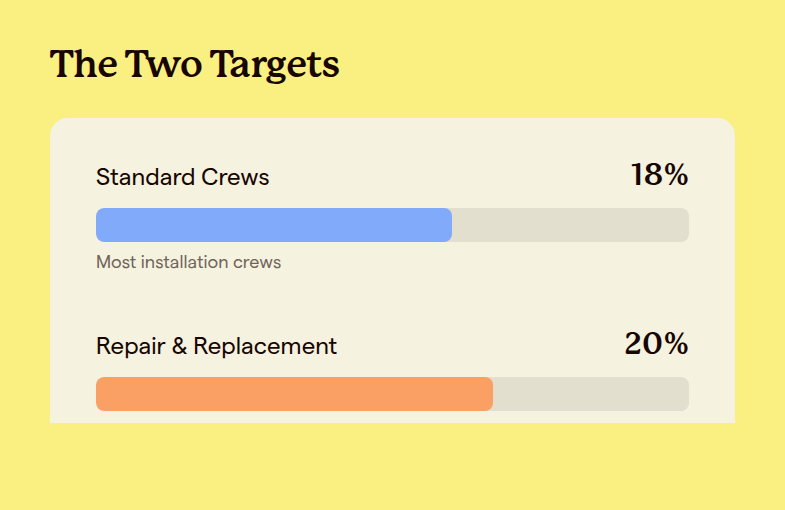
A labor-rate target is a slightly different mental model than a straight commission percentage, and it is worth spelling out why it works well for a trade like roofing. Instead of paying a flat cut of revenue regardless of how efficiently a job ran, it ties pay to the relationship between labor cost and revenue generated, which rewards technicians for working efficiently on jobs of very different sizes without needing a separate formula for every job type. A technician who consistently keeps their labor rate under target across a mix of small repairs and large replacement jobs is demonstrably productive in a way a single job's dollar value cannot show on its own.
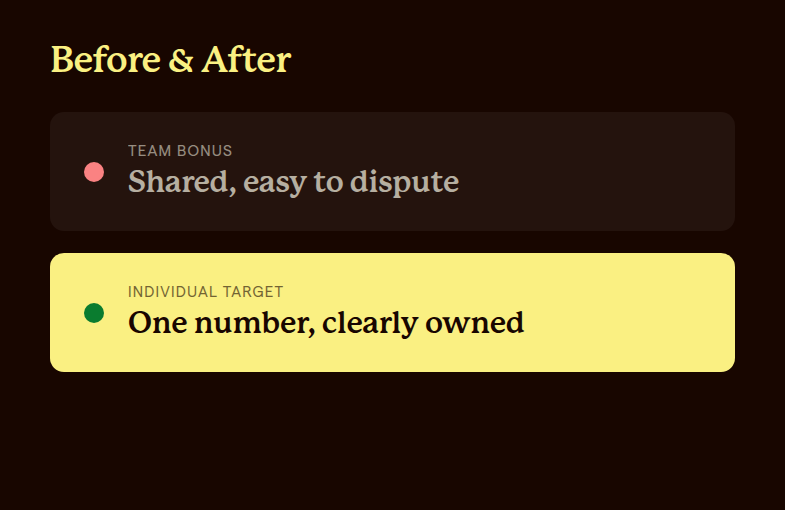
Because the target is now tied to the individual rather than a crew, moving people around to cover scheduling gaps no longer creates a fairness problem. A technician who gets pulled onto a different job for a day carries their own labor-rate number with them. There is no crew identity to argue about and no shared pool to divide up after the fact.
Profit sharing
made simple.
Give your team a stake in the company’s success. ShareWillow helps you create and manage profit-sharing programs that motivate employees and drive business results.
Putting a real number on what the target means
To make the target concrete rather than abstract, the company worked through an example that technicians could actually picture: a crew running a 13% labor rate on a roofing-replacement job, well under the 18% target, would need to generate roughly $165,000 in monthly revenue to be operating at that level of efficiency. Numbers like that turn a percentage into something tangible. A technician does not need to do the math themselves to understand whether they are ahead of or behind the target; they can see it translated into a real monthly revenue figure and judge their own performance against it directly.
That kind of translation matters more than it might seem, because a labor-rate percentage on its own is an abstraction most field technicians do not think in day to day. Nobody walks a roof calculating their personal labor-rate percentage in real time. But almost everyone can look at a monthly revenue number and immediately understand whether a given month has been a strong one or a slow one. Doing the work to translate the target into a figure like that is what turns a compensation plan from something handed down by the office into something a technician can actually use to manage their own performance.
The bigger shift here is really about ownership. A shared crew bonus put the responsibility for hitting a number on a group of people who did not always work together consistently, which meant nobody fully owned the outcome and everybody had a built-in excuse when the number came in low. An individual labor-rate target removes that excuse in both directions. A technician who is crushing their target gets to see that clearly reflected in their own pay, and a technician who is falling short has a specific, personal number to work on instead of a shared pool to blame or take credit for.
This same pattern shows up well beyond roofing. Any trade that stages fixed crews on paper but staffs jobs more fluidly in practice, from general construction to restoration work, runs into the identical problem: a bonus tied to a group identity stops working the moment the group stops being consistent. The fix is rarely to abandon team-based incentives altogether. It is to find the version of the metric that follows the individual, whether that is a labor-rate target, a per-job split, or something specific to how a particular trade gets staffed.
If your own crews have started drifting the way this company's did, with technicians moving between jobs more than a fixed-crew commission plan was ever designed to handle, it is worth checking whether your current bonus structure still matches how work actually gets staffed day to day. ShareWillow's platform tracks labor cost against revenue at the individual level automatically, pulling directly from the job data a roofing company already has in its field service system, so a labor-rate target like 18% or 20% can follow the technician instead of the crew roster.
Related reading
- Six Techs, Fifty Buildings, Zero Bonus Plans: How a Fire Protection Company Built Its First Incentive Plan
- The $51,000 Rooftop Job That Almost Never Got Credited
- HVAC Profit Margins 101: Benchmarks and Proven Ways to Boost Your Bottom Line
- 7 Profit Sharing Plan Examples for Your Small Business
- Crew Bonus Plan: How an Outdoor Living Company Is Paying $50 for Every Hour Its Crews Save
- Fence Installer Pay: How a Fencing Company Is Back-Solving a 7% Crew Commission From a 12% Labor Target
- Production Pay vs Hourly Pay for Crews: Why a Coatings Company Is Moving to a Team Bonus Tied to Forecast Hours
Conclusion
A bonus plan built around a crew roster only works as long as the roster stays fixed; tie the number to the person instead, and it keeps working no matter how the schedule changes.
Create incentives
that
drive results
You shouldn't need complex equity plans to align your team. ShareWillow makes it simple to create transparent profit-sharing programs that motivate employees and grow your business.

Incentive plans to help
small businesses thrive.
.png)
"I was able to leverage the knowledge of the ShareWillow team to learn how other companies were designing their bonus plans. The template was extremely helpful."

Brian Tustin
Owner, First Rate Movers
