
A storm-panel installation and security company had two crews doing the same kind of work, paid the same way, with no data to say whether one was actually pulling more weight than the other. Here is how job-level time tracking surfaced a real productivity gap, and turned a guess into the foundation of a fair commission plan.
Ask most field service owners which crew is their best crew, and you will get an answer immediately. Ask them to prove it with a number, and the conversation usually slows down. Owners know who feels faster, who customers compliment more, who seems to finish early on a hard day. What they often do not have is a clean number that separates a genuinely more productive crew from a crew that simply gets assigned easier jobs, or one that looks fast because nobody is measuring the hours carefully enough to say otherwise.
That was the exact spot a storm-panel installation and security company found itself in, a small operation running install crews out of a single office. The work is physical and job-based: a crew shows up, installs storm panels or security hardware, and moves to the next site. On paper, pay was straightforward, an hourly rate plus whatever bonus structure existed for the team. In practice, the company had no reliable way to say how many hours a crew actually spent on a given job, because time was being tracked at the wrong level of detail to answer that question at all.
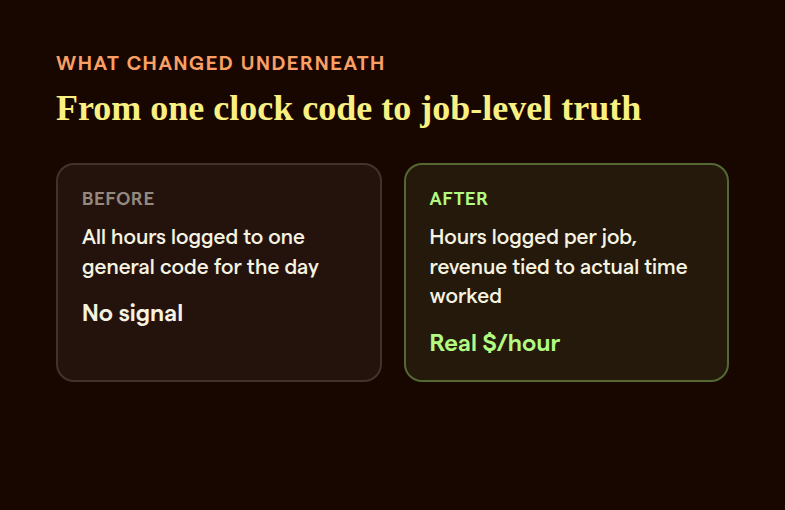
Technicians were clocking in and out of a single general time category for the day rather than logging time against the specific jobs they worked. That distinction sounds small until you try to build a commission plan on top of it. A plan that pays for productivity has to know how much revenue a crew produced relative to how many hours it took them to produce it. With time logged as one undifferentiated block per day, that calculation simply was not possible. The company could see what came in. It could not see what it cost to get it.
Flat time tracking hides exactly the thing you need to see
The absence of job-level time data does not just make a productivity metric hard to calculate. It actively erases the difference between a crew that is genuinely earning its pay and a crew that is not, because both crews look identical on a report that only shows total hours worked in a day. A fast, efficient crew that finishes three jobs before lunch and a slower crew that barely finishes two show up the same way on paper: hours logged, day complete. There is no signal anywhere in that data for which crew actually generated more revenue per hour of labor, which is the number that should be driving both pay and scheduling decisions.
There was a second, quieter problem sitting next to the time-tracking gap: callback and rework pay was ambiguous. When a crew had to return to fix something that was not done right the first time, there was no clean, formal way to track that separately from productive install work, which meant a crew's numbers could look artificially strong even when a meaningful chunk of their hours were spent correcting their own mistakes rather than producing new revenue.
None of this is unusual for a growing install-based business. Time tracking tends to get set up early, before anyone is thinking about incentive design, and it gets built for the simplest possible purpose: knowing who showed up and for how long. Nobody sits down on day one and asks whether the time system will eventually need to support a productivity-based commission plan, because on day one there is no commission plan yet to support. The gap only becomes visible once you are ready to actually pay for performance and discover the data underneath cannot tell performance apart from anything else.
Building a real productivity metric, then a plan on top of it
Working with ShareWillow, the company's first move was not to write a commission formula. It was to fix the time tracking underneath one, because no formula is worth building on data that cannot answer the question it is supposed to answer. The company introduced job-level time tracking, with a distinct clock-in category for delivery and install work, so hours could finally be tied to the specific job that generated them instead of blurred into one daily total.
With clean, job-level hours in place, ShareWillow built a revenue-per-hour productivity metric for each crew, calculated directly from job revenue and the hours actually logged against those jobs. That single metric is what finally let the company compare crews on equal footing. It also became the foundation for testing what a fair commission plan should look like, running historical payroll data through several commission-percentage scenarios, twenty percent, eighteen percent, fifteen percent, thirteen percent, to see how each rate would have paid out against real jobs the crews had already completed.
The company did not need to guess which crew was better. It needed a number that could prove it. Once job-level time tracking existed, the same jobs and the same pay structure revealed a productivity gap that had been invisible the entire time.
The company also formalized how callback and rework time gets handled, building a distinct tracking mechanism for jobs that require a return visit at no additional charge, so that a crew's productivity number reflects genuinely new work rather than time spent correcting a mistake. That distinction matters for fairness in both directions. It keeps a crew's numbers honest when things go wrong, and it protects a crew's incentive from being unfairly dragged down by rework that was not really their fault, once the tracking is specific enough to tell the difference.
What makes this approach durable is that none of it depends on a manager's impression of who works harder. The revenue-per-hour number comes straight from job data and time clock entries, the same inputs every week, calculated the same way every time. A crew does not need to trust a supervisor's judgment call about who is pulling their weight. They can look at the same number the owner is looking at, tied to jobs they can each name themselves.
That transparency is what turns a productivity metric into something a team can build a fair commission plan around, rather than a number management uses privately to make decisions nobody else understands. Once both crews could see the same revenue-per-hour figures, the conversation about commission stopped being about opinions and started being about a shared, visible number everyone agreed described reality.
Profit sharing
made simple.
Give your team a stake in the company’s success. ShareWillow helps you create and manage profit-sharing programs that motivate employees and drive business results.
What the data actually showed
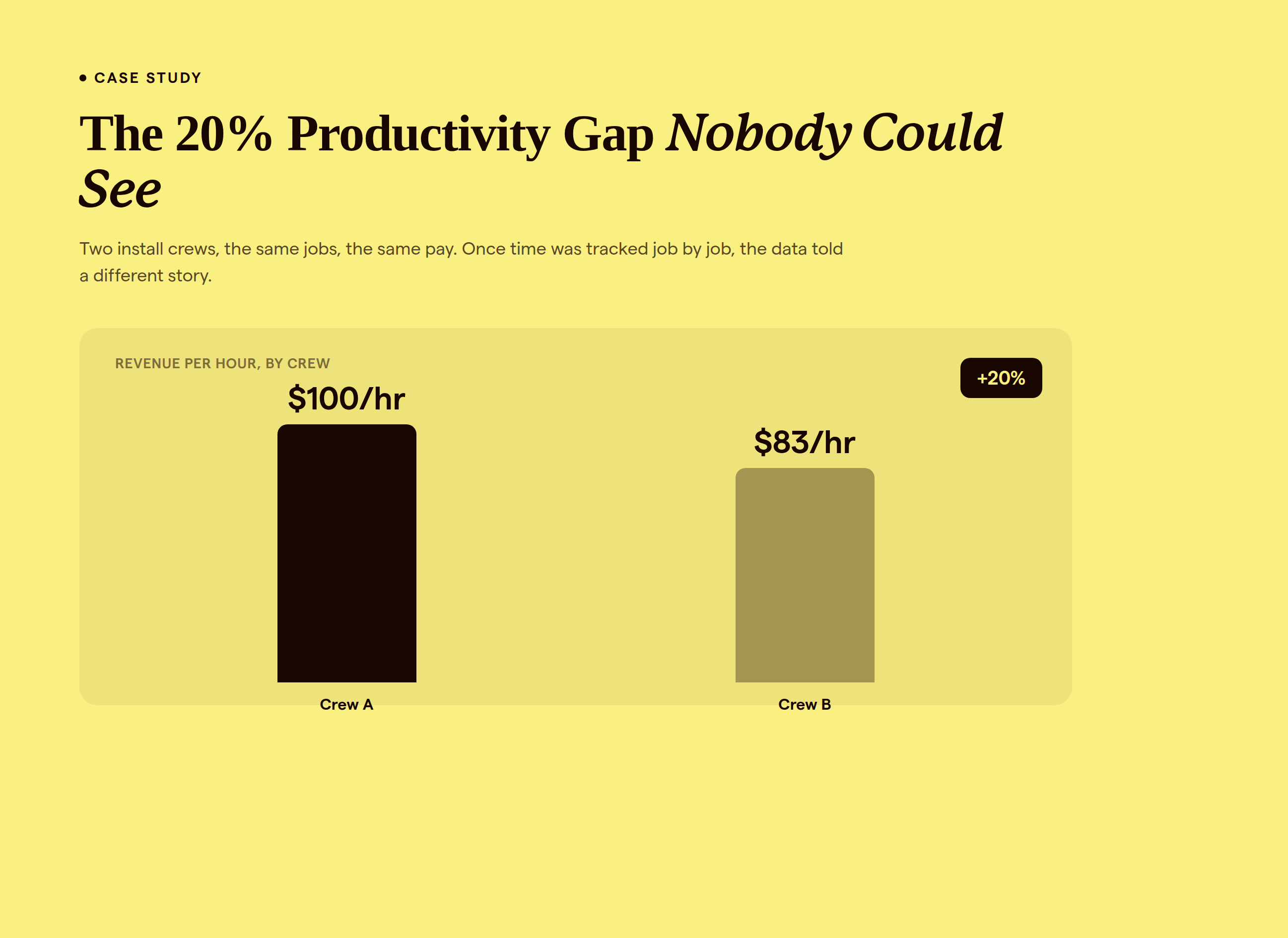
Once job-level time tracking was live and the revenue-per-hour metric was calculating cleanly, the gap between the two crews was not subtle. One crew was generating roughly one hundred dollars of revenue for every hour logged. The other was generating roughly eighty-three dollars an hour for the same kind of work, on the same pay structure, install jobs. That is a productivity gap of right around twenty percent between two crews the company had previously had no reliable way to tell apart.
It is worth sitting with what that twenty percent actually represents, because it is not a story about one crew being lazy and another being heroic. It is a story about what happens when you finally measure something you were previously guessing at. Neither crew was doing anything wrong under the old system, because the old system never told them there was a number to hit in the first place. A crew cannot close a productivity gap it does not know exists, and a company cannot fairly reward the crew that is actually earning more per hour if its own data cannot say which crew that is.
The company is now using that real productivity data, alongside the commission-scenario modeling run against actual historical payroll, to design a plan that rewards revenue per hour directly rather than paying every crew the same flat structure regardless of how efficiently they work. That is a meaningfully different starting point than most crews get. Instead of a commission plan built on assumptions about what feels fair, this one is being built on a real, job-level number every stakeholder can see and verify for themselves.
There is a broader lesson in how this unfolded that applies well beyond storm-panel installation. The instinct in a lot of small field service businesses is to build the incentive plan first and worry about the data later, because the plan feels like the important part and the data feels like plumbing. This company's experience suggests the order should run the other way. A commission plan is only ever as fair as the data feeding it, and if that data cannot tell two crews apart, no formula sitting on top of it will either, no matter how carefully the percentages are chosen.
What this means for your crews
If you run install crews, service teams, or any group of employees doing comparable work, and you have never actually measured revenue per hour by crew, you may be sitting on the same blind spot this company had. A few principles carry over directly.
- Track time at the job level, not the day level. A single daily clock-in tells you who showed up. It tells you nothing about which job, or which crew, actually earned its keep.
- Calculate revenue per hour before you calculate commission. A percentage-based bonus built on top of an unmeasured productivity gap will just pay the gap forward, rewarding the slower crew the same as the faster one.
- Separate rework from productive work. A callback should never quietly inflate a crew's hours in a way that makes a real productivity number impossible to trust.
- Model a plan against real historical data before you launch it. Testing several commission percentages against jobs that already happened is a far better foundation than picking a number that sounds reasonable and hoping it lands right.
- Let the whole team see the same number. A productivity metric only builds trust if everyone, not just management, can look at the same figures and agree on what they mean.
Most field service and facility service teams are not short on hardworking people. They are short on a clean way to measure who is actually producing what, which is exactly the gap that keeps a well-intentioned commission plan from ever working the way it was designed to. ShareWillow builds productivity metrics and incentive plans straight from the job and time data your crews already generate, the same approach that helped a route-based window cleaning company put a price on the growth behaviors flat pay was ignoring. Find out what your own crews' numbers would show, based on what we have learned from over 200 service businesses.
Related reading
Conclusion
You cannot reward the crew that is actually more productive if your time clock cannot tell you which crew that is.
Create incentives
that
drive results
You shouldn't need complex equity plans to align your team. ShareWillow makes it simple to create transparent profit-sharing programs that motivate employees and grow your business.

Incentive plans to help
small businesses thrive.
.png)
"I was able to leverage the knowledge of the ShareWillow team to learn how other companies were designing their bonus plans. The template was extremely helpful."

Brian Tustin
Owner, First Rate Movers
