
A growing handyman company was tracking upsells by memory, and some slipped through every month. Automating the tracking turned $80,000 in missed bookings into a $1,600 team bonus, built live on a single call.
Ask any handyman or home services owner how upsells get tracked day to day, and you'll usually get some version of the same answer: a tech mentions it to the office, or a customer calls back to book the extra work, and someone writes it down somewhere. It works, mostly, until it doesn't. A busy week, a tech who forgets to flag it, a CSR juggling six other calls, and an upsell that should have counted toward someone's bonus just quietly disappears from the record.
That was the exact gap facing a growing handyman services company running a team of technicians alongside a CSR and sales desk handling bookings. Upsells, the difference between a half-day job and a full-day job, were being tracked by memory. Some got caught. Some didn't. And every one that slipped through wasn't just a missed bonus for the team, it was missing revenue the business had actually earned but never fully credited anywhere.
Why "tracked by memory" always leaks eventually
This isn't a story about a disorganized team. It's what happens in almost every home services and handyman business once volume picks up. A tech on site notices the customer wants more done than originally scoped, an extra room, an additional fixture, a job that turns from a half-day into a full day. In a perfect world, that gets flagged immediately, logged accurately, and rolled into whatever bonus or commission structure rewards the team for growing the ticket. In practice, that flag depends entirely on a tech remembering to mention it and an office staffer remembering to record it correctly, both in the middle of a busy day full of other calls and other jobs.
Upsells were tracked by memory, and some slipped through. Every one that did was revenue the business had already earned but never got full credit for.
The cost of this isn't just the missed bonus for the tech who did the extra work. It's a quieter problem underneath that: when upsells go untracked, the business doesn't have an accurate picture of what its own team is actually capable of selling and delivering. The real production number is higher than what's on the books, but nobody can prove it, reward it, or use it to plan staffing and growth, because the data simply isn't there.
Why this hits growing teams hardest
A two or three person operation can sometimes get away with tracking upsells by memory, mostly because the owner is close enough to every job to catch what slips through. The moment a team grows past that, more techs, more jobs per day, a CSR desk handling a full call queue, the informal system stops working. Nobody is doing anything wrong. There are just too many moving pieces for memory alone to catch every qualifying upsell, every single week, without fail.
A few patterns tend to show up right before a growing team realizes this is happening:
- Techs mention upsells informally, but there's no consistent place those mentions get recorded.
- The CSR desk is measured on calls handled and jobs booked, not specifically on upsells captured, so nobody owns catching them.
- Bonus or commission calculations happen at the end of the month, off whatever notes made it into a shared doc.
- Nobody can say with confidence what percentage of eligible upsells actually got tracked versus missed.
None of that means the team is careless. It means the process was built around memory and goodwill instead of the job data that already exists. And any process built around memory will leak a little more each time the team gets busier, which is exactly the wrong direction for a growing business.
Automating the catch instead of relying on memory
The fix here didn't require asking techs to fill out more paperwork or asking the CSR desk to double-check every job by hand. It required job tags that automatically detect full-day and half-day upsells directly from the job data already being generated on every ticket. Once a job crosses from a half-day scope into a full-day scope, that gets flagged automatically, no manual note-taking required, no dependence on any one person remembering to log it correctly.
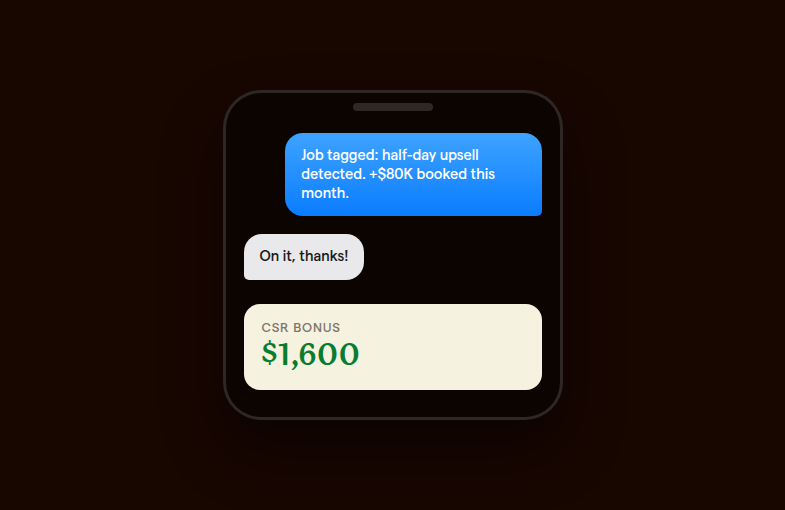
That single change removes the weakest link in the whole process, human memory under time pressure. The tag fires based on what's actually in the job record, so it catches every qualifying upsell consistently, whether it happened on a Tuesday morning or the busiest Friday afternoon of the month. Nobody has to remember anything. The system already knows.
Layered on top of that automatic detection is the second half of the plan: once bookings from these upsells cross a set threshold, it automatically triggers a bonus for the CSR and sales desk team who help drive and capture that additional work. This is the piece that often gets overlooked in performance pay plans built around field technicians only. The office team, the people booking jobs and coordinating with customers, plays a direct role in whether an upsell gets captured and closed. Rewarding only the tech in the field misses half the equation.
Built live, on the call, not months later
One detail worth calling out here, this plan wasn't the result of a long design process or weeks of back and forth. It was built live, during a single call, using the data the business already had sitting in its job records. That's a meaningfully different experience than the typical incentive plan overhaul, which tends to drag on for weeks while everyone tries to agree on thresholds, tiers, and edge cases before anything actually launches.
Because the tags plug directly into existing job data, there was no need to change how technicians did their jobs or how the CSR desk booked appointments. The tracking layer sits underneath the existing workflow and simply catches what was already happening, instead of asking the team to change their behavior to feed a new system.
That distinction, catching existing behavior versus asking for new behavior, is a big part of why this kind of plan tends to stick. Any incentive program that requires the team to change how they work before it can pay off is fighting an uphill battle from day one. A plan that just gets smarter about recognizing work already being done has nothing to fight against. It simply starts paying out for value that was always there.
There's also a trust benefit that's easy to underestimate. When a bonus depends on someone in the office remembering to log something correctly, a tech who feels shorted has a legitimate reason to wonder if the process is fair, even if nothing was done wrong. Automatic tagging removes that ambiguity. The bonus is tied to what's actually in the job record, visible to everyone, and calculated the same way every time. That consistency matters just as much as the dollar amount when a team is deciding whether an incentive plan is worth caring about.
Profit sharing
made simple.
Give your team a stake in the company’s success. ShareWillow helps you create and manage profit-sharing programs that motivate employees and drive business results.
The result: $80,000 in bookings, a $1,600 team bonus
With automatic job tagging live, $80,000 in additional bookings from full and half-day upsells triggered a $1,600 bonus for the CSR team. That number didn't come from a spreadsheet reconciliation weeks after the fact. It came from the job tags themselves, counted automatically as the work got booked and completed.

What's worth sitting with here is the gap between what this business was actually producing and what it had been able to prove and reward before the tags went live. $80,000 in upsell bookings is a meaningful number for a growing handyman operation. Before automatic tracking, an unknown share of that number was likely happening anyway, just uncredited, unrewarded, and invisible to leadership trying to understand what their team could really do.
It's also worth noting who the bonus rewarded. It wasn't only the techs finding the extra work in the field, it was the CSR and sales desk team turning that opportunity into a booked, completed job. Splitting credit that way tends to change behavior on both sides of the business at once. Techs have a reason to flag what they see, and the office has a reason to move fast on closing it, instead of treating the upsell as an afterthought to the main job.
For an owner or office manager reading this and wondering where to start, the honest answer is you probably don't need to build anything from scratch. The job data that would power a plan like this, scope changes, time on site, what got added to an invoice, is usually already sitting inside whatever scheduling or invoicing system the business runs on today. The work is connecting that existing data to a pay plan that actually uses it, not creating a new process for the team to adopt on top of everything else they're already doing.
What this means if your team relies on someone remembering
If your business, handyman, home services, or any trade where techs regularly spot upsell opportunities in the field, still depends on someone remembering to flag the extra work, you likely have a version of this same leak. It rarely shows up as a dramatic problem. It shows up as a slow trickle of missed credit that nobody notices because there's nothing to compare it against.
The fix isn't more oversight or more forms. It's connecting the incentive plan directly to the job data that's already being created, so upsells get caught automatically and the team, both in the field and in the office, gets rewarded for revenue they're already generating. For a closer look at how performance pay plans are structured across similar trades, ShareWillow's features page covers how job level tracking connects directly to pay, and the home services industry page has more on what this looks like specifically for handyman and home services teams.
Related reading
- From 340 Fake Hours to a Real Bonus: How a Landscaping Company Fixed Its Mowing Incentive
- The Window-Cleaning Company That Has Paid Performance Pay Every Week for 23 Weeks Straight
- 11 Types of Employee Incentives (And How To Use Them)
- 7 Profit Sharing Plan Examples for Your Small Business
- Technician Upsell Commission: How a Pest Control Company Is Paying on the Increase Over the Expected Sale, Not the Whole Ticket
Conclusion
The upsell was always there. The company just needed a way to catch it automatically instead of hoping someone remembered.
Create incentives
that
drive results
You shouldn't need complex equity plans to align your team. ShareWillow makes it simple to create transparent profit-sharing programs that motivate employees and grow your business.

Incentive plans to help
small businesses thrive.
.png)
"I was able to leverage the knowledge of the ShareWillow team to learn how other companies were designing their bonus plans. The template was extremely helpful."

Brian Tustin
Owner, First Rate Movers
