
When production slipped for a month at a commercial refrigeration and HVAC company spanning three states, nobody could pinpoint why. Here's how live performance tracking found the answer and got payouts running in weeks, not quarters.
Running a service business across a single market is hard enough. Running one across three states multiplies every blind spot you already have. That's the situation a commercial refrigeration and HVAC service company found itself in: technicians spread across multiple regions, each market with its own rhythm, and one month where production quietly slipped and nobody in leadership could say exactly why.
Was it a specific market having a rough stretch? Was it a handful of techs having an off month? Was it seasonal, or was something actually broken in how work was getting scheduled and closed? The honest answer was nobody knew, because nobody had a way to see performance broken down cleanly enough to tell the difference between normal seasonal noise and a real problem that needed fixing.
The visibility gap that grows with every new market
This is a pattern that shows up constantly in HVAC and commercial refrigeration businesses once they cross from a single location operation into something spanning multiple markets. The reporting that worked fine for one location, a shared spreadsheet, a monthly rollup call, a gut check conversation with each market lead, stops working once there are three states, different customer mixes, and technicians who never cross paths with each other.
By the time a slowdown shows up in the monthly revenue number, it's already a month old. Nobody can say whether it was one underperforming tech, a batch of longer than usual callbacks eating into billable time, or a shift in average ticket size across a specific region. The data existed somewhere, buried across dispatch software, invoices, and whatever spreadsheet someone was maintaining that quarter. It just wasn't assembled anywhere a leader could look at it and immediately understand what changed.
Production slipped for a month, and no one could say why. That's not a performance problem. That's a visibility problem.
And visibility problems are dangerous precisely because they don't announce themselves. A single bad month can look like noise. Two bad months start to look like a trend, but by then you've lost two months of margin trying to figure out what's actually wrong. Multiply that lag across three states and it gets very easy to lose track of which market, which crew, or which specific metric is the actual source of the slip.
Why this hits multi-market operators harder
Owners who run a single shop in a single town develop an intuition for their business almost by osmosis. They see the trucks, they know the techs, they hear the customer complaints directly. That intuition doesn't scale. Once a business crosses into a second or third state, the owner isn't in the room for most of what happens day to day, and the tools that used to substitute for that intuition, a spreadsheet, a weekly call, stop being fast enough or granular enough to catch a problem while it's still small and fixable.
A few signs tend to show up right before a business realizes it has a visibility gap like this one:
- Monthly numbers move, but nobody can point to a specific cause without a lot of digging.
- Different markets report performance in slightly different formats, so comparing them apples to apples takes manual work every time.
- The first place a slowdown gets noticed is the bank account or the revenue report, not a technician level number that would have flagged it weeks earlier.
- Facility managers and regional leads are making decisions off numbers that are already a few weeks stale by the time they see them.
Any one of those on its own is manageable. Two or three of them stacked together, across multiple states, is how a month can slip without a clear explanation. It's rarely one dramatic failure. It's a handful of small blind spots compounding at the same time.
Building live tracking instead of monthly guesswork
The fix wasn't a bigger reporting meeting or a new dashboard nobody would check. It was building live tracking of the three metrics that actually explain performance at the technician level: revenue, average ticket, and callbacks, tied directly into the incentive plan technicians are paid on. Instead of leadership waiting for a month end rollup to spot a problem, the numbers are visible as they happen, at the individual level, across every market.
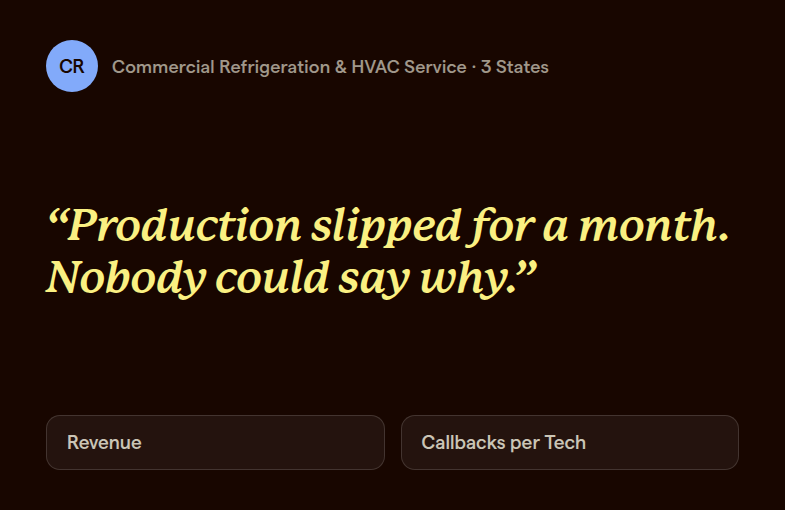
That combination of metrics matters. Revenue alone tells you volume, not health. Average ticket tells you whether jobs are being priced and closed well, or whether techs are leaving money on the table. Callbacks tell you whether the work being billed is actually holding up, since a high callback rate quietly erases the value of every job that has to get redone for free. Track all three together, at the technician level, and a slowdown stops being a mystery. It becomes a specific, visible pattern: this tech, this market, this metric, this week.
Building this into the performance pay plan itself, rather than a separate reporting tool, was the part that made it actually get used. When the same numbers that explain performance are also the numbers technicians are paid on, everyone is looking at the same dashboard for the same reason. There's no separate management report that techs never see and no separate tech scorecard that management ignores. It's one shared set of numbers.
This also solves a quieter problem that shows up whenever a company tries to run two different systems side by side, one for performance tracking and one for pay. The two almost never stay in sync for long. A metric gets redefined in one system and not the other, a report gets built for a specific meeting and never updated again, and within a few months the "official" performance numbers and the "official" pay numbers tell two different stories. Collapsing them into one system removes that failure mode entirely.
It's worth being specific about why these three metrics, and not some longer list of a dozen KPIs, were the right starting point. More metrics isn't automatically better. A scorecard with fifteen numbers on it tends to get ignored by the people it's supposed to guide, because nobody can hold fifteen priorities in their head while they're standing in front of a customer. Revenue, average ticket, and callbacks were chosen because together they cover volume, quality of the sale, and durability of the work, which is enough to explain almost any performance swing without burying anyone in noise.
Why three states made this harder, and why it still worked
Rolling this out across multiple markets could have been the hard part. Different regions, different customer bases, different crew sizes. But because the tracking lived at the technician level rather than the market level, it scaled cleanly. A technician in one state is measured the same way as a technician in another. Leadership can compare markets apples to apples instead of trying to normalize three different spreadsheets that were never built to talk to each other in the first place.
That consistency is what let this get built and rolled out without a long, drawn out implementation. There was no multi month integration project and no long term contract required to get it running. The plan connected to the numbers the business already had, and made them visible and actionable instead of buried in a month end close process.
Profit sharing
made simple.
Give your team a stake in the company’s success. ShareWillow helps you create and manage profit-sharing programs that motivate employees and drive business results.
The result: payouts running by week four, no manual math
Once the plan was live, the company had its first payouts running by week four, with no manual math required to get there. That detail matters more than it sounds like at first. A lot of performance pay plans fail not because the idea is wrong, but because the plan is too complicated to actually calculate and pay out consistently. If getting a tech their bonus check requires someone in the office to rebuild a spreadsheet every pay period, that plan eventually gets abandoned or run inconsistently, and inconsistency is what kills trust in any incentive program faster than almost anything else.
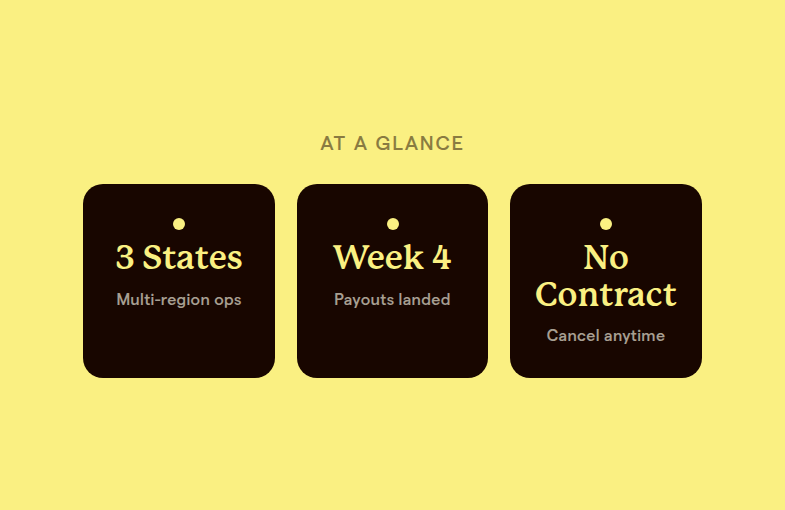
Here, the payout math runs on the same live tracking that surfaces the performance data in the first place. Revenue, average ticket, and callbacks feed straight into what a tech earns, so there's no lag between doing the work and seeing it reflected in a paycheck, and no lag for leadership between a market slipping and that slip showing up somewhere visible.
There's a second, quieter benefit that showed up once the plan was running: leadership finally had a clean answer the next time a month looked soft. Instead of guessing whether it was seasonal, whether it was one market, or whether something needed real attention, the technician level data made the answer obvious within days, not weeks. That's the actual value of live tracking. It's not just about paying people accurately, it's about giving ownership a fast, honest read on the business instead of a delayed one.
For a facility manager or regional lead specifically, this kind of live tracking changes what a weekly check in actually looks like. Instead of asking a market lead to explain a soft number from memory, the conversation starts from the same real time data everyone already has in front of them. That turns a defensive conversation into a problem solving one, because nobody is arguing about whose numbers are right.
What this means if you're scaling across markets
If you're running a field service business that's grown past a single location, whether that's HVAC, commercial refrigeration, plumbing, or any other trade covered under HVAC and related industries, this is the exact moment most owners lose their grip on performance visibility without realizing it. What worked as a spreadsheet at one location doesn't survive contact with a second or third market. The fix isn't a bigger spreadsheet. It's building the tracking and the pay plan around the same live numbers, at the technician level, so a slowdown gets caught in week two instead of discovered a month later with no explanation attached.
For HVAC pros and facility managers weighing how to keep visibility intact while scaling, it's worth looking at how other field service and construction businesses have handled the same growing pains. The pattern repeats across trades: visibility and pay need to live in the same place, or performance quietly slips through the cracks between them.
ShareWillow builds performance pay plans that plug directly into the metrics multi location service businesses already track, so you're never waiting on a monthly close to find out something changed.
Related reading
Conclusion
You can't fix what you can't see, and most shops can't see performance until it's already too late to change it.
Create incentives
that
drive results
You shouldn't need complex equity plans to align your team. ShareWillow makes it simple to create transparent profit-sharing programs that motivate employees and grow your business.

Incentive plans to help
small businesses thrive.
.png)
"I was able to leverage the knowledge of the ShareWillow team to learn how other companies were designing their bonus plans. The template was extremely helpful."

Brian Tustin
Owner, First Rate Movers
