
Learn how to pay plumbing technicians fairly: see how one home service company fixed a commission timing bug and closed a $1,700 payroll gap for good.
If you're trying to figure out how to pay plumbing technicians in a way that's fair, motivating, and doesn't blow up your payroll spreadsheet every other week, you're not alone. Commission-based pay is one of the most common structures in the trades, but it's also one of the easiest to get wrong. One multi-trade home services company running HVAC, plumbing, and electrical work found that out the hard way when a routine sewer-dig job turned into a nearly $1,700 payroll discrepancy for one of its plumbing technicians, and the root cause wasn't fraud or a bad employee. It was a timing problem buried inside the pay structure itself.
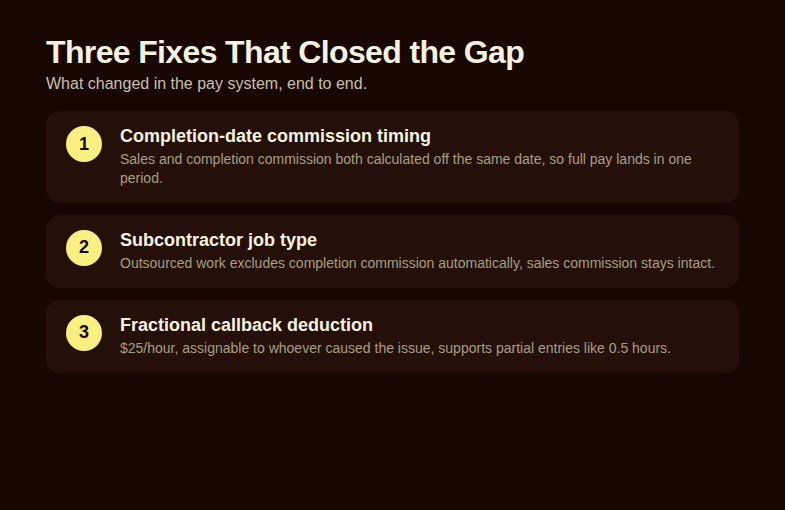
This article walks through how that company figured out what was going wrong, how they fixed it, and what any home service company can borrow from their approach when deciding how to pay plumbing technicians fairly, whether you use commission, hourly, or a blend of both. Here's a quick look at the three changes that closed the gap, explained in detail below.
How to Pay Plumbing Technicians: Commission vs. Hourly Pay
Most home service companies land on one of three general approaches when they set up pay for plumbing technicians.
- Flat hourly: simple and predictable, but it doesn't reward technicians for selling additional work or closing bigger jobs, which can leave your best performers feeling capped.
- Commission-only: technicians earn a percentage of what they sell and complete, which ties pay directly to production, but it can create wide swings in take-home pay and, as you'll see below, gets complicated fast when jobs involve multiple technicians or outside labor.
- Hybrid or "greater of" pay: technicians get a guaranteed hourly base and then earn whichever is higher between their hourly total and their commission total for the period, which smooths out income while still rewarding production.
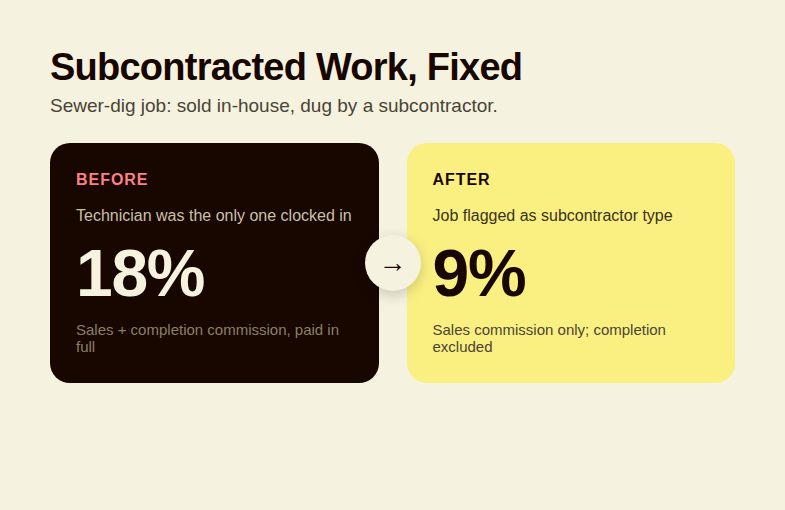
The multi-trade company in this story used a commission structure: plumbing technicians earned 9 percent commission on the revenue they sold and another 9 percent commission on the revenue they completed, meaning a technician who both sold and performed the work could earn 18 percent total on a job. That structure works well in theory. In practice, it depends entirely on the payroll system correctly tracking who sold what and who actually did the work, and that's where things started to fall apart.
Why Pay Timing Matters: Sale Date vs. Completion Date
The first crack in the system wasn't about the commission rate at all. It was about timing. Sales commission was calculated based on the original sale or report date, while completion commission was calculated using a different date entirely. On a job that got sold one week and finished the next, the two halves of a technician's commission could land in different pay periods and never fully reconcile against each other.
For the plumbing technician at the center of this story, that timing mismatch showed up clearly across two consecutive pay periods. In one week, he had about $5,004.73 in completed revenue attributed to him, which at the standard commission rate should have produced roughly $985 in payout. He was actually paid $2,666 that period, a number that didn't map cleanly to either the sales or completion side of the formula. The following week, he had about $25,008.58 in completed revenue, which at the full 18 percent rate should have produced around $4,004.74. He was paid about $2,700. Add it up across the two periods and the technician was shorted by roughly $1,700 compared to what the math said he should have earned, not because anyone was trying to shortchange him, but because the system had no single, consistent date to anchor commission calculations to.
This is a mistake that's easy to make and easy to miss, because both halves of the commission still get paid eventually, just not in a way that lines up on any one paycheck. If you're setting up or auditing how to pay plumbing technicians on commission, the fix is straightforward in concept even if it takes some rebuilding to implement: anchor both the sales commission and the completion commission to the same date, ideally the job's completion date, so the full commission on a job lands in one predictable pay period. Companies that have gone through a similar rebuild, like the one described in this plumbing company's tiered pay plan overhaul, tend to find that clean, consistent timing rules do more to reduce payroll disputes than changing the commission rate itself ever could.
How to Handle Commission on Subcontracted or Outsourced Work
The bigger and more expensive problem at this company had nothing to do with timing and everything to do with how the field service software attributed labor. On the sewer-dig job that triggered the whole investigation, the actual digging was subcontracted out to a third-party crew. The plumbing technician handled the sale, which correctly earned him 9 percent. But because he was the only person clocked into that job inside the field service software, the system also credited him the full 9 percent completion commission, as if he'd done the physical work himself. That pushed his payout on that job to the full 18 percent when he should only have received the 9 percent sales portion.
This is a version of a problem that shows up constantly in home service businesses that mix in-house labor with subcontracted or outsourced work: your payroll math is only as good as your job classification. If a job type doesn't distinguish between "we did this" and "we sold this and handed it to someone else," your commission system will happily pay full completion commission to whoever happens to be logged into the job, regardless of who actually swung the shovel.
The company's fix was to build a distinct job type, specifically labeled as a subcontractor category (their example was "sewer dig subcontractor"), so that any job flagged this way automatically excludes the completion-commission portion while still preserving the technician's sales commission. That one change closed the double-pay hole for good, and it's a pattern worth copying if your company regularly outsources digging, duct work, or any other specialty labor. The same discipline around clearly defined commission categories shows up in this plumbing company's incentive plan rebuild, where getting the categories right mattered as much as getting the percentages right.
Fair Callback Pay for Plumbing Techs
The third piece of the puzzle was callback pay, and it followed a similar pattern: a reasonable policy undermined by a system that couldn't apply it correctly. The company's standard was simple enough on paper. A technician who has to return to fix a callback caused by someone else's work earns $25 per hour for that return trip, since it isn't their fault the customer needs a second visit. A technician who has to return to fix their own callback earns $0, since that return trip is on them to make right.
The problem was that the system only ever attributed callbacks to the original lead technician on the job, regardless of who actually caused the issue or who was the one who drove back out to fix it. That meant the $25/hour versus $0 distinction, which was supposed to be a fairness mechanism, wasn't actually being applied based on fault. It was being applied based on whoever's name happened to be attached to the original ticket.
The fix here was less about rebuilding a formula and more about giving humans a way to make the call correctly. The company added a manual, fractional callback-deduction field, supporting partial entries like 0.5 hours, so office staff or managers could assign callback responsibility to whoever actually caused the issue and pay whoever actually returned to fix it, instead of defaulting blindly to the lead technician. It's a small addition, but it's the kind of granular control that separates a commission system that feels fair from one that just feels automated.
Profit sharing
made simple.
Give your team a stake in the company’s success. ShareWillow helps you create and manage profit-sharing programs that motivate employees and drive business results.
Building Transparency Technicians Can Trust
None of these fixes would have mattered much if the technician still had to take the office's word for it every payday. So the company added one more piece: self-service visibility into pay periods inside the payroll app, so the plumbing technician could see exactly how each dollar of his paycheck was calculated, sales commission, completion commission, subcontractor exclusions, and callback deductions, all broken out instead of collapsed into one lump number. That kind of transparency turns "trust me" into "check for yourself," which matters enormously in a role where pay disputes can quietly erode morale long before anyone files a complaint.
The results were concrete. The roughly $1,700 reconciliation gap across those two pay periods was traced to its source and closed. The 18 percent versus 9 percent double-commission error on subcontracted work was eliminated going forward, protecting the company's margins on every job it outsources. And the technician gained a transparent, self-service way to verify his own pay, which turned a recurring source of friction into a system both the owner and the technician actually trust. If you're building or fixing a bonus or commission structure for any role, not just plumbing, this step-by-step guide to calculating bonus pay correctly is a solid place to check your math against.
If your company is still deciding how to pay plumbing technicians, or you suspect your current setup has a similar timing or classification gap hiding in it, the underlying lesson from this case study applies broadly across HVAC, plumbing, and electrical teams: the commission rate you choose matters less than whether your system can consistently and correctly apply it. A generous plan that pays inconsistently will frustrate technicians faster than a modest plan that pays predictably. Explore how purpose-built profit-sharing and incentive pay software handles this kind of job-level nuance automatically, or see how the same principles apply across other home service industries beyond plumbing.
FAQ
Should plumbers be paid commission or hourly?
Many home service companies use a hybrid approach: a guaranteed hourly base combined with commission on sales and completed work, so technicians get income stability plus a direct incentive to produce. Pure commission can work well for experienced, high-producing technicians, but it requires very clean job tracking to stay fair, as the timing and subcontractor issues in this article show.
How much commission should a plumbing technician get?
There's no single right number, but a common structure splits commission between the sale and the completion of a job, such as 9 percent for selling and 9 percent for completing, for up to 18 percent total when one technician does both. The right rate depends on your margins, your average ticket size, and how much of the sales process the technician actually controls.
How do you pay a plumber on a subcontracted job?
When a job is sold by your technician but the actual labor is outsourced to a subcontractor, the technician should typically still earn the sales commission but not the completion commission, since they didn't perform the work. That requires a job type or flag in your system that automatically excludes completion pay on subcontracted work, otherwise you risk paying full commission twice, as this company discovered.
Related reading
- The Plumbing Company Where 90 Percent Of Techs Got A Raise
- From Pennies to a $3,000 Bonus: One Plumbing Company's Incentive Plan Rebuild
- How to Calculate Bonus Pay: A Step-by-Step Guide to Fair and Motivating Compensation
- HVAC Commission Pay: How to Design a Plan That Drives Profit (Not Problems)
- Plumbing Labor Cost Percentage: How a Leak Detection Company Held Payroll at 25%
- How to Pay HVAC Helpers and Apprentices: A 26-Person Plumbing and HVAC Company's Fix for a 'One-Size-Fits-All' Bonus Plan
- Plumbing Commission Structure: How a Plumbing Company Split a 22% Pool Between the Seller and the Techs Who Finish the Job
- Plumbing Technician Minimum Pay: How a Plumbing Company Raised Its Weekly Floor From $600 to $900 and Fixed a $3,000 Add-On Commission Error
Conclusion
One timing fix turned a $1,700 payroll dispute into pay both the owner and the technician trust.
Create incentives
that
drive results
You shouldn't need complex equity plans to align your team. ShareWillow makes it simple to create transparent profit-sharing programs that motivate employees and grow your business.

Incentive plans to help
small businesses thrive.
.png)
"I was able to leverage the knowledge of the ShareWillow team to learn how other companies were designing their bonus plans. The template was extremely helpful."

Brian Tustin
Owner, First Rate Movers
