
A service manager bonus plan built on a metric nobody trusted, until an HVAC company audited the data and built a monthly, auditable process both sides believe.
Building a service manager bonus plan sounds simple until the numbers show up and nobody agrees with them. That's exactly what happened at an HVAC company that tied part of its service manager's monthly bonus to something called estimate success rate: the percentage of estimates a service manager provides to customers that get properly logged and credited to them. The target was 95%. One month the report came back at 75%, a number that looked like a performance problem serious enough to put real pay on the line. It wasn't. It was a data problem, and fixing it changed how the company builds every incentive plan since.
If you're building or troubleshooting a service manager bonus plan of your own, this is the story to read before you finalize your metrics, because the lesson isn't about estimates specifically. It's about what happens when a bonus plan measures something the underlying system wasn't built to track cleanly.
What Metrics Should a Service Manager Bonus Plan Use?
Before you can trust a number, you have to pick the right one. A good service manager bonus plan rewards things the service manager actually controls, not company-wide outcomes they can only nudge. A few metrics that tend to hold up:
- Estimate follow-through: did the service manager present the estimate and get it logged correctly, not just verbally quoted
- Close rate: how many presented estimates turn into booked work
- Callback or quality rate: how often a job has to be revisited for something that should have been caught the first time
- Team scorecards: a blended view across several direct reports, useful when a service manager's real job is coaching technicians rather than running calls themselves
For a broader look at how these pieces fit together across a whole team, ShareWillow's guide to HVAC technician incentives walks through the most common structures companies use. Whatever you choose, the metric only works if the underlying data collection is airtight, which is exactly where this company's plan first ran into trouble.
The mix also shifts depending on how the role is actually structured across different home service industries. A service manager at a small HVAC company might run calls and manage two technicians. At a larger plumbing or electrical company, the role might be almost entirely coaching and dispatch oversight. Either way, the plan needs a metric the person in that seat can actually move, and a system that logs it accurately enough to pay against.
Why Bonus Metrics Fail: Attribution vs. Performance
The HVAC company's estimate success rate was supposed to be straightforward: of all the estimates a service manager delivered to a customer in a given month, what percentage got marked "provided" in the job system. Hit 95% and the metric pays out in full.
One month, the number came back at 75%, just 3 of 4 estimates credited. On its face, that looked like a real drop in performance, and it put the service manager's bonus, and their trust in the plan, at risk.
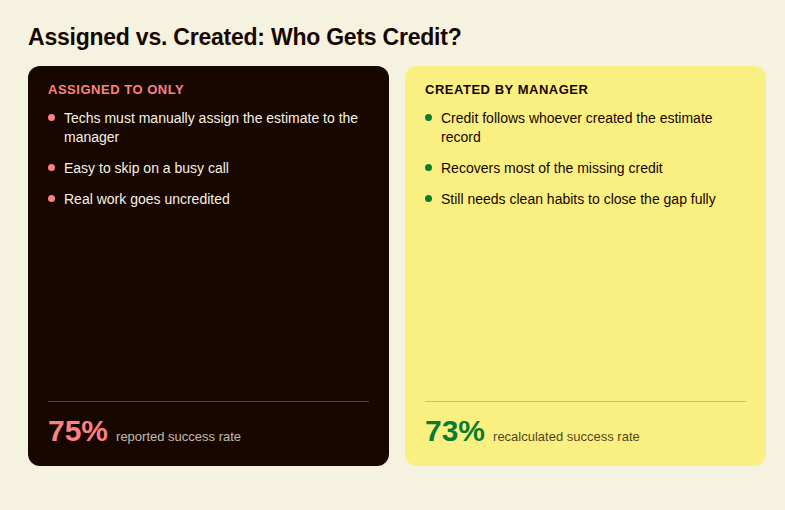
When the owner sat down with their software partner to dig into the raw data, the picture changed fast. The problem wasn't that the service manager had stopped doing the work. It was that the work wasn't being counted. Field technicians weren't consistently assigning estimates to the service manager who actually delivered them, so credit was landing on the wrong person or nobody at all. Technicians also weren't always clicking "estimate provided" in the system after a real conversation with the customer, which meant legitimate estimates simply never entered the numerator. On top of that, the dataset was cluttered with duplicate and abandoned estimates: a tech would create one estimate, then create a second one for the same job without deleting the first, leaving orphaned records that dragged the percentage down further.
This is a more common failure mode than most owners expect. A metric can look like a performance issue when it's actually an attribution issue, and if a company acts on the number without checking where it came from, it ends up punishing good work instead of measuring it. That's close to what almost happened in a different HVAC company's dispatch operation, where a broken KPI nearly cost a dispatcher a raise before anyone traced the number back to how it was being logged.
How to Audit a Bonus Metric Before You Trust It
Before assuming the 75% was real, the owner and their software partner ran a test: what if the service manager were credited based on who created the estimate in the system, rather than only who it was assigned to? That single change recovered most of the gap, pushing the number up to around 73%, close to the original 75% but not a full fix.
That result mattered, because it proved the problem wasn't just a mapping error that a formula change could patch. The gap that remained was procedural: technicians in the field simply weren't following the habits that make the data trustworthy in the first place. No attribution rule can fix an estimate that never got marked "provided" at all.
If you're auditing your own service manager bonus plan, this is the sequence worth following:
- Pull the raw, underlying records behind the metric, not just the summary percentage
- Test an alternate attribution rule (created versus assigned, technician versus manager) to see how much of the gap is a data-mapping issue
- Look for duplicates, abandoned records, and anything that should have been deleted but wasn't
- Separate what's left into "the number is wrong" versus "the behavior needs to change"
Skipping this step is how companies end up eroding trust in every bonus plan they roll out afterward, not just the one with the bad number.
Building a Monthly Review Process That Builds Trust
A one-time audit fixes one month. It doesn't fix the plan. So the company built a simple, repeatable process around the metric instead of just re-running the numbers once and moving on.
First, they wrote a standard operating procedure for pulling the monthly estimate-success report: filter by employee, filter by month, pull it the same way every time so the number is comparable month over month.
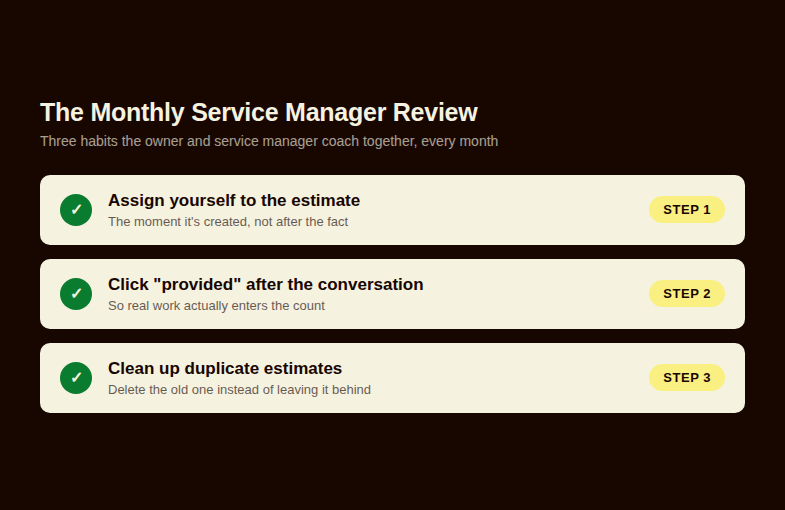
Second, they set up a recurring monthly review meeting where the owner and the service manager go through the data together. Instead of the service manager finding out their bonus number after the fact, they see it with the owner, in context, with the ability to flag what looks wrong. The meeting is also where the real coaching happens: assign yourself to the estimate the moment you create it, click "provided" as soon as the conversation with the customer happens, clean up duplicate estimates instead of leaving the old one sitting in the system.
That combination, a clean pull process plus a standing conversation, is what turns a bonus metric from a monthly surprise into something both sides actually believe. It's a similar dynamic to what happened when another HVAC company put its technician bonuses on a shared leaderboard and adoption of the incentive program nearly tripled once the team could see the numbers themselves instead of waiting for a payout to explain them.
Profit sharing
made simple.
Give your team a stake in the company’s success. ShareWillow helps you create and manage profit-sharing programs that motivate employees and drive business results.
The Result: A Bonus Metric Both Sides Trust
The measurable outcome wasn't just a better percentage. It was a different relationship with the number itself. Instead of a bonus metric nobody trusted and a service manager at risk of losing pay for work they had actually done, the company now has an auditable, repeatable monthly process both the owner and the service manager review together, a real baseline number to work from (not one artificially depressed by attribution gaps and system clutter), and a clear path to a pay increase once the clean number consistently clears the 95% target.
That last part is the piece owners tend to underrate. A service manager bonus plan doesn't build trust because the number is high. It builds trust because both people believe the number is real. Once that's true, the conversation shifts from "is this metric fair" to "how do we hit it," which is the conversation you actually want to be having.
There's a retention angle here too. A service manager who suspects the number tracking their bonus is broken doesn't just lose a month of pay, they lose confidence in the whole comp plan, and that's the kind of thing that quietly pushes good people to look elsewhere. An auditable process costs an hour a month. Losing a trusted service manager costs a lot more than that.
If you're setting up a service manager bonus plan from scratch, or auditing one that already feels shaky, ShareWillow's platform features are built around exactly this kind of clean, auditable metric tracking, so the monthly review looks like the one described here instead of a guessing game.
What should a service manager bonus be based on?
Base it on metrics the service manager directly controls, like estimate follow-through, close rate on presented estimates, and callback or quality rate, rather than company-wide revenue they can only indirectly influence. A blended team scorecard works well when their role is mostly coaching technicians.
How much bonus should a service manager get?
There's no single right number, but most home service companies structure service manager bonuses as either a percentage of a defined pool or a flat amount tied to hitting specific thresholds, often landing somewhere between a few hundred and a couple thousand dollars a month depending on company size and role scope. What matters more than the exact figure is that the underlying metric is one both the owner and the service manager trust.
Why does my bonus metric not match what my service manager actually did?
The most common cause is attribution, not performance: work getting logged under the wrong name, marked incomplete when it wasn't, or lost to duplicate records. Before assuming a low number reflects a real problem, pull the raw data behind it and test whether crediting the person who created the record versus the person assigned to it changes the outcome.
Related reading
Conclusion
A trusted service manager bonus plan starts with data both sides can audit, not a number nobody believes.
Create incentives
that
drive results
You shouldn't need complex equity plans to align your team. ShareWillow makes it simple to create transparent profit-sharing programs that motivate employees and grow your business.

Incentive plans to help
small businesses thrive.
.png)
"I was able to leverage the knowledge of the ShareWillow team to learn how other companies were designing their bonus plans. The template was extremely helpful."

Brian Tustin
Owner, First Rate Movers
