A 9-person Texas HVAC company didn't trust its own efficiency data. Verifying it first led to a rebuilt biweekly pay plan and a team payout that grew 31 percent.
Sixty-five percent. That was the billable efficiency number ServiceTitan was showing for the technicians at a small, independent HVAC company in Texas, and it was low enough to worry the owner without being low enough to fully explain. A number like that usually means one of two things: either the crew genuinely is spending a third of every day not doing billable work, or the number itself is wrong. Before this company brought ShareWillow in to rebuild its pay structure, nobody could say for certain which one it was, and that uncertainty is a bad place to build a bonus plan from.
The owner's instinct, and the right one, was to suspect the data before the technicians. A price-book misconfiguration, a mistagged job type, or a setup issue in how ServiceTitan calculated billable hours could easily produce a number that looked like underperformance without any tech actually doing anything wrong. Paying or withholding a bonus based on a number nobody trusted was worse than having no bonus tied to efficiency at all, so before any new plan went live, the priority was validating that 65 percent figure against the company's own master pay files rather than accepting it at face value.
Validating the number meant pulling ServiceTitan's billable-hours calculation apart and checking it line by line against what the company's own master pay files actually showed for each technician. That kind of reconciliation is tedious, unglamorous work, the sort of task that is easy to skip when a plan feels ready to launch and everyone is eager to get it in front of the crew. Skipping it here would have meant building a bonus formula on top of a number that might have been wrong from the start, and a technician who gets shorted because of a software misconfiguration is just as unhappy as one who gets shorted for any other reason. The reconciliation did not resolve the question with a single clean answer either way. It surfaced enough inconsistency in how certain job types were tagged that the company and ShareWillow agreed the metric needed tighter definitions before it could safely anchor a bonus, which is exactly the kind of finding that never makes it into a highlight reel but quietly protects everyone the plan is supposed to reward.
A Pay Cadence Built For Visibility, Not Just Speed
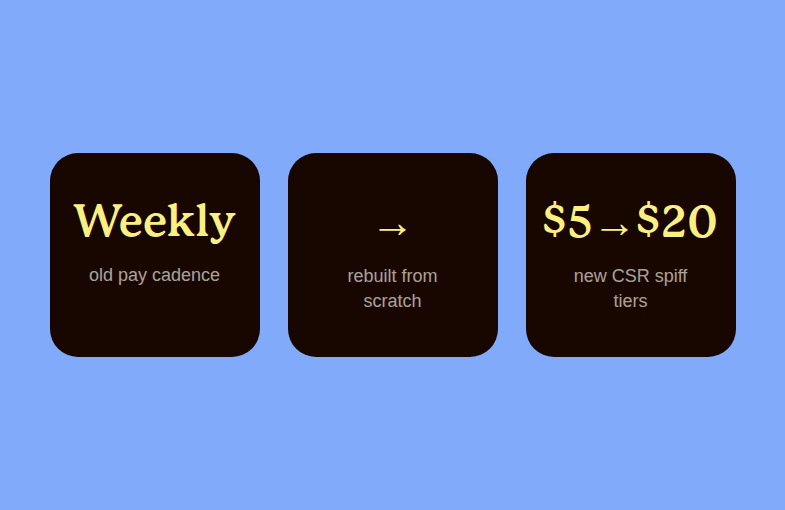
The company's technician pay had been running on a simple weekly cycle, which sounds like a benefit for the crew, faster money, but in practice gave the owner limited visibility into whether payouts were landing correctly before they went out the door. ShareWillow rebuilt the structure around a biweekly cycle instead, with a full historical backfill so the transition did not create a gap or a confusing jump in anyone's pay. A two-week window gives the office enough time to actually check the numbers behind a payout before it happens, rather than discovering a mistake after the money is already gone and having to claw it back or explain a shortfall after the fact.
That single change, weekly to biweekly, is easy to undersell because it does not sound like an incentive redesign at all. But it was the foundation everything else got built on. A company that cannot trust its own payout cadence has no business layering tiered commissions and bonus pools on top of it. Slowing the cycle down just enough to verify it, without losing the responsiveness that makes a bonus plan feel real to the technicians earning it, was the first problem ShareWillow had to solve before touching anything else.
Four Technicians, A Team Payout That Kept Climbing
Once the biweekly cadence was live and the underlying data had been checked, the results showed up quickly. In the pay period running January 11 through January 24, the company's four-person service technician plan paid out a combined $5,515.25. The next period, January 25 through February 7, came in slightly lower at $4,814.47, a reminder that a real incentive plan moves with real job volume and does not climb in a straight line just because the structure improved. By the period ending March 7, the same four-technician team posted a combined payout of $7,240.48, the highest of the periods on record, a 31 percent increase over the first confirmed cycle. The period after that settled back to $5,648.21, still well above where the plan started.
That pattern, a jump followed by a dip and then another strong period, is exactly what a healthy incentive plan should look like once the data behind it can be trusted. A number that only ever goes up is usually a sign nobody is checking it closely enough. A number that moves with the actual work, and that the owner can now verify two weeks at a time instead of finding out about after the fact, is a sign the underlying reporting is finally doing its job.
It also matters that this was a small team. Four technicians is not a lot of room for a bad month to hide in. A single missed job or one slow week shows up immediately in a combined team number that size, which is part of why the dip between the January 25 to February 7 period and the following March high looks as sharp as it does on paper. For a shop this size, an incentive plan lives or dies on whether the owner and the crew both trust the number driving it, since there is no large roster to average a bad reading away.
A Spiff Program Built From Nothing
Technicians were not the only role that needed a rebuild. Before ShareWillow, customer service representatives had no formal incentive at all for after-hours bookings, the calls that come in outside normal business hours and often require the most persistence to convert into a scheduled job. ShareWillow built a tiered CSR spiff from scratch: five dollars for every after-hours job successfully booked, rising to twenty dollars if the technician who ran that job sold over $500 on the visit. The tiered structure ties the CSR's incentive directly to the outcome of the call, not just the fact that it got answered, so a CSR who books a job that turns into real revenue earns more than one who books a job that goes nowhere.
On top of the technician and CSR plans, ShareWillow also built a new manager bonus pool, weighted roughly 30 percent on technician utilization and billable efficiency, the same category of metric that had been in question at the start of this whole process, paid out quarterly with a 20 percent holdback that true-ups at year end. Putting a validated efficiency metric into a manager's own bonus formula only made sense once that metric had actually been checked and trusted. Doing it before the data was verified would have repeated the exact problem the company started with, just one level up the org chart.
The CSR spiff is a small line item next to the technician plan and the manager pool, but it closed a gap the company had lived with for years without ever naming it. After-hours calls are the hardest bookings to convert, the customer is often anxious, the job is often urgent, and the CSR taking that call at nine at night had never had a single dollar riding on getting it right. A five-to-twenty-dollar spiff will not change anyone's life, but it changes the calculus of that one phone call, and it means the person answering it has some of the same financial stake in the outcome that the technician driving to the job already had.
Profit sharing
made simple.
Give your team a stake in the company’s success. ShareWillow helps you create and manage profit-sharing programs that motivate employees and drive business results.
How This Compares To Other HVAC Shops
Set against other HVAC companies running incentive plans through ShareWillow, the typical shop runs a little over 40 confirmed distribution cycles with a median payout per cycle just under $965. A four-person biweekly plan posting payouts in the $4,800 to $7,200 range per cycle, alongside a newly built CSR spiff and a quarterly manager pool, fits well within that range. It is a strong result for a shop this size, not a number so unusual that another small HVAC company reading this should assume it doesn't apply to them. That matters for an owner sitting on a suspicious efficiency number of their own: the fix that worked here, validate the metric first, rebuild the pay cadence around real visibility, then layer in role-specific incentives, is a repeatable process, not a one-off.
It's worth being direct about what two and a half months of data can't prove. This is not a full year of results, and it would be dishonest to promise every HVAC shop a 31 percent swing the moment it moves to a biweekly cycle. Job volume, seasonality, and crew size all move these numbers around, and the March peak may well settle into something closer to the April average over a longer stretch. What the data does prove is that once the 65 percent efficiency number got checked against the company's own records instead of taken at face value, the pay structure built on top of it started producing numbers the owner could actually stand behind, cycle after cycle.
Where This Goes From Here
The company is now watching whether the technician plan settles into a steady range between its best and weakest confirmed periods, while the new CSR spiff and manager pool continue building their own track record. The bigger shift already happened: an owner who once had a billable-efficiency number he didn't trust enough to pay a bonus on now has a technician incentive plan, a CSR spiff program, and a manager bonus pool all running on data that has actually been verified. For a nine-person shop, that is the difference between an incentive program built on hope and one built on numbers the owner checked himself. Shops sitting on a similar efficiency number they aren't sure they can trust can start with a free incentive plan audit to find out which one it is before building a bonus plan on top of it, and companies wanting to see the mechanics up close can look at ShareWillow's product features directly.
Related reading
Conclusion
After validating a suspicious 65 percent efficiency number against its own records, this HVAC company rebuilt technician pay around a biweekly cycle, added a new CSR spiff and manager bonus pool, and its team payout climbed 31 percent in six weeks.
Create incentives
that
drive results
You shouldn't need complex equity plans to align your team. ShareWillow makes it simple to create transparent profit-sharing programs that motivate employees and grow your business.

Incentive plans to help
small businesses thrive.
.png)
"I was able to leverage the knowledge of the ShareWillow team to learn how other companies were designing their bonus plans. The template was extremely helpful."

Brian Tustin
Owner, First Rate Movers