
A small commercial refrigeration and HVAC company almost used a broken estimate-tracking number to deny a dispatcher's raise. Fixing the data behind a 75% estimate-success rate, instead of reacting to the number itself, turned a questionable performance call into a trustworthy monthly KPI.
A raise decision, and a number that did not look right
A small commercial refrigeration and HVAC service company, running a handful of field technicians under one dispatcher, was working through something that sounds simple on paper: deciding whether that dispatcher had earned a raise. The company wanted to make the call on real performance, not a gut feeling, so it looked at the metric that mattered most for the role, the dispatcher's estimate-to-sold conversion rate. If a technician writes up an estimate and it gets marked as provided to the customer, that is the dispatcher doing their job well. Miss that step consistently, and revenue that should be flowing through the pipeline quietly stalls.
The number that came back for August was 75%. The target was 95%. On its own, a twenty-point miss looks like a clear answer, and it is tempting to read it as a performance problem and move on. But the owner had worked with this dispatcher long enough to know that the day-to-day did not feel like a twenty-point miss. So instead of using the number as-is to decide the raise, the company did the less convenient thing and asked where the number actually came from.
That is a harder habit than it sounds. Most shops that track a KPI like this pull it once, glance at the percentage, and treat it as ground truth. It takes a specific kind of discipline to say "this number is about to affect someone's pay, so before I act on it, I want to see the estimates it is counting." Once the company did that, the picture stopped looking like a performance issue and started looking like a data issue.
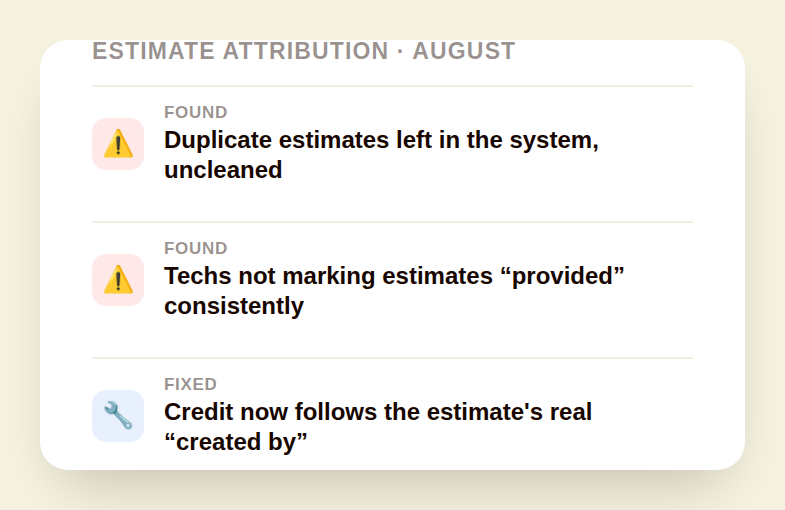
Two problems surfaced. First, duplicate estimates were sitting uncleaned in the field service system. A single job had, in some cases, more than one estimate on record, and depending on which one the reporting pulled, the "provided" status could be missing even when the customer had, in fact, received a quote. Second, and more fundamentally, the estimates were not being consistently attributed to the person who actually created them. Techs and dispatch were not reliably assigning themselves to an estimate or marking it "provided" the moment it went out, so the system had no clean record of who did what, on which job, and when. Add those two issues together, and a 75% estimate-success rate stopped being a verdict on the dispatcher. It became a verdict on how cleanly the underlying data was being captured, which is a very different problem to solve.
This distinction matters well beyond one refrigeration company. Any HVAC, plumbing, or electrical business that ties pay, bonuses, or performance reviews to a number pulled from a field service platform is exposed to the same risk. The metric itself might be exactly the right thing to measure. The pipeline feeding that metric, who marks what, when, and how duplicates get handled, is where trust quietly breaks down. A manager who says "the performance this month has not met expectations" needs to be just as sure about the estimates being counted as they are about the target itself.
It helps to sit with why this particular role and this particular metric matter so much. A dispatcher who is also handling estimates sits at a genuine pinch point in the business. Every estimate that gets written up but never marked as provided is potential revenue quietly stuck in limbo, invisible to sales reporting and invisible to the customer follow-up process. A company that pays attention to this number is doing something right: it is treating estimate follow-through as a real, measurable part of the job, not an assumed courtesy. The mistake would have been to let a flawed version of that same instinct undercut a good employee simply because the plumbing behind the number was not yet trustworthy.
Rebuilding the number so it can actually be trusted
The fix started with attribution, not with the target. Instead of assuming the field service platform's raw "created by" field was reliable as-is, the company adjusted the logic behind it so credit follows how the dispatcher actually works day to day, rather than whichever field happened to get populated first in the source system. Duplicate estimates got flagged and excluded from the count, so a job with two overlapping estimate records no longer quietly dragged the rate down for a mistake nobody actually made.
With the attribution problem addressed, the estimate-success rate became a monthly KPI qualifier built directly into the incentive plan, rather than a number someone pulls manually and drops into a spreadsheet once a quarter. The qualifier lives inside a dataset the company can filter by employee and by month, and export whenever it needs to, which means the same number driving a pay decision is also the number available for a five-minute sanity check any time someone asks how it was calculated.
That last part is the piece that is easy to skip and expensive to skip. A KPI that only exists as a single static percentage invites exactly the kind of doubt this company ran into, where a manager has to take the number on faith or spend an afternoon manually reconstructing it from raw job records. A KPI that lives in a live, filterable dataset can be interrogated in the moment. If a dispatcher or technician pushes back on a monthly result, the underlying estimates are one filter away, not a data-pull request away.
It is worth naming why this company did not simply lower the target or throw out the metric once the data looked messy. A 95% estimate-success target is a reasonable bar for a dispatcher whose whole job is making sure estimates turn into sold work. Abandoning that target because the plumbing behind it was leaky would have solved the wrong problem. The leak was in attribution and duplicate handling, not in the ambition of the goal itself, and conflating those two things is a common way well-intentioned incentive plans quietly get watered down over time.
There is also a quieter cost to getting this wrong that is easy to miss until it happens to your own team. If the company had used the uncorrected 75% to deny or shrink a raise, the dispatcher would have felt that decision immediately, and no later data cleanup would have fully undone the damage to trust. Incentive plans and pay decisions are one of the few places where being right eventually is not the same as being right when it counts. Checking the data before the conversation, not after, is what actually protects both the company and the employee.
Profit sharing
made simple.
Give your team a stake in the company’s success. ShareWillow helps you create and manage profit-sharing programs that motivate employees and drive business results.
Building a habit out of a one-time fix
Fixing August's number was only half the job. The company also asked for something more durable: a repeatable way to run this same check every month, rather than treating the August review as a one-off cleanup. That request, in effect, was for an SOP, a standard monthly process where the estimate-success rate gets pulled from the live dataset, reviewed against the 95% target, and used consistently, instead of being reconstructed from scratch every time a pay conversation comes up.
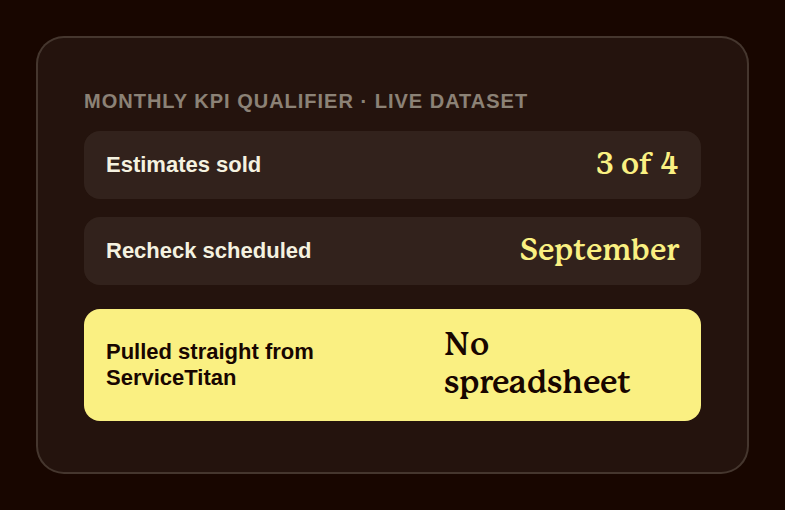
A September recheck is already scheduled, which turns this from a single corrected data point into an ongoing coaching tool. That is really the bigger shift here. Once the number can be trusted, it stops being just the input to a once-a-year raise conversation and becomes something a manager and a dispatcher can look at together every month: is the rate trending toward 95%, is a specific week dragging the average down, is there a pattern worth coaching before it becomes a pay problem at review time. None of that is possible with a metric nobody fully trusts, because every conversation about it starts by re-litigating whether the number is even right.
There is a broader lesson here for any HVAC or field service business that is building or refining an incentive plan around KPIs pulled from a job management platform. The instinct, when a number looks bad, is usually to react to the number: cut the bonus, delay the raise, have a hard conversation about performance. The more useful first move is almost always to ask where the number came from and whether the people, or the systems, feeding it are actually capturing the thing you think they are capturing. Estimate attribution, duplicate job records, and inconsistent status-marking are common failure points in HVAC service operations specifically, because so much of the work involves multiple people touching the same job, in the field and in the office, often faster than anyone is documenting it cleanly.
This kind of check is worth running on every KPI feeding a comp plan, not only the ones that happen to look bad in a given month. A metric that looks great can be just as broken as one that looks bad. If duplicate estimates can drag a rate down artificially, the same mechanism can inflate a different number in someone else's favor, and a company that only audits the numbers it is suspicious of will miss that entirely. The discipline that saved this dispatcher's raise is the same discipline worth applying across the board: know where every number in the comp plan actually comes from, on a schedule, not only when something looks off.
None of this required the dispatcher to change how they worked, and it did not require the company to lower its standards. What changed was entirely on the measurement side: a rate that looked like a 20-point miss turned into a rate that was mostly a data cleanup problem, once someone was willing to look under the hood before making a call that affected a real person's paycheck. That willingness, more than any specific fix, is what turned a number that almost cost a good employee a raise into a metric the whole team can now actually rely on.
Related reading
Conclusion
A KPI is only as trustworthy as the data feeding it; check the pipeline before you use the number to decide someone's pay.
Create incentives
that
drive results
You shouldn't need complex equity plans to align your team. ShareWillow makes it simple to create transparent profit-sharing programs that motivate employees and grow your business.

Incentive plans to help
small businesses thrive.
.png)
"I was able to leverage the knowledge of the ShareWillow team to learn how other companies were designing their bonus plans. The template was extremely helpful."

Brian Tustin
Owner, First Rate Movers
