
A growing HVAC company built a commission plan its technicians were genuinely excited about, then watched that excitement curdle into daily complaints when the numbers on the check never quite matched the numbers in the field. Here is how fixing the data behind the plan, not the plan itself, turned a source of daily arguments into a system technicians actually trust.
Most incentive plans do not fail because the idea was bad. They fail in a much quieter way: the plan is sound on paper, technicians like the structure, and then the numbers on an actual paycheck do not match what a technician calculated in their head on the drive home. That gap, even when it is small, even when it is an honest mistake, does more damage to an incentive program than a plan with no bonus at all. A technician who never expected extra money is neutral. A technician who expected a bonus and watched it come in wrong, or missing, or lower than the job clearly earned, stops trusting the entire system.
That is roughly where a growing HVAC company found itself, a shop with a small office team and four field technicians running calls across a single market. The company had already done the hard part. They had built a real commission structure on top of technician pay, tied to the jobs each tech closed and sold. The techs were on board. Everyone understood, in theory, that selling more and doing good work meant a bigger check. The plan was not the problem.
The problem was underneath the plan, in the plumbing nobody thinks about until it breaks. The company ran its jobs through ServiceTitan, but the commission calculation depended on a separate tracking sheet the office kept to tag which technician got credit for which job. Every job needed to be tagged correctly and mapped to the right technician for the commission math to come out right. Most of the time it did. Often enough, it did not, and when it did not, a technician's bonus quietly came in lower than the job actually earned.
Why a tagging mismatch is worse than it sounds
It is tempting to treat a mistagged job as a minor clerical slip, the kind of thing you fix and move on from. In practice it is one of the most corrosive problems a commission plan can have, because of who discovers it and when. The office does not usually catch a mistagged job. The technician does, because the technician knows exactly what they sold, what the ticket was worth, and roughly what their commission should be. When the number on the check is lower, they notice immediately, and they are right to.
Multiply that by four technicians and a handful of pay periods, and what you get is not one clean, correctable error. You get a running background hum of small discrepancies, each one individually explainable, that together add up to a team that has quietly stopped believing the bonus system reflects reality. Office staff start fielding the same kind of complaint week after week, not because anyone is trying to shortchange anyone, but because a manual tagging step run by hand will eventually drift out of sync with a fast-moving field schedule. Nobody designed it to fail. It just does, the way any manual process attached to a growing business eventually does.
There is a version of this story that ends badly. A shop keeps running the manual tag sheet, the discrepancies keep piling up, and eventually a strong technician who has quietly done the math on how often they get shorted decides the grass is greener somewhere with a cleaner system. The cost of that outcome never shows up as a line item. It shows up months later as an open technician seat and a scramble to hire and train a replacement, and by then it is very hard to trace the departure back to a spreadsheet tagging error from two quarters ago.
Fixing the pipeline, not the plan
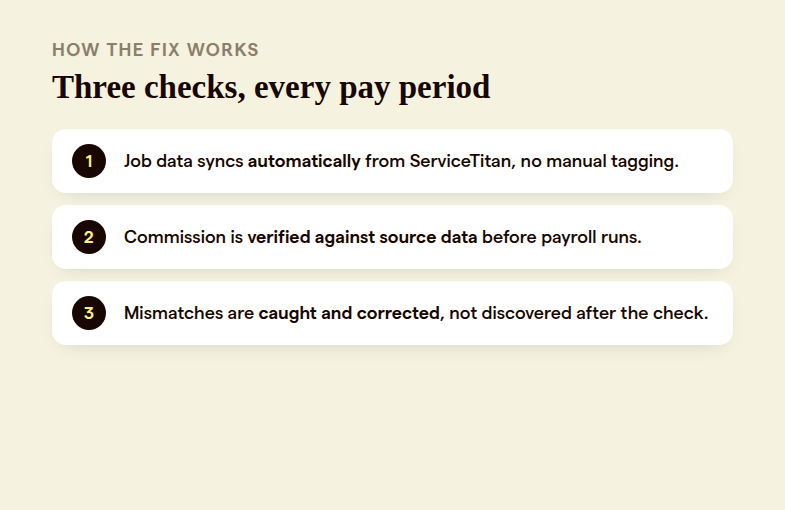
Working with ShareWillow, the company did not touch the commission structure itself. The rates, the tiers, and the philosophy of paying for performance were already right. What needed to change was how job data actually got from ServiceTitan into the commission engine, so that a technician's pay depended on a clean automated sync instead of a hand-maintained tagging sheet that had to be re-created every pay period.
The fix ran through ShareWillow's integration layer, which pulls job, sale, and technician-assignment data directly out of ServiceTitan and maps it automatically, instead of relying on office staff to re-tag every job by hand. Where the old process asked a person to correctly remember and record who sold what, the new process asks the source system, the one the technician actually worked in that day, to answer the question once and pass it straight through. That single change removes the exact point where the old workflow kept breaking.
The plan was never the problem. The problem was that a technician's bonus depended on a spreadsheet a person had to update by hand, and hand-updated sheets drift. Automating the sync did not change the incentive plan at all. It just made sure the plan calculated the truth.
Because the sync runs automatically, the company gained something just as valuable as accuracy: a verification step. Before a payroll run finalizes, the numbers can be checked against the source data, so a mismatch gets caught before a technician ever sees a wrong number on a check, rather than after, when the only fix is an apology and a correction on the next pay period. That distinction matters enormously to a technician standing in a truck deciding whether the company they work for actually has their back on pay.
The other quiet fix was around helper and split jobs, the calls where more than one technician touches the work and credit has to be divided. Splits are exactly the kind of detail a manual system tends to get wrong under time pressure, because they take more thought than a straightforward single-technician job. Automating the assignment logic meant splits calculated the same correct way every time, instead of depending on whichever office staffer had a spare minute to work it out that week.
None of this required rebuilding trust with a speech or a company meeting about how seriously leadership takes fair pay. It required removing the mechanism that was breaking trust in the first place. Technicians do not need to be told a bonus system is fair. They need the number on the check to match the number in their head, pay period after pay period, until they stop double-checking it.
Profit sharing
made simple.
Give your team a stake in the company’s success. ShareWillow helps you create and manage profit-sharing programs that motivate employees and drive business results.
What one real payroll run looked like
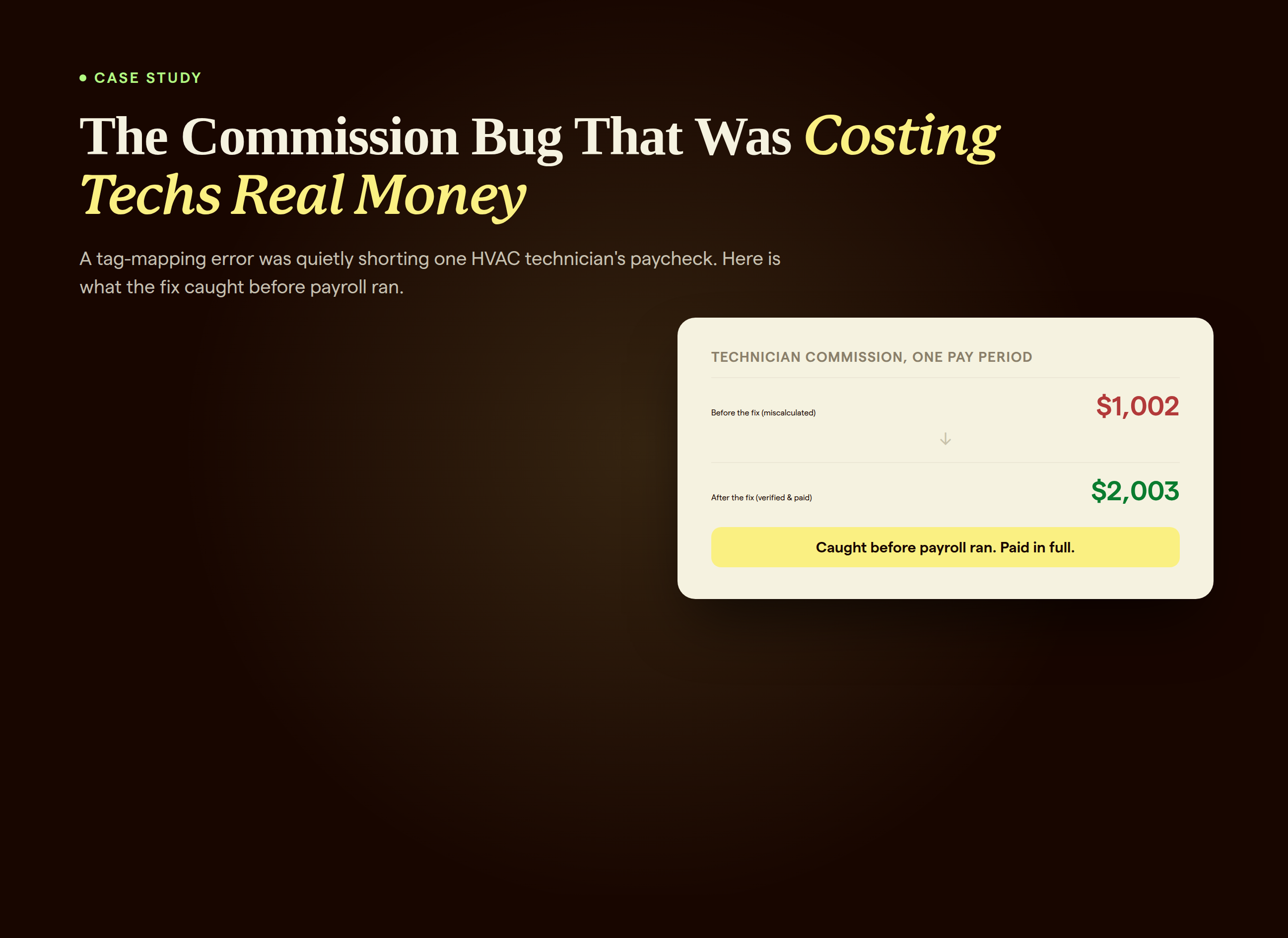
The clearest evidence that the fix worked shows up in a single real payroll cycle, run once the automated sync was live. Before the sync caught it, one technician's commission was on track to come in with a missing tag and an incorrect salesperson attribution baked into the number, an error that would have cost him close to a thousand dollars in commission he had legitimately earned. The automated verification step flagged the mismatch before payroll ran, the tag was corrected, and the technician was paid what the job actually earned.
That near-miss is worth sitting with, because it is exactly the kind of error that a manual process has no way to catch. Nobody was trying to shortchange the technician. The job was simply tagged to the wrong record, the way jobs occasionally get tagged wrong when a person has to do it by hand across dozens of calls a week. Under the old system, that thousand dollars would have quietly vanished from the technician's check, and the company would likely never have known it happened at all.
Once the sync was running cleanly, the same payroll cycle produced commission payouts the technicians could check against their own math and trust: one technician's payout landed at just over three thousand dollars, another cleared six thousand, a third came in a little above three thousand, each figure traceable back to the actual jobs and sales behind it. On one technician's sales alone, a little over twenty-eight thousand dollars in tracked system sales, the plan's eight percent commission rate translated into right around two thousand dollars in earned bonus, a number the technician could reconstruct himself from his own job list.
That last point is the real outcome here, more than any single dollar figure. A technician who can independently reconstruct their own commission from the jobs they remember doing is a technician who trusts the plan. Before the fix, technicians were raising the same kind of pay discrepancy complaint on a near-daily basis. After it, that stream of complaints stopped, not because anyone got better at customer service, but because the underlying numbers finally matched what technicians already knew to be true.
What this means for your shop
If your team has a commission or bonus plan that occasionally pays out numbers nobody can quite explain, the lesson from this fix is not that you need a new plan. It is that you need to look at what is feeding your existing one.
- Trace every dollar back to a source system. If a technician's bonus depends on a hand-maintained spreadsheet instead of the system they worked in that day, you have a drift problem waiting to happen, even with the best intentions on your team.
- Automate the tagging, not just the math. A calculator that runs the wrong inputs correctly still produces the wrong answer. The highest-value fix is often upstream of the formula, in how job and technician data gets captured in the first place.
- Build in a check before payroll runs, not after. Catching an error before a check goes out costs you nothing but a few minutes. Catching it after costs you a technician's trust and an awkward conversation about a correction.
- Take repeated small complaints seriously. A single pay discrepancy is a mistake. A pattern of them across pay periods is a system problem, and it is almost never the plan itself that is broken.
- Remember what silence is worth. The real win here was not a bigger bonus. It was technicians who stopped complaining about pay, because the numbers finally matched reality every single time.
A commission plan your technicians cannot verify is a commission plan they will eventually stop believing in, no matter how generous the rates look on paper. ShareWillow's platform pulls job and technician data directly from ServiceTitan and other field service systems HVAC shops already run on, so the plan calculates the truth every pay period instead of whatever a spreadsheet happened to capture. It is the same lesson we saw play out at a Pennsylvania HVAC shop that made its bonuses visible on a leaderboard: the money was never really the problem, the system behind the money was. See how ShareWillow can audit your own incentive pay pipeline, based on what we have learned from over 200 service businesses.
Related reading
Conclusion
A commission plan is only as trustworthy as the data behind it, and the fastest way to kill a good incentive is to let the math be wrong even once.
Create incentives
that
drive results
You shouldn't need complex equity plans to align your team. ShareWillow makes it simple to create transparent profit-sharing programs that motivate employees and grow your business.

Incentive plans to help
small businesses thrive.
.png)
"I was able to leverage the knowledge of the ShareWillow team to learn how other companies were designing their bonus plans. The template was extremely helpful."

Brian Tustin
Owner, First Rate Movers
