
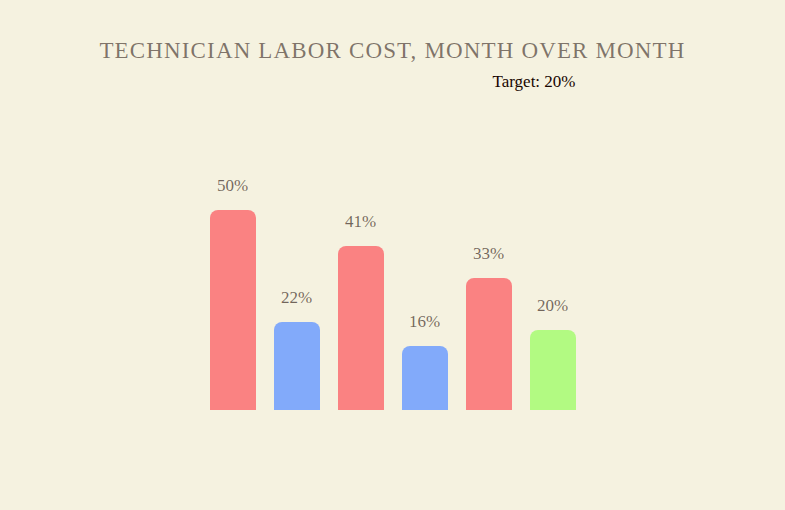
A 6-tech HVAC company watched labor cost swing from 50% of revenue to 16% in a single month. Here's how they built a plan that targets one stable number instead.
The Spreadsheet That Never Says The Same Thing Twice
Ask most HVAC owners what percentage of revenue goes to technician labor, and you'll usually get a range, not a number. That range is normal. What isn't normal is when the range gets so wide it stops meaning anything at all.
That's the exact situation a 6-tech HVAC company found itself in. One month, technician labor cost ran at 50 percent of revenue, an eye-watering number that would eat any shop's margin alive if it held steady. The very next month, that same number dropped to 16 percent, a figure so low it barely resembled a real labor cost at all. Same crew. Same rough call volume. A swing of more than 3x in either direction, month over month, with no clear pattern connecting one month to the next.
For an owner trying to run payroll, plan hiring, or simply understand whether the business was healthy, that kind of swing isn't just inconvenient. It's disorienting. You can't budget against a number that might be 16 or might be 50 depending on factors nobody can fully explain in advance. You can't confidently quote growth plans to a bank or a partner when your single biggest controllable cost refuses to hold still.
This wasn't a case of a poorly run shop. Plenty of well run HVAC companies hit this exact wall, because the root cause isn't mismanagement. It's pay structure. When technician pay is a flat hourly rate with occasional, inconsistent bonuses layered on top, the connection between what a tech gets paid and what the business can actually afford to pay him doesn't really exist. Labor cost becomes a byproduct of how many hours got logged and how big or small that particular month's jobs happened to be, not something anyone is actively steering toward a target.
Slow months make the percentage spike, because fixed hourly pay still has to be covered even when revenue is thin. Big months make the percentage crash, because the same fixed pay now covers a much larger revenue base. Neither swing tells you anything useful about whether your team is performing well. It just tells you the math is riding on a number nobody set on purpose.
Most owners in this position try to solve it the same way: watch the number more closely. Pull the labor report more often, ask the office manager to flag it sooner, maybe build a spreadsheet that tracks it week by week instead of month by month. All of that helps you see the swing faster. None of it stops the swing from happening, because watching a number more closely doesn't change what's driving it. The pay structure underneath is still disconnected from revenue, no matter how often someone checks in on it.
There's a specific kind of frustration that comes with this, too, one a lot of small HVAC owners will recognize immediately. You did everything right that quarter. Calls got answered, jobs got closed, customers were happy. And yet the labor cost number still came out somewhere you didn't expect, for reasons that have more to do with how hours happened to fall that month than with how well anyone actually performed. When a KPI stops correlating with the thing it's supposed to measure, owners understandably start to distrust the number altogether, which makes it even harder to use for real decisions.
Replacing A Guess With A Target
The fix ShareWillow built with this company wasn't a bigger bonus pool or a one-time cash injection to smooth things over. It was something more structural: a performance pay plan built to hold technician labor cost near a single, predictable target, roughly 20 percent of revenue, every single month, instead of swinging wherever the calendar happened to land.
The mechanics matter here, because "predictable payroll" is the kind of phrase that sounds nice and means nothing until you see how it's actually built. A few pieces make it work:
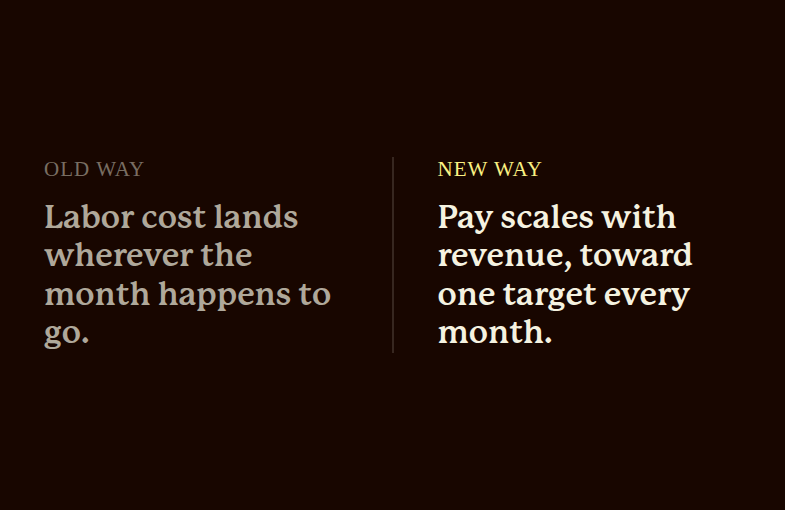
- Pay scales with revenue, not just with hours. Instead of a fixed hourly number that stays flat no matter how the month goes, a portion of technician pay is tied to the value of the work performed, which naturally tracks the ups and downs of the business instead of fighting against them.
- One target replaces a moving one. Rather than managing to whatever number the month happens to produce, the plan is built around a specific, agreed-upon percentage the business can actually plan payroll and pricing around.
- It's calculated automatically from the same job data the shop already tracks. No new system, no separate spreadsheet living outside the field service software this HVAC company already runs every job through.
There's a subtlety worth naming here. A predictable labor cost percentage doesn't mean technician pay stops growing when the company grows. It means the two move together, on purpose, instead of technician pay staying flat while revenue swings underneath it. In a strong month, techs earn more because there's more value being created. In a slower month, the target still holds because pay is scaled to what the business actually generated, not fixed against a number set months or years ago.
This is a very different mental model than the one most HVAC owners default to. Most shops treat labor cost as something to watch and react to after the fact, a number that shows up on the P&L a month later, good or bad, with little anyone can do about it in the moment. Building the plan around a target flips that. Instead of reacting to whatever labor cost turned out to be, the business is actively steering toward the number it decided made sense, month after month, using the exact same job data that used to only tell the story after it was too late to act on it.
Picking the right target matters as much as the mechanics that hold it in place. Twenty percent isn't a number every HVAC company should copy blindly; it's the number that made sense for this particular company's pricing, overhead, and crew size. A target set too low starves technician pay and invites turnover. A target set too high erodes margin no matter how efficiently the plan runs. Getting it right means starting from the company's own historical job data, not an industry rule of thumb pulled from a forum post, which is exactly why building the plan off real numbers, rather than guessing at a round figure, mattered as much as the target itself.
It's also worth noting what doesn't change under a plan like this. Technicians aren't asked to take on new responsibilities, learn a new system, or track anything by hand. The target lives in the pay structure, calculated automatically in the background from the jobs they're already running through the field service software. From a technician's seat, the day to day work looks the same. What changes is what happens on the back end, where pay finally scales with the value being created instead of sitting fixed against a number that made sense years ago and hasn't been touched since.
Profit sharing
made simple.
Give your team a stake in the company’s success. ShareWillow helps you create and manage profit-sharing programs that motivate employees and drive business results.
What Predictable Payroll Actually Buys An Owner
It's easy to undersell how much "predictable" is worth to a small HVAC company, because it doesn't show up as a flashy number the way a revenue jump does. But for an owner running six technicians, knowing labor cost will land somewhere near a target instead of somewhere between 16 and 50 percent changes real decisions.
Hiring is the clearest example. It's nearly impossible to responsibly plan a seventh hire when you don't know whether next month's labor cost will be 20 percent or 45 percent of revenue. A stable target turns that into a real, answerable question: can the business support another technician at this target percentage, given current call volume? That's a question an owner can actually run numbers against. "It depends on the month" isn't.
Pricing gets easier too. When labor cost as a share of revenue is wildly unpredictable, pricing decisions end up padded with guesswork, a buffer added just in case the percentage runs hot that month. A stable target removes a big piece of that uncertainty, letting pricing reflect the business's actual, known cost structure instead of a worst case scenario built to survive the roughest months.
And for the technicians themselves, there's a version of stability here too, even if it's less obvious from the owner's side of the table. A pay structure built around a consistent, sustainable target is one the business can actually keep promising over time. A plan that only works in the good months, propped up by whatever bonus felt affordable that quarter, tends to get quietly walked back the first time revenue dips. A target the whole pay structure is built around, tested against real job data instead of hoped into place, is a plan a tech can trust will still be there next year.
There's also a simpler, less discussed benefit: fewer surprises at the owner's own kitchen table. Running a small HVAC company means payroll is one of the most stressful lines on the calendar every two weeks. A labor cost that could be a comfortable 20 percent or a brutal 50 percent depending on the month keeps that stress live, all year, regardless of how well the crew is actually performing. Replacing that swing with a target the business steers toward on purpose doesn't just clean up a spreadsheet. It takes a genuine source of owner anxiety and turns it into a number you can actually plan around.
None of this required the company to abandon hourly pay or overhaul how its technicians work day to day. It required connecting the pay structure to the same job data the business was already generating, and pointing it at a target instead of letting it drift wherever the month happened to land.
A quick gut check for your own numbers
If any of this sounds familiar, it's worth pulling your own labor cost percentage for the last six months before assuming it's just how HVAC payroll works. A few questions worth asking:
- What's the actual spread between your highest and lowest month for technician labor cost as a percentage of revenue?
- Could you explain, in one sentence, why last month's number came out the way it did?
- If you hired one more technician tomorrow, do you know what that would do to the percentage, or would you find out next month?
If those answers feel shaky, the issue usually isn't your team's effort. It's that pay was never built to track revenue in the first place, and no amount of watching the number more closely fixes a structure that isn't designed to hold still.
Related reading
Conclusion
If your own labor cost percentage swings wide enough that you can't answer "what will payroll look like next month" with any confidence, the fix usually isn't tighter budgeting. It's a pay structure that scales with revenue on purpose, built around a target instead of left to chance. See how ShareWillow builds that kind of plan directly from the job data your team already generates, and take a look at how it's helped other HVAC companies turn unpredictable payroll into a number they can finally plan around.
Create incentives
that
drive results
You shouldn't need complex equity plans to align your team. ShareWillow makes it simple to create transparent profit-sharing programs that motivate employees and grow your business.

Incentive plans to help
small businesses thrive.
.png)
"I was able to leverage the knowledge of the ShareWillow team to learn how other companies were designing their bonus plans. The template was extremely helpful."

Brian Tustin
Owner, First Rate Movers
