
A small home services company's tiered commission plan only ever paid out to the same one or two technicians, because the thresholds sat just out of reach for everyone else. Moving the cutoffs down and adding a finer tier turned one $3,000 bonus into a real $4,000 team payout.
A commission tier that only the top performer could ever reach
A small home services company running a handful of field technicians had built its commission plan the straightforward way: pick a revenue or hours threshold, pay a percentage once someone clears it. It is a common structure, and it is easy to explain in one sentence to a new hire. The problem showed up once the owner looked at who was actually clearing the bar month after month. It was almost always the same one or two people. Everyone else was landing just under the cutoff, close enough to see the tier, never quite close enough to touch it.
That kind of near-miss is worse for morale than missing badly. A technician who is 40% short of a bonus tier does not expect to hit it and is not particularly bothered by that. A technician who lands at 24 sold hours against a 26-hour cutoff, month after month, starts to feel like the plan was built for someone else. It stops reading as a stretch goal and starts reading as a wall. The owner had heard enough of that sentiment secondhand to know it was becoming a real retention risk, not just a mood problem.
The pressure was not only internal. The owner had also seen a competitor's commission structure, one that paid out more generously for a similar level of revenue, and it left him wondering whether his own plan was quietly pushing good technicians toward the door. That is a legitimate worry in any trade where the labor market is tight and a tech can walk down the street to a shop offering a friendlier commission curve. A commission plan does not just need to be fair on paper. It needs to feel achievable to the people working under it, or it stops functioning as an incentive at all and just becomes a number on a pay stub that only ever benefits the same one person.
None of this meant the underlying idea, paying more to technicians who generate more revenue and work more sold hours, was wrong. The mechanics of where the tiers sat were wrong. A threshold that only the strongest performer in the shop can reach is not really a team incentive. It is a bonus for one person dressed up as a program for everyone.
It is also worth being honest about how this kind of threshold usually gets set in the first place. Few owners sit down with a spreadsheet of every technician's historical sold hours and calculate exactly where a 50th-percentile cutoff should land. More often, a number like 26 hours gets chosen because it sounds reasonable, or because it matches what a consultant or a franchise playbook suggested years earlier, and then it just sits there, unexamined, while the actual composition and skill level of the team drifts underneath it. A threshold is only as good as the moment it was set. If nobody revisits it, it eventually stops describing the team it was built for.
Moving the line so more people can actually reach it
The fix was almost entirely arithmetic, not philosophy. The company kept its tiered structure, revenue and sold hours driving a percentage-based commission, and simply moved where the tiers sat. The Level 1 minimum came down from 26 sold hours to 24. Level 2 was rebuilt with finer steps: under 28 hours pays 0%, 28 to 30 hours pays 1%, and the rate scales up from there. Small movements on paper, but they change who is realistically in range of a payout in a given month.
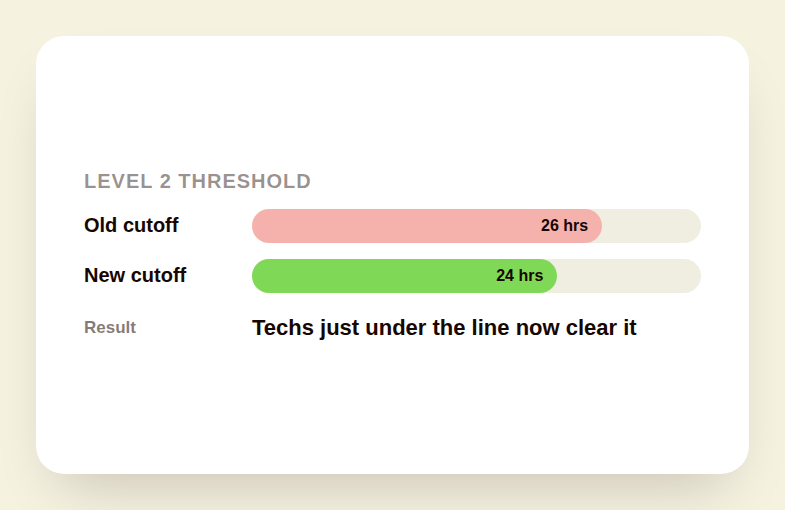
The reasoning behind the specific numbers matters more than the numbers themselves. Twenty six sold hours as a monthly minimum was set at some point without much data behind it, the kind of number a shop picks early on and never revisits. Once the owner looked at where his actual technicians were clustering, the fix was obvious: a meaningful share of the team was landing in the 24-to-26 range every month, doing solid, dependable work, and getting zero recognition for it under the old structure. Lowering the floor by two hours did not lower the bar for excellence. It stopped punishing consistency.
The finer-grained Level 2 steps do something similar for the middle of the pack. Instead of one steep jump from nothing to a full percentage, the 28-to-30-hour band pays a modest 1%, giving a technician who is close but not at the top tier something real to work toward, rather than an all-or-nothing cliff. That structure rewards the honest middle of a team, not just the ceiling, which is exactly where most shops lose the retention battle without realizing it.
This is also where building the plan on top of the company's existing job data mattered. Sold hours and revenue per technician were already being tracked in the field service system the shop ran on every day. The commission calculation pulls directly from that same source, so the numbers a technician sees on payday are the same numbers dispatch and the office are already looking at, not a manually reconciled spreadsheet that drifts out of sync the moment someone forgets to update a row after a schedule change.
There is a second, quieter benefit to moving the thresholds instead of redesigning the whole plan from scratch. Technicians already understood the shape of this commission structure. They knew it was tiered, they knew it was based on sold hours and revenue, and they had already built a mental model of how it worked, even if that model included some frustration about where the lines sat. Changing the numbers inside a structure people already trust is a much smaller announcement than replacing the structure itself. Nobody had to relearn how their pay worked. They just discovered the goalposts had moved somewhere they could actually reach them.
Profit sharing
made simple.
Give your team a stake in the company’s success. ShareWillow helps you create and manage profit-sharing programs that motivate employees and drive business results.
What one adjusted cycle actually paid out
Run the corrected tiers against one real pay period, and the shift shows up immediately. The top-performing technician generated roughly $100,000 in revenue for the period and landed in the 3% tier, earning a $3,000 bonus. That number alone would have been possible under the old plan too. What changed is what happened below him. A second technician, who would have cleared nothing under the old 26-hour floor, landed a real payout of around $500. A third technician, previously nowhere near a tier, still cleared a small but genuine $65 bonus. Total team payout for the cycle came to roughly $4,000, calculated automatically inside the platform rather than assembled by hand at the end of the month.
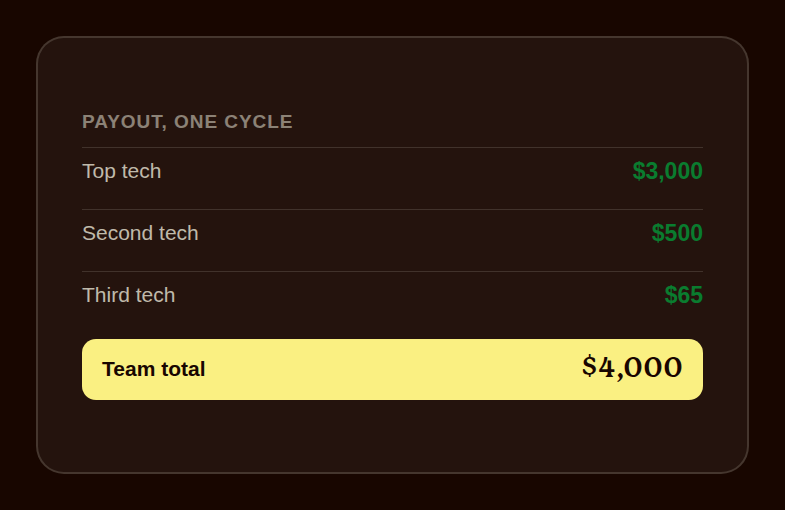
Sixty five dollars is not a life-changing bonus, and it would be easy to dismiss it as too small to matter. That misses the point of what it represents. For the technician who received it, that payout is proof the plan sees them, that showing up and doing solid work every day is worth something concrete, even if it is not the headline number. A commission structure that only ever produces one big check and a lot of zeroes is not a team incentive, no matter how generous that one check is.
The owner's own instincts about how to use this confirm as much. He asked for the ability to "zero out" specific entries before locking payroll, useful for handling a one-off correction without redoing the whole calculation, and he wanted a photo of the top technician's paycheck to show around the shop. That second request is worth sitting with. A business owner does not go looking for a way to publicize a paycheck unless he believes the number itself will do some of the motivating work for him. A $3,000 bonus that other technicians can see is real, tied to a tier they can also picture themselves reaching, does more for morale than the same number kept quiet.
That instinct only works, though, if the paycheck being shown around the shop was calculated the same way for everyone, off the same live data, with no manual adjustments quietly propping up one number. A technician who suspects the top payout involved some behind-the-scenes rounding in someone's favor will not be motivated by seeing it. A technician who can trust that the same tiered formula, pulling from the same job data, produced every number on the sheet is far more likely to see a big check on the wall and think "that could be me next month" instead of "that was rigged for him."
The lesson generalizes well past this one shop. Any HVAC, plumbing, or field service business running a tiered commission plan is worth auditing the same way: look at where your technicians actually cluster relative to your thresholds, not where you assumed they would land when you first set the numbers. If a meaningful share of the team is bunched just under a cutoff, the fix is rarely to blow up the whole structure. It is usually to move the line and add a step or two beneath it, so the plan starts rewarding the technicians who are already doing good, consistent work instead of only the one person at the very top. ShareWillow's platform calculates tiered commission plans like this directly from the job and revenue data a field service company already has, so moving a threshold is a five-minute change instead of a payroll-week scramble.
Related reading
Conclusion
A commission tier nobody can reach is not an incentive; move the line until the team you actually have can hit it.
Create incentives
that
drive results
You shouldn't need complex equity plans to align your team. ShareWillow makes it simple to create transparent profit-sharing programs that motivate employees and grow your business.

Incentive plans to help
small businesses thrive.
.png)
"I was able to leverage the knowledge of the ShareWillow team to learn how other companies were designing their bonus plans. The template was extremely helpful."

Brian Tustin
Owner, First Rate Movers
