
A two-location HVAC and plumbing company found nearly half its install revenue wasn't triggering any incentive pay at all. Here's the single mislabeled field that was quietly erasing $260,000 a month from the bonus pool, and how fixing one word in the qualification logic closed the gap.
The Number That Was Supposed To Be Simple
A two-location HVAC and plumbing company with about a dozen technicians built its install incentive pool the way most growing shops do: take a slice of qualifying install revenue each month, roughly 1.5%, and split it across the crew who earned it. A lead installer might carry a bigger share, an apprentice a smaller one, but the math itself was never the hard part. Multiply a percentage by a revenue number. That is a calculation a ten-year-old could do correctly on the first try.
The hard part turned out to be the revenue number itself. Every month, the owner would look at total install revenue on one screen and the incentive pool payout on another, and the two never seemed to line up the way he expected. Total revenue for one location came in at $598,000 for the period. The amount that actually qualified for the incentive pool was $338,000. That is not a rounding gap. That is 44% of the location's install revenue sitting completely outside the plan that was supposed to reward the people who produced it.
For a while, that gap just felt like noise. Field service businesses are messy. Jobs get rescheduled, invoices get corrected, a customer disputes a line item and revenue moves between periods. An owner used to running a shop learns to expect some slop between what the top-line number says and what actually flows through to payroll. But 44% is not slop. That is closer to half the number just not existing as far as the pay plan was concerned, and once someone actually sat down to ask why, the reason turned out to be almost embarrassingly small.
Every qualifying job needed a specific field marked in the company's field service software: proof that a documentation photo, what the team called the "company cam" field, had been uploaded for that job. The logic behind the requirement made sense on paper. If a tech is going to get paid extra for an install, there should be a record that the work actually happened the way it was billed. Nobody was trying to make that a hard hurdle to clear. It was meant to be a two-second box to check, not a gate.
In practice, it became a gate anyway, because the field wasn't reliably getting filled in, and the incentive logic treated a blank field exactly like a "no." A tech who did a flawless $14,200 system replacement and simply forgot to upload the photo, or uploaded it to the wrong job, or had a dispatcher enter the ticket before the photo step ran, lost the entire job's worth of incentive credit. Not a partial deduction. The whole thing, gone, invisible to the report the owner was using to run his pay plan, with no flag anywhere telling him it had happened.
It's also worth saying plainly what that gap costs beyond the dollar figure. A technician who checks his own math, even loosely, notices when a big month somehow produces a small bonus. He might not know why. He might not be able to point to the company cam field or explain qualification logic. But he feels the mismatch between the work he knows he did and the number that landed in his check, and that feeling erodes trust in the whole pay plan a lot faster than a straightforward miss on a sales target ever would. An incentive plan people don't trust stops motivating anyone, no matter how well-designed the underlying math is.
That is the trap hiding inside a lot of well-intentioned HVAC incentive plans. The rule that is supposed to protect the integrity of the pay plan becomes, through nothing more than a busy shop's normal friction, the thing quietly gutting it. And because the failure mode was silent, a missing checkbox rather than an error message, nobody had a reason to go looking for it until the gap between two numbers got big enough that it couldn't be explained away as normal variance anymore.
Finding The Gate, Then Deciding What It Should Actually Do
Once the owner and his incentive team started pulling qualification detail job by job instead of just staring at the two top-line totals, the pattern was obvious inside the first few minutes. Jobs with a real, uploaded company cam photo qualified every time. Jobs without one didn't, regardless of size, regardless of whether the work was done correctly, regardless of anything except whether that one field had been populated before the report ran.
"It's not lost revenue exactly. It's a habit gap. The work happened, the photo just never made it into the system before the report pulled," the owner said, once the pattern was laid out job by job instead of buried in a single monthly total.
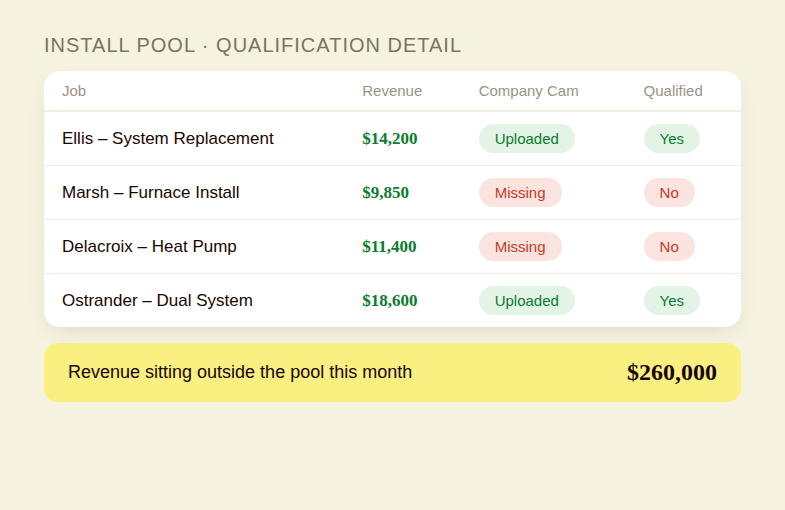
That distinction matters enormously for what happens next, and it is worth sitting with for a second. A 44% qualification gap could mean two very different things. It could mean the crew is doing a lot of work that genuinely shouldn't count toward incentive pay, jobs that were rushed, undocumented, or disputed by customers. Or it could mean the crew is doing the work just fine and a data-entry habit is quietly erasing the proof. Those two explanations call for completely different responses. One calls for a hard conversation with the team about quality and documentation discipline. The other calls for fixing a rule that was never supposed to be this strict in the first place.
Before this got fixed, the owner had no way to tell which story he was actually living in. He only had one number a month, a percentage that moved around for reasons he couldn't see. That is the same trap a lot of incentive pay platforms quietly set for the businesses using them: a plan can look sophisticated on paper, tracking real revenue, applying a real percentage, splitting credit by role, and still be functionally broken if the underlying qualification logic has a single strict field nobody is watching.
Once it was clear the second story was the true one, the fix wasn't to loosen the plan's standards. It was to make the qualification rule match what it was actually meant to check for. The original logic required the company cam field to explicitly equal "yes" before a job counted. That single word, "explicitly," was doing all the damage. A blank field and a field marked "no" were being treated identically, when in reality a blank field almost always just meant nobody had gotten to it yet, not that anything was wrong with the job.
The rule got rewritten to qualify a job unless it was explicitly marked out, rather than requiring it to be explicitly marked in. That is a small, almost pedantic-sounding change. In practice, it is the difference between a pay plan that defaults to trusting the crew's real work and one that defaults to erasing it the moment someone forgets an administrative step in the middle of a busy install day. The threshold for disqualifying a job also got tightened up separately: jobs under a minimum ticket size, and jobs with an actual recall or callback attached, still don't qualify, which is exactly the kind of guardrail a real incentive plan should keep. What changed was narrowly the part that was punishing missing paperwork as if it were missing work.
Profit sharing
made simple.
Give your team a stake in the company’s success. ShareWillow helps you create and manage profit-sharing programs that motivate employees and drive business results.
What Closing The Gap Actually Looks Like In Practice
The owner didn't take the fix on faith. Before rolling the corrected logic out for real, the team recalculated a full prior period side by side, the old strict rule against the new one, and compared the two payout numbers directly against what the crew should have actually earned based on real job records.
"The recalculated numbers came out much closer to what we actually expected the payouts to be," the owner said, describing the side-by-side comparison. "That was the moment I trusted it."
That validation step is worth calling out on its own, because it is the difference between a fix that sounds right and a fix that is actually verified. Anyone can propose a plausible-sounding change to a qualification rule. Running it against real historical jobs and confirming the output lines up with what the owner independently expected, based on his own read of the crew's actual production, is what turns a guess into something he could stand behind at payroll time.
The $260,000 gap between $598,000 in total revenue and $338,000 in qualified revenue didn't represent money the company was somehow going to pay out that it hadn't earned. It represented real, already-completed work that the incentive plan had been blind to for reasons that had nothing to do with performance. Closing that gap didn't inflate anyone's pay artificially. It corrected a measurement error that had been running underneath the plan the entire time, one that happened to run in exactly the direction that erodes a technician's trust the fastest: doing the job right and still not seeing it reflected in the number that's supposed to represent your performance.
There's a broader lesson here for any HVAC or plumbing company running incentive pay off data pulled from field service software. The qualification rule you write down, "revenue counts if documentation is complete," is never actually the rule your system enforces. The rule your system enforces is whatever the underlying field logic says, and those two things can drift apart without anyone noticing, especially when the failure mode is a blank field rather than an error. A plan that looks airtight in the design meeting can still be quietly discarding close to half of a location's qualifying revenue by the time it reaches a live report, and the only way to know for sure is to periodically pull the qualification detail behind the summary number and check whether the jobs getting excluded are actually the jobs that should be.
If your own incentive numbers ever look a little too round, or a little too far off from what your gut tells you the team produced that month, it's worth asking the same question this owner did: is the plan measuring performance, or is it measuring whether someone remembered to click a box. Those are very different things to be paying people for, and only one of them is actually your incentive plan doing its job.
This isn't a problem unique to install crews, either. The same failure mode shows up anywhere a pay plan leans on a single administrative field as a stand-in for real performance: a service technician's membership-sale checkbox, a plumber's upsell tag, a CSR's booking-confirmation flag. Any of them can silently gate someone's pay the same way the company cam field did here, and none of them announce themselves. They just sit there, blank, quietly subtracting from a number nobody thinks to double-check until the total finally looks wrong enough to investigate. Building the habit of pulling qualification detail behind the summary number, on a regular schedule rather than only when something feels off, is what keeps a rule like that from costing a crew tens of thousands of dollars a month before anyone notices.
Related reading
Conclusion
If your incentive numbers look a little too round, check whether you're measuring performance or just whether someone remembered to click a box.
Create incentives
that
drive results
You shouldn't need complex equity plans to align your team. ShareWillow makes it simple to create transparent profit-sharing programs that motivate employees and grow your business.

Incentive plans to help
small businesses thrive.
.png)
"I was able to leverage the knowledge of the ShareWillow team to learn how other companies were designing their bonus plans. The template was extremely helpful."

Brian Tustin
Owner, First Rate Movers
