Job profit bonus plan: how an electrical company pays 10% of paid job profit, split 30% by level and 70% by hours, plus 2.5% to service techs.
A job profit bonus plan ties pay to what a job actually keeps after costs, not what it billed. One small electrical and construction company on Housecall Pro just set one up for its field crew and office team: a pool equal to 10% of job profit on construction work, split 30% by employee level and 70% by hours worked, with service technicians earning 2.5% of the profit on the jobs they work. Nothing pays out until the job is paid in full.
This article walks through each pool, shows the math on a sample job, and covers the rollout choice that mattered most: running the plan quietly in the background before anyone on the team sees a dollar amount.
The Problem: Bonuses With No Continuity and Profit Nobody Could Trace
The owner already paid bonuses, but they came and went without a pattern. Five-star reviews, callbacks, attendance problems, and performance infractions were all tracked in a shared spreadsheet, and none of it connected to the profit on a specific job. When an owner cannot explain why a bonus was a certain size, the team stops believing it will come back.
Three gaps showed up quickly:
- Bonuses felt random. Without a formula, every payout was a judgment call
- Job profit was invisible to the people creating it. Crews saw hours and tickets, never what a job kept after labor and materials
- The office had no place in the plan. The people who estimate, schedule, and chase payment keep profit intact, but they sat outside the incentive
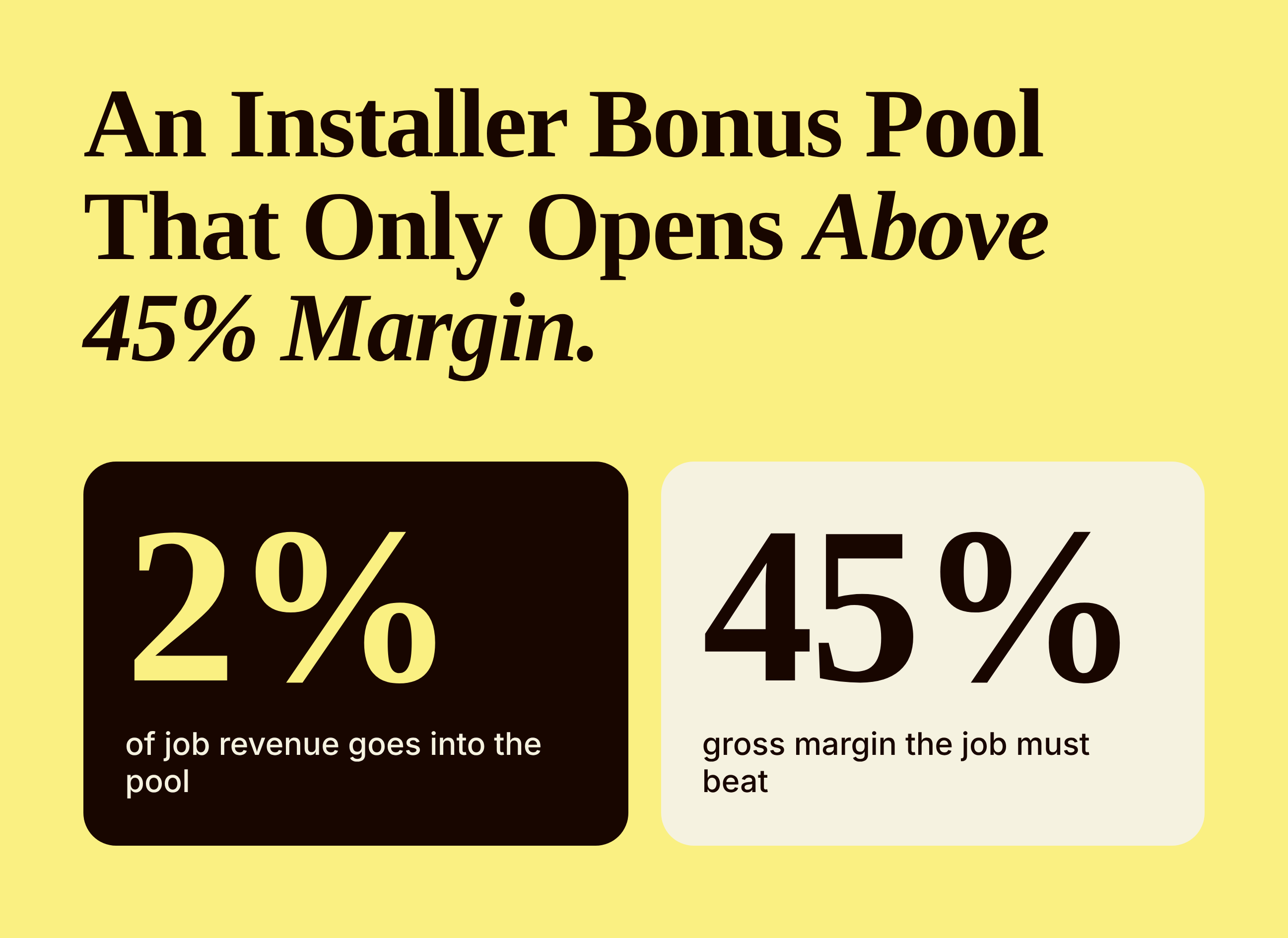
Other companies solve this with a margin gate. Our story on an electrical installer bonus plan funds a 2% pool only on jobs above a 45% gross margin. This company went a more direct route: profit itself is the pool, and the owner sets the percentage. It is the same owner-first thinking behind how a small electrical company rebuilt commission to keep its best installers.
How the Job Profit Bonus Plan Splits Construction Profit
On construction work, the company sets aside 10% of each job's profit as a crew pool. Two rules decide who gets what:
- 30% of the pool is split by employee level. Each person has a level, and the level acts as a weight. A level 3 earns three times the level share of a level 1
- 70% of the pool is split by hours worked on the job. The person who spent the most time on a job earns the biggest share of this part
Only jobs paid in full qualify, not jobs that are merely marked complete. That one rule keeps the plan from paying out on money the company has not collected yet.
A Worked Example
Here is an illustration with made-up numbers. Say a construction job finishes with $20,000 of profit and is paid in full. The pool is $2,000. Of that, $600 is split by level and $1,400 is split by hours.

Three technicians worked the job. Their levels are 3, 2, and 1, which adds up to 6 level points, so each point is worth $100. They logged 20, 30, and 50 hours, which adds up to 100 hours, so each hour is worth $14.
- Level 3, 20 hours: $300 for level plus $280 for hours, so $580
- Level 2, 30 hours: $200 for level plus $420 for hours, so $620
- Level 1, 50 hours: $100 for level plus $700 for hours, so $800
Notice what the 70% hours weighting does. The most junior person, who put in the most time, earns the largest check. The senior person still comes out ahead of where hours alone would put them, because the level share rewards experience. If you want to see how other companies weight these choices, our roundup of bonus structure examples compares several approaches.
Service Technicians and the Office Get Their Own Pools
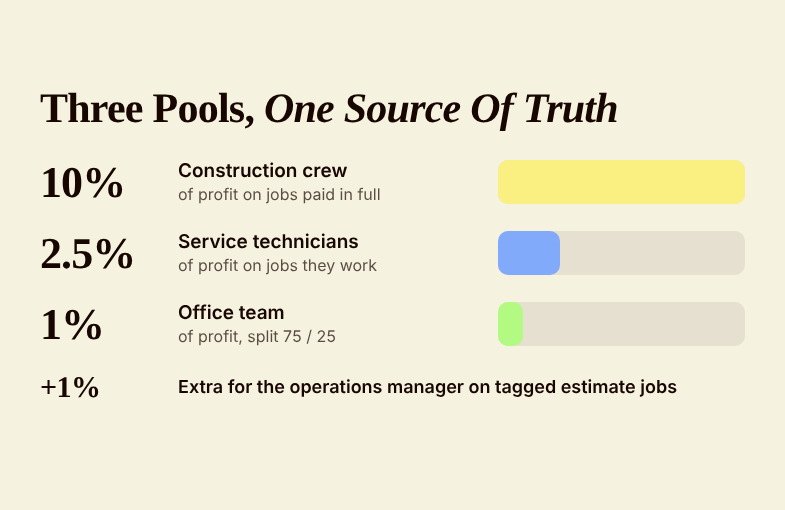
Service technicians are on a simpler rule: they earn 2.5% of the profit on the jobs they work. A $2,000-profit service call pays $50. The plan also counts five-star reviews as a metric, and callbacks, attendance problems, and performance infractions come off as fixed deductions rather than percentages.
The office pool is 1% of job profit, split 75% and 25% between two people. The split mirrors their levels, 3 and 1, since 3 divided by 4 is 75%. The operations manager, who also estimates and does some job work, earns an extra 1% on jobs he estimates. Because the estimates report does not show who sold a job, those jobs carry a tag so the plan knows when to apply the bonus.
On the $20,000 example job, that works out to $150 for the operations manager's base share, $50 for the other office team member, and an extra $200 for the operations manager if the job carries the estimate tag.
Profit sharing
made simple.
Give your team a stake in the company’s success. ShareWillow helps you create and manage profit-sharing programs that motivate employees and drive business results.
Rollout: Run It in the Background Before Anyone Sees a Dollar
The owner made a choice worth copying. Instead of announcing the plan, he kept it running under his own login while he verified the numbers. The team will see it only after the job costing and calculations hold up. Early in the process the Housecall Pro login stopped working, probably after a password change, and the automated data pulls stalled. Plan data went stale until fresh credentials were entered and the sync restarted.
That is exactly the kind of problem you want to discover before payday. A quiet rollout gave the company a safe window to fix it. They also agreed to meet weekly and review what each payout would have been, which turns the first few weeks into a rehearsal instead of a launch.
Profit-based plans depend on accurate job costing, so the owner is checking those inputs first. If you want a deeper look at how a plan like this fits into a broader program, see our guide to profit sharing plan examples for a small business, or look at how Sharewillow's plan builder and job-level datasets let an owner trace any payout back to the jobs behind it.
The Outcome So Far
In one onboarding conversation, the company moved from scattered bonus tracking to four defined pools with exact percentages: 10% of construction job profit, 2.5% of service job profit, 1% for the office, and 1% extra on tagged estimates. The Housecall Pro connection was restored, the construction data was recalculated in about 30 minutes, and a weekly review was set to compare projected payouts before the team sees any of it.
It is early, and the real test is whether the first live payouts match what the owner expects. But the structure answers the original problem. Every dollar now traces to a paid job, a level, and a count of hours.
How to Build Your Own Job Profit Bonus Plan
- Pick the profit definition. Decide what comes off revenue before profit is calculated, and make sure your system captures it
- Set the pool percentage. Start small enough that the company still wins on every job. This company chose 10% for construction crews
- Split by role and effort. A mix like 30% by level and 70% by hours rewards both experience and time on the job
- Gate it on payment. Pay only on jobs paid in full
- Handle exceptions with tags. Use a job tag for special cases, like an estimate that earns the operations manager an extra share
- Rehearse before launch. Run the plan in the background and review projected payouts weekly
Frequently Asked Questions
What percentage of job profit should go to a bonus pool?
There is no universal number. This company uses 10% for construction crews and 2.5% for service technicians. Start with a percentage that leaves your margin healthy even on a slow month, then adjust after you see real payouts.
Should a profit bonus be paid when a job is complete or when it is paid in full?
Paid in full is the safer rule. A completed job can sit with an open balance for weeks, and paying a bonus on money you have not collected puts the company at risk.
How do you split a crew bonus fairly?
Combine a fixed weight, like employee level, with a variable one, like hours worked. The level share rewards experience, and the hours share rewards the people who put in the time on a specific job.
Related reading
Conclusion
Fund the pool from paid job profit, split it by level and hours, and run it in the background until the data earns the team's trust.
Create incentives
that
drive results
You shouldn't need complex equity plans to align your team. ShareWillow makes it simple to create transparent profit-sharing programs that motivate employees and grow your business.

Incentive plans to help
small businesses thrive.
.png)
"I was able to leverage the knowledge of the ShareWillow team to learn how other companies were designing their bonus plans. The template was extremely helpful."

Brian Tustin
Owner, First Rate Movers