
Electrical installer bonus plan: how a contractor funds a 2% pool only on jobs above a 45% gross margin, split by hours, with commission paid when jobs are paid.
An electrical installer bonus plan has a built-in tension: installers want to be paid for the work they do, and the company only wants to pay extra when the job actually made money. One Mid-Atlantic electrical contractor settled that tension with a single sentence. Installers share a pool equal to 2% of a job's revenue, but only on jobs that clear a 45% gross profit margin, and the pool is divided by hours worked.
The company agreed to that rule during its onboarding, along with a second rule that keeps sales commission honest: nobody earns commission on a job until it is complete and fully paid. Here is how both pieces work, and how you can adapt them.
The Problem: Sales Staff Could Not See Their Pay, and Installers Had No Stake in Margin
Before this setup, the company ran commission through a manual process. Salespeople had no visibility into what they had earned, and the office had to track by hand which jobs were finished and which had a balance left. Installers and technicians were paid hourly, with nothing tying their work to whether a job was profitable.
That gap shows up in a few predictable ways:
- Commission paid too early. A job marked complete can still have an unpaid balance for weeks
- Commission paid in the wrong month. A job completed in one month and paid in the next can land in the wrong pay period
- No reason to protect margin. Installers who finish fast but sloppy, or burn extra material, never feel the cost
The company wanted a plan that answered all three at once, without turning the technician side into a complicated spreadsheet of its own. Our story of a small electrical company that rebuilt commission to keep its best installers covers a related retention angle if that is your concern.
Electrical Installer Bonus Plan: The 2% Pool Above a 45% Margin
The installer plan is deliberately short. Three rules cover it:
- The job has to clear 45% gross profit margin. Below that line, the pool does not open
- The pool is 2% of the job's revenue. It is a small, predictable slice rather than a share of profit that moves around
- The pool is split by hours worked. The installer who spent more hours on the job earns the larger share
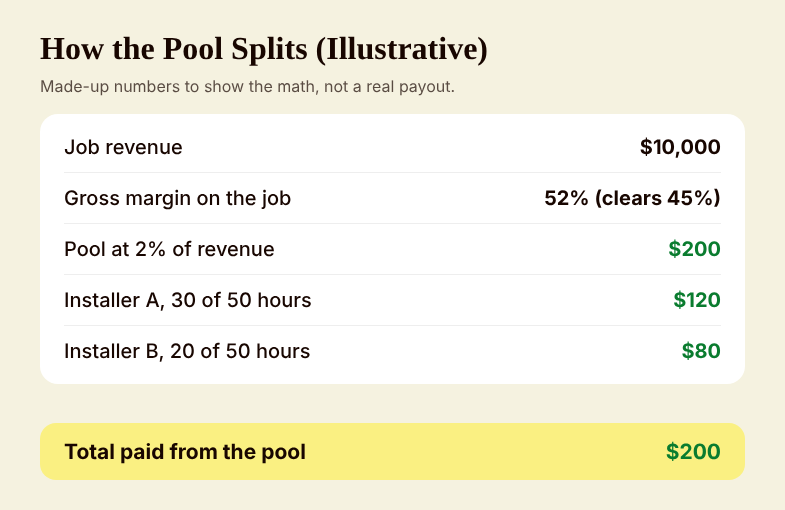
Here is the math with made-up numbers, shown in the image above. Suppose a $10,000 job finishes at a 52% gross margin, so it clears the 45% bar. The pool is 2% of $10,000, which is $200. If one installer worked 30 of the job's 50 hours and another worked 20, the first earns $120 and the second earns $80. If the same job had finished at 40%, the pool would be zero, and nobody would earn it. These are illustrative figures, not the company's payroll.
The reason this works is that it ties the reward to the thing the company cares about, which is profit, without asking installers to understand accounting. They can see that a clean install with no wasted material and no return trips is the one that opens the pool. Our case study on an HVAC company that set $300 to $1,000 awards by job type approaches the same goal with fixed awards, and it is a helpful comparison if you prefer a flat number.
Why a Small Percentage and a Margin Gate Beat a Big Promise
Owners sometimes start by asking what percentage of profit installers should receive. That question is harder than it looks, because job profit changes as costs come in, and a plan that pays on a moving number is hard to explain. A fixed 2% of revenue, unlocked by a margin test, is easy to say out loud, easy to calculate, and easy to defend.
The margin gate also protects the company from its own generosity. Without it, a plan that pays a percentage of revenue would reward installers for jobs that lost money. With it, the company only shares when it has already earned a healthy margin. If you want a wider view of pool-style plans, our roundup of profit sharing plan examples shows several structures side by side.
There is one practical dependency, and it is worth flagging. A gross margin gate is only as good as the job costs underneath it. If labor and material costs are not recorded accurately, the margin will be wrong and the pool will open or close for the wrong reasons. Before you launch a plan like this, spot-check a few finished jobs against your own books.
Sales Commission: Paid Only When the Balance Hits Zero
The second half of the plan covers the salespeople. Two commission plans were built, one at 7% and one at 3% shared between two reps. The rate matters less than the trigger. Commission is only earned when the project is 100% complete and fully paid, with a zero balance.
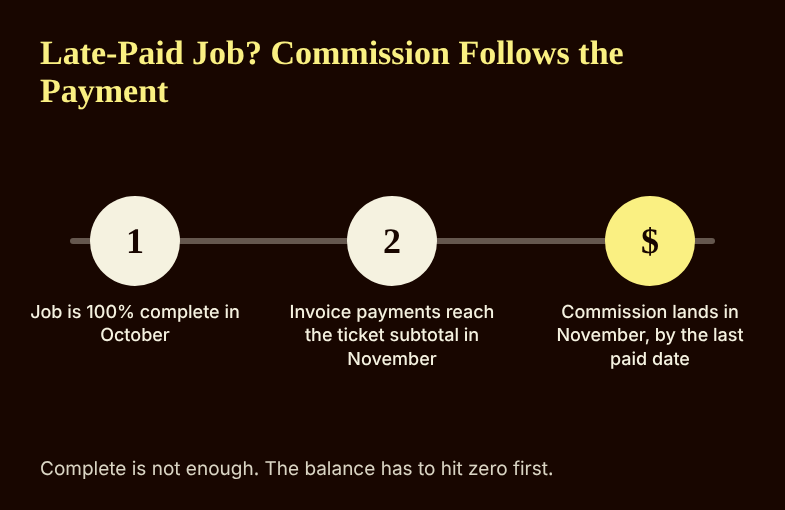
That rule raised the obvious question on the kickoff call. What about a job that is completed in one month and paid in the next? The answer is that commission follows the payment. The plan uses the job's last paid date, and it confirms that invoice payments equal the ticket subtotal before the job counts. If a job finishes in October and the final payment arrives in November, the commission belongs to November.
This is the same problem explored in our case study on completed date versus paid date and the $6,600 in open balances that forced the question. The takeaway is consistent: decide the trigger first, then write it into the plan, so nobody has to argue about it at month end.
Keeping the Technician Plan Clean
One more decision kept the plan from sprawling. Technicians are paid hourly through a separate process, so their monthly plan shows bonus amounts only. Regular and overtime hours were removed from the technician view on purpose. When a pay screen mixes hourly pay and incentive pay, employees struggle to tell what they earned from what they were already owed, and the office ends up fielding questions about hours that the incentive plan never touches.
The company's operations lead agreed with that choice and will receive the month-end payout steps. Anyone reviewing a number can filter by month and employee and look at the individual jobs behind it, so a result that looks odd can be traced to a specific job rather than guessed at.
Profit sharing
made simple.
Give your team a stake in the company’s success. ShareWillow helps you create and manage profit-sharing programs that motivate employees and drive business results.
The Result: Three Rules Written Down Before the First Payout
The company approved its installer pool and its sales commission trigger in a single session. The pool is 2% of revenue above a 45% margin, split by hours. Sales commission waits for a complete, fully paid job and follows the last paid date. Technician plans show bonus dollars only. A final review is scheduled to walk through closing a payout and to plan how the team is introduced to the plans.
Nobody has been paid yet, so there is no payout number to report, and that is the point. The hard questions were answered before the first confusing paycheck, not after.
How to Build an Electrical Installer Bonus Plan
- Pick a margin gate. Choose a gross margin your company is happy with and make it the entry requirement.
- Fund a small, fixed pool. A percentage of revenue is easier to explain than a share of moving profit.
- Split by hours. It rewards the people who put the work in.
- Define "paid." Use the last paid date and require the balance to be zero before sales commission counts.
- Separate hourly pay from bonus pay. Show employees one thing at a time.
- Check your costs. A margin gate needs accurate job costs.
For an electrical contractor that wants to see how margin, hours, and payment dates turn into payouts, ShareWillow's product features walk through the setup.
Frequently Asked Questions
How do you structure an installer bonus plan?
Start with a gate that protects the company, such as a minimum gross margin, then fund a small pool from job revenue and split it by hours worked. This company uses 2% of revenue on jobs above a 45% margin.
When should sales commission be paid on an electrical job?
Many companies wait until the job is complete and fully paid. Using the job's last paid date keeps a job that finishes in one month and gets paid in the next from landing in the wrong pay period.
Should installers see their regular and overtime hours in a bonus plan?
Not necessarily. If hourly pay is handled separately, showing only the bonus amount keeps the plan easy to read and avoids confusion about what the incentive actually covers.
Related reading
- How a Small Electrical Company Rebuilt Commission to Keep Its Best Installers
- When to Pay Technician Commission: Completed Date vs. Paid Date, and the $6,600 in Open Balances That Forced the Question
- HVAC Installer Bonus: How One Company Set $300 to $1,000 Awards by Job Type Before Its First Payout
- Electrician Bonus Plan: How an Electrical Company Rewards Passed Inspections and Scores Apprentices Every Week
Conclusion
Gate the pool on margin, split it by hours, and pay sales commission only when the balance is zero.
Create incentives
that
drive results
You shouldn't need complex equity plans to align your team. ShareWillow makes it simple to create transparent profit-sharing programs that motivate employees and grow your business.

Incentive plans to help
small businesses thrive.
.png)
"I was able to leverage the knowledge of the ShareWillow team to learn how other companies were designing their bonus plans. The template was extremely helpful."

Brian Tustin
Owner, First Rate Movers
