
A regional moving company's bonus plan was quietly rewarding the wrong behavior: attendance over hours, review percentage over volume, and claims math that could break entirely. Here's how the formula got rebuilt around hours worked, real review counts, and a hard claims-ratio gate, and what the first live month proved.
Moving companies live with a kind of exposure most businesses don't think about every day. A crew shows up, lifts a client's belongings onto a truck, drives them across town or across the state, and sets them back down. Somewhere in that chain, a dresser gets a scuff, a TV corner cracks, a box of dishes doesn't survive the ride. It's not a hypothetical. It's the job.
That's exactly why a bonus formula for a moving crew can't just reward volume or attendance. If you pay purely on how many jobs got done or how many days someone showed up, you're optimizing for speed and presence, not for the care that keeps claims down and reviews up. And the moment your incentive plan and your actual business goals point in different directions, you start paying people to do the wrong thing well.
This is the story of a regional moving and storage company in the Midwest, running about a dozen movers and drivers, that found out the hard way how easy it is for a bonus formula to drift from what you meant to reward. It's also the story of what it took to fix it, and the first real numbers that came back once the fix went live. If you run any kind of crew-based field service business, whether that's moving, HVAC, plumbing, or general construction, the failure modes here will look familiar.
A formula that measured the wrong things
On paper, the original bonus plan looked reasonable. Movers and drivers could earn extra pay based on how much they worked, how well customers rated them, and how clean their claims record was. In practice, each of those three legs had a quiet flaw, and the flaws compounded.
Start with eligibility. The plan measured days worked instead of hours worked. That sounds like a small distinction until you picture two real movers. One shows up for ten days and works six or seven hours each time, doing real, sustained labor. Another shows up for the same ten days but gets cut early more often, or catches lighter assignments, and logs meaningfully fewer total hours. Under a days-worked eligibility rule, both movers look identical on the one number that decides whether they qualify for a bonus at all. The person doing more of the actual work has no way to show it.
Then there was the review metric. Five-star reviews were tracked as a percentage of all 4- and 5-star ratings, not as a raw count. That measures consistency, which isn't nothing, but it hides volume completely. A mover who brought in twenty-five five-star reviews in a month and a mover who brought in eight can post the exact same percentage if their ratios happen to line up. Percentage and count tell genuinely different stories, and a formula that only looks at one of them can't tell a workhorse from someone who just did fewer jobs cleanly. The mover generating far more praise, far more repeat business, far more of what actually keeps a moving company's reputation intact, wasn't being paid any differently for it.
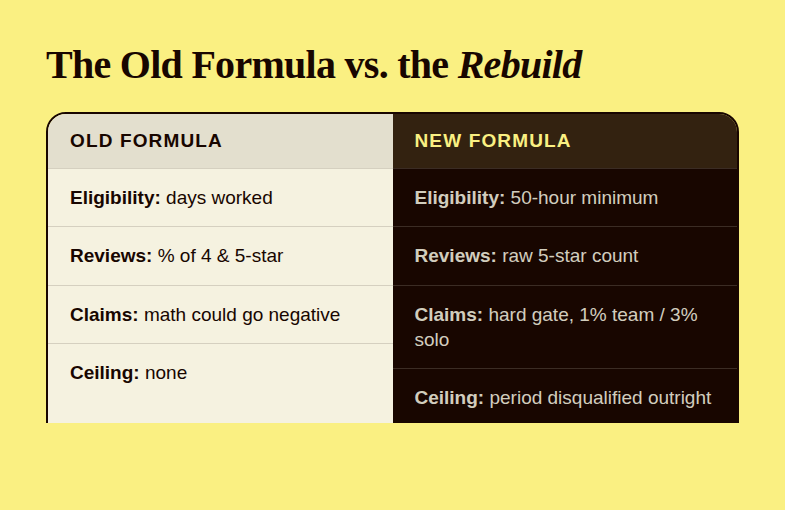
The third leg was the most dangerous one: damage claims. This is the metric that exists specifically because moving companies carry real liability every time a crew touches a customer's belongings, and it was the one most quietly broken. The underlying claims data occasionally produced negative claims numbers, which is obviously not a real state of the world, but it was enough to break the bonus math outright when it happened. And separate from that bug, there was no firm ceiling anywhere in the plan. An employee could rack up a meaningful amount of claims activity in a period and still stay technically eligible for a payout, because nothing in the formula said "past this point, it matters enough to stop the bonus entirely."
Put those three flaws together and you get a plan that could hand out money based on attendance instead of effort, reward consistency over volume in a way that shortchanged the highest performers, and fail to meaningfully penalize a bad claims period. None of that was intentional. It's what happens when a bonus formula is built once and then left alone while the business keeps moving.
Rebuilding the formula, rule by rule
Fixing a bonus plan like this isn't about scrapping it and starting over. It's about going through each piece, asking what it was actually supposed to measure, and rebuilding it so the number matches the intent. That's what happened here, one rule at a time.
Hours replaced days. Eligibility now runs on hours actually worked in the period, with a minimum 50-hour threshold required just to qualify for a bonus at all. That single change closes the gap between the mover who shows up and the mover who works. It also sets a real floor: show up for a handful of shifts and clock out early every time, and you simply don't hit the bar. The bonus period starts counting real effort, not attendance.
Review count replaced review percentage. Five-star reviews are now tracked as a raw total, not a share of 4- and 5-star ratings. The mover who brings in twenty-five five-star reviews now visibly outperforms the one who brings in eight, because the number the formula reads is the number that actually reflects more satisfied customers and more reinforcement of the brand. Volume counts again.
A hard claims gate replaced no ceiling at all. This is the centerpiece of the rebuild. Cross a 1% claims ratio at the team level, or 3% individually, and that bonus period is disqualified outright. No partial credit, no exceptions, no sliding scale. A gate like this only works if it's absolute, because the entire point is to make claims performance something the whole crew has a direct stake in, not a number that quietly caps out a bonus a little.
Company gross profit margin sits underneath all of this as a secondary funding gate on the whole pool. Even if every individual and team-level rule is satisfied, the bonus pool itself only gets funded if the company is actually generating the margin to support it. That keeps the incentive plan tied to the business's actual financial health, not just to crew-level metrics in isolation.
Team leads got their own separate structure entirely: a quarterly bonus tied specifically to claims performance. That's a deliberate design choice. Team leads are the ones actually managing crew behavior on the truck in real time, deciding how items get wrapped, how a tight stairwell gets handled, how a rushed afternoon gets paced. Giving them a bonus tied directly to the metric they have the most influence over, on a cadence that matches how claims patterns actually show up, puts accountability where the leverage is.
Driving and same-day bonuses were also broken out onto their own separate line, instead of being folded into the main incentive pool. That keeps the core formula, hours, reviews, and claims, focused on the behaviors it's designed to reward, without a strong same-day bonus month distorting what the rest of the crew sees in their own numbers.
Training the crew before flipping the switch
None of this went live quietly. Before the new formula rolled out, the company ran a live training session with the entire team, not just supervisors and managers. Every mover and every driver walked through exactly how their own number would be calculated going forward: what counted as an hour, how the review count worked, where the claims gate sat, and what would happen if it got crossed.
That step matters more than it might seem. A bonus formula only changes behavior if the people earning it actually understand it. A plan that quietly disqualifies a bonus period at a 1% claims ratio only works as a deterrent if the crew handling boxes on a Tuesday afternoon knows that number exists and knows roughly where their team stands relative to it. Explaining the mechanics up front, to everyone, turns the formula from a black box into a shared target.
Profit sharing
made simple.
Give your team a stake in the company’s success. ShareWillow helps you create and manage profit-sharing programs that motivate employees and drive business results.
What the first live month actually proved
Formulas are easy to design on a whiteboard. The real test is what happens when a real crew runs real jobs against the new rules for the first time. In this case, that test came fast.
In the very first month the new formula ran, the team's claims ratio came in at 0.32%, less than a third of the 1% ceiling the whole plan is built around. That's not a number anyone could engineer after the fact. It's what happened when a dozen movers and drivers went about a normal month of real moving jobs under a new set of rules they'd just been trained on.
The pool paid out just over $450 across seven movers and drivers that month, with individual payouts ranging from about $15 to $135 depending on hours worked, review count, and attendance. Those aren't huge numbers, and they aren't supposed to be. This was month one. What matters is that the spread of payouts tracked the things the formula was actually designed to reward, and the crew stayed comfortably clear of the one number that could have zeroed the whole pool out.

A claims-ratio gate is only as credible as the first real month it survives. Set a threshold too loose and it never does anything. Set it without testing it against actual operating data and you risk disqualifying a crew for reasons that have nothing to do with how they're actually performing. Watching a real team clear the gate by a wide margin in its first live cycle is exactly the kind of validation a business owner needs before trusting a new pay formula with real money.
The takeaways for any crew-based field service business
This case study happens to be about a moving company, but almost none of it is specific to moving. Any business that sends a crew into someone else's home, building, or job site, and pays them based on performance, is running the same risks.
- Measure the unit that matters. If hours worked is the real driver of output, don't let days worked stand in for it. The gap between the two hides your best performers.
- Counts and percentages tell different stories. Know which one you actually want to reward, and don't default to percentage just because it's easier to normalize across a team.
- Build hard gates around real liability. Damage claims, safety incidents, callbacks, anything with financial or reputational exposure deserves a firm ceiling, not a soft penalty buried in the math.
- Fix the data bugs, not just the policy. A formula that can produce a negative claims number is a formula that can break in front of the people counting on it. Data integrity is part of plan design, not separate from it.
- Give the people with the most influence their own incentive. Team leads managing crew behavior in real time need a bonus tied to what they can actually control.
- Train the whole team before launch, not just management. A formula only changes behavior if the people earning it understand exactly how their number gets calculated.
The underlying lesson is simple, even if the fix takes real work: a bonus formula is a set of instructions for what to optimize. If it's built on the wrong units, or missing a ceiling where one clearly belongs, it will quietly train your best people to do the wrong thing, no matter how good your intentions were when you wrote it.
This same logic shows up across every field-service trade, not just moving. Crews doing construction and other crew-based field work face the same tension between speed, quality, and liability that any pay plan has to balance. If you want to see how ShareWillow builds pay calculations that hold up against real operating data instead of just looking clean on a spreadsheet, or you're curious how a similar rebuild played out for an HVAC company automating its spiff program in our companion case study, those are good next stops. And if your own bonus formula hasn't been pressure-tested against a real month of data yet, get started with ShareWillow and find out what it's actually rewarding.
Related reading
Conclusion
A bonus formula that survives its first real month, at a 0.32% claims ratio against a 1% ceiling, is a formula worth trusting.
Create incentives
that
drive results
You shouldn't need complex equity plans to align your team. ShareWillow makes it simple to create transparent profit-sharing programs that motivate employees and grow your business.

Incentive plans to help
small businesses thrive.
.png)
"I was able to leverage the knowledge of the ShareWillow team to learn how other companies were designing their bonus plans. The template was extremely helpful."

Brian Tustin
Owner, First Rate Movers
