
A refrigeration and HVAC service company's techs waited up to a month to feel a big sale pay off. Moving to biweekly payouts with a tiered 3 to 4 percent commission closed that gap and gave top performers a reason to keep pushing.
A great week should feel like a great week
There is a specific kind of frustration that shows up on service teams with monthly commission cycles, and it has nothing to do with how much money techs are actually earning. It has to do with timing. A technician lands a big commercial refrigeration sale on the second Monday of the month, closes it cleanly, does everything right, and then waits. And waits. The commission does not show up until the next scheduled payroll run, sometimes three weeks later, by which point the sale that felt like a genuine win barely registers anymore. It just becomes a slightly bigger number on a paycheck that arrives like every other paycheck.
That was the exact situation at a refrigeration and HVAC service company running a standard monthly payout cycle. The commission structure itself was not the problem. Techs earned a percentage of the jobs they closed, the math was fair, and nobody was disputing the plan on paper. The problem was the gap between doing great work and feeling any reward for it. One manager summed it up in a single sentence during a plan review: a great week should feel like a great week, not a month later.
This is a more common issue in HVAC and refrigeration incentive pay than the industry tends to talk about. Commission structures get a lot of design attention: what percentage to pay, which tiers to set, how to handle installs versus service calls. Payout frequency gets almost none. It is treated as a payroll logistics question rather than a motivation question, which is a mistake, because behavioral research on incentive pay is pretty consistent on this point: the closer a reward sits to the behavior that earned it, the stronger the effect on future behavior. A monthly cycle does not just delay the money. It weakens the connection between the sale and the feeling of being rewarded for it, and that connection is most of what makes variable pay work as a motivator in the first place.
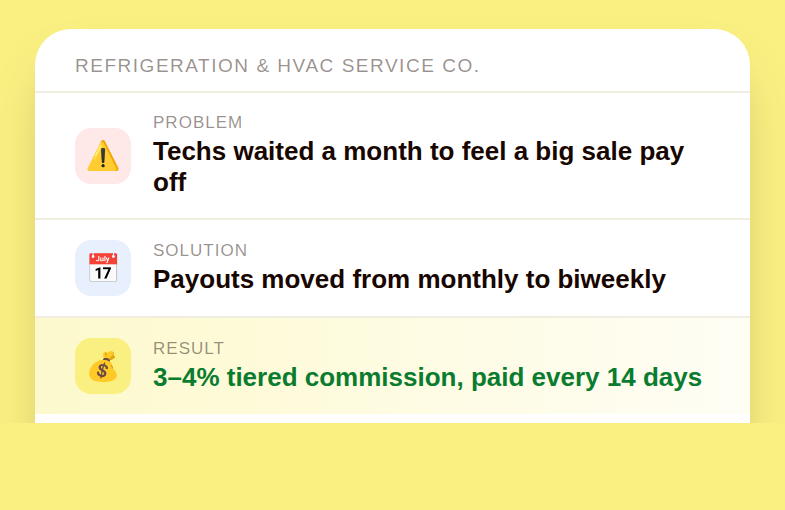
The company's techs were not underpaid. They were under-rewarded, in the sense that mattered for behavior. A tech who closes a great week and does not feel the payoff for a month has plenty of time for that feeling to fade before the next paycheck even arrives, and a feeling that fades before it gets reinforced does not build the habit a business actually wants: pushing for the extra upsell, taking the harder commercial job, staying sharp on a Friday afternoon the same way they would on a Monday morning.
The fix: shorten the gap, sharpen the tiers
The company made two changes at once, and both mattered, though for different reasons. First, they moved the payout cycle from monthly to biweekly, cutting the average wait between closing a job and seeing it paid out roughly in half. Second, they restructured the flat commission rate into a tiered structure, paying 3% on standard performance and stepping up to 4% once a technician cleared a defined monthly threshold.
The biweekly change addressed the emotional gap directly. Techs now saw the financial result of a strong week within roughly two weeks instead of up to a month, which kept the connection between effort and reward intact instead of letting it go cold. It also gave managers a much better coaching tool. A slow week now shows up in a paycheck within two weeks instead of getting buried inside a full month of mixed performance, which makes it far easier to have a timely conversation about what happened and what needs to change, rather than trying to reconstruct a month-old slump from memory during a performance review nobody enjoys having.
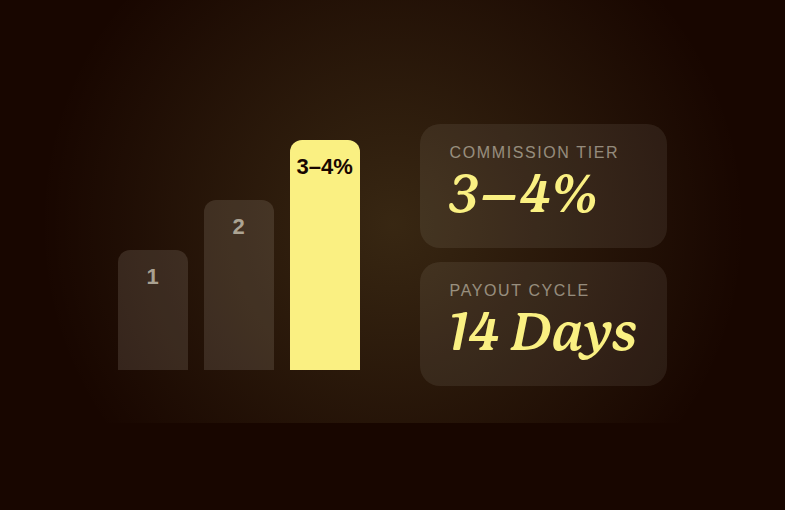
The tiered structure did something the flat rate never could: it gave techs a reason to push in the final stretch of a strong month instead of coasting once they hit a comfortable number. Under a flat 3% rate, a tech's twentieth job of the month pays exactly the same percentage as their fifth. Under the tiered structure, clearing the threshold means every job after it, for the rest of that period, earns a meaningfully higher rate. That is a very different incentive at the margin, and margin behavior is exactly where most commission plans quietly leave performance on the table. The techs who were already strong performers had the clearest new incentive to keep pushing instead of settling once their numbers looked "good enough" for the month.
Running this combination by hand is where most shops give up before they even try. A biweekly cycle doubles the number of payroll calculations a manager has to run correctly every month, and a tiered structure means that calculation is not even the same formula for every technician; it depends on where each person's month-to-date total sits relative to their personal threshold at the moment of each payout. Doing that math manually, twice a month, for an entire crew, without a mistake, is a genuinely hard operational lift, and mistakes in commission math are exactly the kind of thing that erodes trust in a pay plan fast. This is the kind of calculation ShareWillow's platform is built to handle automatically, pulling job data directly from the field service system the company already uses, tracking each tech's progress toward their tier threshold in real time, and calculating the correct payout at every cycle without anyone in the office re-running a spreadsheet formula and hoping they got the reference cells right.
Profit sharing
made simple.
Give your team a stake in the company’s success. ShareWillow helps you create and manage profit-sharing programs that motivate employees and drive business results.
What changed, and how to think about your own cycle
The result the company cared about most was not a dollar figure. It was a shift in how techs talked about their pay. Commission stopped being an abstract monthly outcome and started being something techs tracked actively, the same way they might track their close rate or their average ticket. A strong week now had an obvious, near-term payoff attached to it, and that payoff arriving on a predictable, tighter schedule made the whole plan feel more like an honest exchange and less like a lagging indicator nobody could quite connect to their actual work.
If you are running a monthly cycle today and wondering whether this is worth the operational lift, a few questions are worth asking honestly. How long, in practical terms, does a tech wait between closing a strong job and seeing it reflected in a paycheck? If the honest answer is anywhere from two to six weeks depending on when in the cycle the job happened to land, you already have the exact problem this company had, even if nobody on your team has articulated it that clearly yet. The fix does not have to be as aggressive as a full switch to biweekly right away. Even moving from monthly to twice-monthly narrows the gap meaningfully, and it is worth testing before committing to a bigger operational change to your payroll cadence.
Tiered commission is worth evaluating separately from the payout cadence question, since the two changes solve different problems and either one can be implemented without the other. A flat rate is simpler to explain and simpler to run, and for some teams that simplicity is worth more than the marginal behavior change a tier would create. But if you have a group of top performers who tend to ease off once they hit a comfortable number partway through the month, a tier that rewards the final push is one of the more direct ways to address that specific pattern without rewriting the entire plan. This is the same logic behind how one HVAC technician's pay nearly doubled once a plan was rebuilt to actually reward performance at the margin instead of flattening it out.
One caution worth naming honestly: a biweekly cycle is not free from the business's side. It means more frequent payroll processing, more frequent reconciliation, and a real operational commitment to getting the math right twice as often. Shops considering this shift should have accurate, automated job-level data feeding the calculation before they move to a tighter cycle, not after. Attempting biweekly variable pay on top of a manual, error-prone process is the fastest way to introduce mistakes into paychecks, and a mistake in a tech's pay does more damage to trust in the plan than a slow payout ever did. Get the calculation automated first, in whatever cadence you are already running, then tighten the cycle once you are confident it will be correct every single time.
For multi-location operators, this same principle scales up rather than changing shape. The details covered in rebuilding a multi-location HVAC bonus plan from quarterly to monthly payouts apply just as directly here: the tighter the loop between performance and payout, the more the incentive actually functions as an incentive rather than a delayed acknowledgment. Whether the change you need is quarterly to monthly or monthly to biweekly, the underlying math is the same. Money that arrives faster changes behavior faster, and a commission plan that cannot keep up with that pace is leaving real performance on the table every single pay period.
The cash flow question owners actually ask
Every owner who considers a biweekly commission cycle eventually asks some version of the same practical question: does paying out more often hurt cash flow? It is a fair concern, and the honest answer is that it depends far less on frequency than most people assume. The total dollar amount paid out over a month does not change just because it arrives in two installments instead of one; the business is not paying more, just paying on a shorter interval. What actually strains cash flow is unpredictability, not frequency, and a well-structured biweekly plan is if anything more predictable, since it forces the business to reconcile commission against closed, invoiced revenue every two weeks rather than letting a month of activity pile up and get reconciled all at once under time pressure at the end of the cycle.
Where this matters most is for smaller HVAC and refrigeration shops that are still tightly managing working capital week to week. For those businesses, the right sequencing is to tie payout timing to actual collections wherever possible, so a biweekly commission run is drawing against revenue that has genuinely come in the door, not against jobs that are invoiced but not yet paid. Get that sequencing right, and biweekly payouts end up being a scheduling change rather than a financial risk. Get it wrong, and any payout cadence, monthly or biweekly, can create a cash crunch. The cycle length was never really the variable that mattered for cash flow. The discipline behind what triggers a payout always was.
Related reading
Conclusion
Money that arrives faster changes behavior faster; a commission plan that lags a month behind the work is not really an incentive at all.
Create incentives
that
drive results
You shouldn't need complex equity plans to align your team. ShareWillow makes it simple to create transparent profit-sharing programs that motivate employees and grow your business.

Incentive plans to help
small businesses thrive.
.png)
"I was able to leverage the knowledge of the ShareWillow team to learn how other companies were designing their bonus plans. The template was extremely helpful."

Brian Tustin
Owner, First Rate Movers
