
A 60-plus person HVAC, plumbing, and electrical company ran eighteen scattered pay arrangements instead of one system. Rebuilding them as one connected incentive plan tied to real job data helped take revenue from $23 million to $26 million.
Most incentive plans start small. One spiff here, one bonus there, usually built for a single department because that is the department that complained loudest. A multi-trade home services company running HVAC, plumbing, and electrical crews under one roof had built its pay structure exactly that way for years, and it worked well enough that nobody questioned it. Then growth stalled out around $23 million in annual revenue, and leadership had to ask a harder question: was the pay plan actually driving the business, or just riding along with it.
The honest answer was that nobody could say for sure. Install technicians had their own bonus. Install helpers had a different one. A handful of individual sales reps, the kind of people every home services company ends up with, each had a bonus built just for them, negotiated one conversation at a time. Electrical and plumbing on-call staff worked off yet another structure. None of it was wrong exactly. It just was not one thing. It was a patchwork, and patchwork pay plans are hard to steer.
When Every Department Runs Its Own Pay Plan
The real cost of a patchwork incentive structure rarely shows up as an obvious problem. Technicians were still getting paid. Nobody was actively upset. The cost shows up quietly, in the gap between what a company could be paying for and what it is actually paying for. When install techs are on one formula, install helpers on another, and a dozen sales reps are each on their own custom deal, leadership loses the ability to answer a simple question: is this money buying us more revenue, or just buying us peace?
That is the trap a lot of growing HVAC and multi-trade companies fall into. Every one-off plan felt reasonable when it was created. Stacked together, they stop functioning as a system and start functioning as a collection of side deals. Technicians in one role could not see how their work compared to technicians in another. Leadership could not roll the numbers up into one clear picture of what the incentive spend was actually buying.
The fix was not to strip pay back down to a flat wage. Cutting an existing incentive is one of the fastest ways to lose good people to a competitor who will happily match the old number. The fix had to be structural: build one incentive architecture that covered every role, tied to the same source of truth, instead of a dozen separate arrangements nobody could fully see at once.
Building One System Instead of a Dozen Side Deals
ShareWillow worked with the company to rebuild its pay structure role by role, but as one connected system rather than isolated fixes. Install technicians got a monthly incentive plan tied directly to completed installs. Install helpers, twenty-nine of them, got their own structure scaled to their role on the job. Individual installers with unique arrangements, the kind of person who has been closing their own deals for years, kept a plan built around how they actually work, but now sitting inside the same platform as everyone else instead of a spreadsheet only one manager understood.
Plumbing and electrical technicians got a weekly on-call incentive, since emergency and after-hours work needed a faster pay cycle than the monthly install bonus. Sales reps, nine of them by name, moved onto individual weekly commission plans that scaled with what they actually closed. In total, the company now runs incentive pay across roughly eighteen distinct plans, all connected to the same underlying job and revenue data pulled from their field service software instead of hand-entered into a dozen separate trackers.
That last part matters more than it sounds like it should. When install bonuses, on-call awards, and sales commission all draw from the same live data, a technician's pay reflects what actually happened on the job, not what someone remembered to write down two weeks later. It also means leadership can finally see incentive spend as one number instead of eighteen separate ones scattered across departments.
From $23 Million to $26 Million
The company's revenue moved from $23 million to $26 million after the incentive rebuild went live, a jump leadership has since pointed to directly when explaining what changed. That is roughly $1 million of added cash flow on top of the incentive payouts themselves, not instead of them. The plan did not grow revenue by cutting pay. It grew revenue by connecting pay to the specific behaviors, completed installs, efficient on-call response, closed sales, that actually move the business forward.
That pattern shows up across ShareWillow's broader HVAC customer base too, not just in this one company's numbers. Among companies that have connected their field service data to a live incentive plan, average ticket size has climbed from roughly $800 to $1,800, and average job completion time has dropped from about 4.5 hours to 2.5 hours. Faster, higher-value jobs are exactly what you would expect once technicians can see a direct line between doing better work and taking home more of it.
None of this is theoretical for the shops running it. Across a cohort of HVAC companies on ShareWillow with at least one confirmed payout, the average shop has already run through 39 separate payout cycles. These are not pilot programs a company tries for a quarter and quietly drops. They are pay structures that keep running, cycle after cycle, because the plan keeps paying for itself.
Why a Sales Rep's Custom Deal Did Not Get Thrown Out
One detail worth calling out: the rebuild did not force every sales rep onto an identical formula just for the sake of tidiness. A rep with a long track record and a plan built around how they actually sell kept a version of that plan. What changed was where it lived. Instead of a side arrangement only one manager remembered the details of, it became a documented, trackable plan inside the same system as every other technician and rep. Consistency did not mean sameness. It meant every plan, however customized, was finally visible, auditable, and tied to real numbers instead of memory.
That distinction matters for any multi-trade company nervous about a full incentive redesign. The goal is not to erase the arrangements that already work. It is to stop letting good, individually reasonable pay decisions add up to a system nobody can see clearly. A rep who has earned a custom deal can keep it. Leadership just needs to be able to see it next to everyone else's.
It also removes a quiet risk that shows up in almost every company running side-deal pay plans: what happens when the one manager who understands a given arrangement leaves. A custom commission structure that lives in one person's head, or in a spreadsheet tab nobody else opens, is a liability disguised as flexibility. Moving that same arrangement into a shared, documented system does not make it less personal to the rep who earned it. It just means the company does not lose the ability to run it correctly the day that manager takes a vacation, or a new job.
Profit sharing
made simple.
Give your team a stake in the company’s success. ShareWillow helps you create and manage profit-sharing programs that motivate employees and drive business results.
What This Means for the Person Signing the Checks
For a business owner or a facilities director looking at a multi-trade P&L, incentive pay usually shows up as a single line: total commissions and bonuses paid. That single number hides everything useful about it. It does not say whether the money went to the technicians closing the highest-margin jobs or the ones simply logging the most hours. It does not say whether a $4,000 monthly bonus pool moved revenue at all, or whether it just kept pace with what technicians would have earned anyway on a straight commission.
Rebuilding eighteen plans into one visible system changed that. Leadership could finally see incentive spend broken down by role, by plan, and by outcome, in the same place they were already looking at revenue and labor cost. That visibility is what let them keep the individual sales rep deals that were working while still being able to say, with confidence, what the plan as a whole was buying. A business owner does not need every incentive plan to look identical. They need to be able to see all of them at once.
That kind of visibility also changes how a leadership team makes its next decision. Before the rebuild, adding a new incentive for a new role, say a dedicated warranty callback technician, meant building another one-off plan from scratch and hoping it did not conflict with anything else already running. After the rebuild, adding a role means slotting it into an existing system with a known shape. The eighteenth plan was not meaningfully harder to stand up than the fourth one, because the underlying structure, tying pay to live job data instead of manual tracking, was already built.
What This Looks Like Day to Day
For an install technician, the monthly plan means a completed job flows straight from the field service platform into a bonus calculation without anyone re-entering data. For an on-call plumber or electrician, a weekly cycle means a busy emergency week shows up in a paycheck days later, not a month later, which keeps the incentive close enough to the work that it actually changes behavior. For a sales rep, a live weekly commission means the number on a closed deal and the number in a paycheck are the same number, calculated the same way every time.
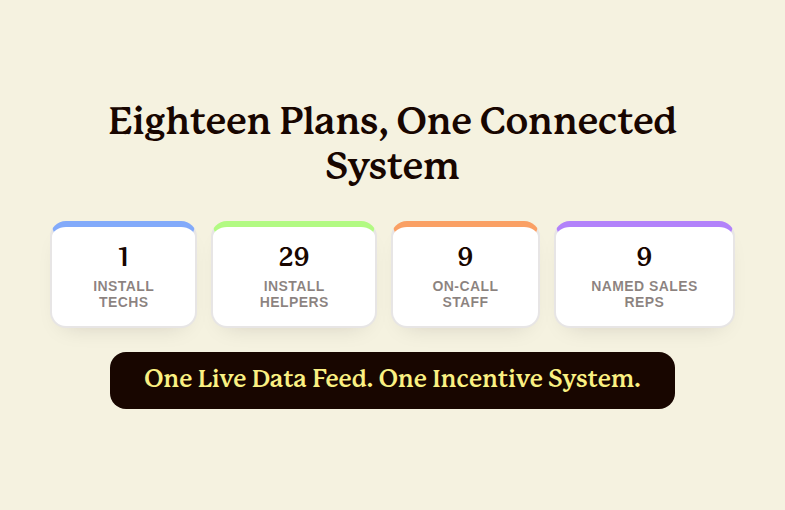
That consistency is what let the company scale the approach past a single department. Once install techs had a working plan, extending the same logic to install helpers, then to on-call staff, then to sales reps, was a matter of adjusting the formula to the role, not rebuilding the whole approach from scratch. Automated, data-driven incentive tracking is what makes that kind of expansion realistic. Doing it by hand across eighteen plans and dozens of employees would have consumed a full-time role on its own.
What Other Multi-Trade Companies Should Take From This
If your company runs more than one trade under one roof, there is a good chance your pay structure looks like this one did before the rebuild: reasonable in isolation, hard to see as a whole. The question worth asking is not whether any single plan is fair. It is whether leadership could pull up every incentive plan in the company right now and explain, in one sitting, exactly what each one is paying for and why.
The version of this story that plays out in pure commission structures looks a little different. This plumbing and leak-detection company's move from commission-only pay to tiered hourly-plus-commission bands tackles the same core problem, inconsistent pay that does not scale, from the angle of a single department instead of a whole multi-trade operation. Different starting point, same underlying fix: replace ad hoc pay decisions with one system everyone can see.
Growth that stalls at a specific revenue number is rarely a demand problem. More often, it is a pay structure that stopped scaling with the business years before anyone noticed. Rebuilding it as one system, instead of patching the loudest complaint each quarter, is what turned $23 million into $26 million here. It is worth checking whether the same gap is sitting quietly in your own numbers.
Related reading
Conclusion
Rebuilding eighteen scattered pay arrangements into one connected incentive system helped take this multi-trade company's revenue from $23 million to $26 million, roughly $1 million in added cash flow.
Create incentives
that
drive results
You shouldn't need complex equity plans to align your team. ShareWillow makes it simple to create transparent profit-sharing programs that motivate employees and grow your business.

Incentive plans to help
small businesses thrive.
.png)
"I was able to leverage the knowledge of the ShareWillow team to learn how other companies were designing their bonus plans. The template was extremely helpful."

Brian Tustin
Owner, First Rate Movers
