A 3-person pest control operator in California knew flat hourly pay was rewarding slow work and creating overtime headaches under state law. A blended-rate, points-based production and attendance plan fixed both problems and now tracks a 0% reservice rate.
Ask most pest control owners running a small crew on straight hourly pay what worries them about switching to performance pay, and the answer usually has nothing to do with the paperwork. It has to do with what happens to the work itself once speed starts paying better than thoroughness. That was exactly the concern at a small pest control operator running crews across California and the surrounding region: pure hourly pay was quietly training technicians to take their time, because there was no reason not to. As the team put it plainly during the buying conversation, the flat rate was letting techs get away with "milking the clock," stretching out routine stops with no consequence, while time-per-stop varied wildly from one technician to the next with nothing tying pay to either efficiency or the quality of the work actually being done.
That alone would be reason enough to look at a different pay structure. But there was a second, sharper problem sitting underneath it, one that a lot of small operators in California run into without fully realizing how exposed it leaves them: state overtime and bonus law requires that when a bonus is layered on top of hourly pay, the effective regular rate used to calculate overtime has to be recalculated to account for that bonus, for every employee, every pay period. Doing that by hand, correctly, for every technician on every paycheck is the kind of compliance task that is easy to get wrong quietly for months before anyone notices, and expensive to get wrong once someone finally does.
So this was never simply a motivation problem. It was a motivation problem tangled up with a real legal and payroll compliance problem, and any fix that only solved one of the two was not going to be a real fix at all.
The Trap of "Just Pay Them a Percentage"
The obvious-sounding fix, paying technicians straight production pay instead of an hourly rate, would have solved the clock-milking problem and created a new one in its place. Pure production pay on a small crew, with no quality checks built in, tends to reward exactly the kind of rushed, corner-cutting work that a company doing pest control cannot afford. A technician racing to maximize stops per day has every incentive to shorten service time, skip the parts of a job a homeowner will not immediately notice, and move to the next stop. In a business where a callback means an unhappy customer and a second unpaid visit, that tradeoff is not hypothetical.
And a pure production switch still would not have touched the California overtime compliance problem at all. If anything, moving to a percentage-of-production model without solving the blended-rate calculation would have made the compliance exposure worse, not better, since production pay has its own set of rules for how it interacts with overtime.
A Blended Rate, Recalculated Automatically, Tied to Quality and Attendance
What ShareWillow built instead was a points-based production and attendance plan that computes each technician's blended effective hourly rate on an ongoing basis and exports it directly into the company's payroll system as a bonus line, recalculated automatically rather than by hand every pay period. That single piece of automation removes the exact compliance risk the owner was worried about: the blended rate that California law requires for correct overtime calculation gets recalculated every cycle without anyone on staff needing to run that math themselves.
The plan tracks four specific things for each technician: job quality, job efficiency, approved overtime, and callback or reservice rate. That combination is deliberate. Job efficiency alone would recreate the same rushed-work problem that pure production pay causes. Job quality and callback rate sitting alongside it are what keep efficiency from becoming an excuse to cut corners. A technician who moves fast but leaves a customer needing a second visit does not come out ahead under this structure the way they would under a plan measuring speed alone. The points system converts all four inputs into a single award payout on a biweekly basis, so the technician sees one number reflecting the full picture of how they performed, not four disconnected metrics competing for attention.
Four Metrics, Not One, and Why That Matters at This Size
It would have been simpler to build a plan around a single number, say, revenue per hour or stops per day, and call it done. Simpler is not the same as safer. A single-metric plan on a two- or three-person crew is especially risky precisely because there is no depth on the team to absorb one technician gaming the system. On a fifty-person crew, one technician chasing a bad incentive is a localized problem a manager can catch and correct. On a two-person crew, that same behavior is half the company's field capacity, and it shows up in customer complaints fast.
That is the practical argument for tracking job quality, job efficiency, approved overtime, and callback rate together rather than picking the single easiest metric to measure. Efficiency alone rewards speed. Quality alone can reward slow, cautious work that never quite hits a real productivity bar. Callback rate alone is a lagging indicator that only shows a problem after a customer has already been let down once. Combined into one points-based score, the four metrics check each other: a technician cannot maximize their payout by excelling at only one of them while letting the others slide, because the formula is built to weigh all four together rather than let any single input dominate the outcome.
What the Early Numbers Actually Show
This is a small crew, two technicians on the plan during the period reviewed, and it is worth being upfront that the dollar amounts involved reflect that scale rather than a large operation. Confirmed biweekly award payouts across four pay periods came to roughly $1,410 total, trending from $142.61 in the earliest period reviewed up to $627.95 two periods later, before a dip in the most recent period sampled. That is a real, if modest, bonus pool moving through a two-person team, and modest is exactly what you would expect from a company this size. The number that matters more here is not the dollar total. It is what the quality metrics show.
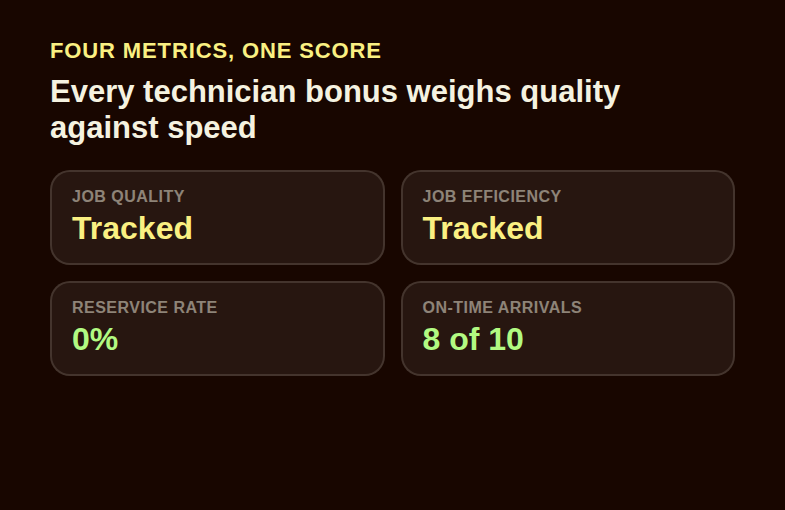
In the operations review conducted partway through the plan's early run, the sampled period showed a 0% reservice rate and 8 on-time arrivals against 2 late arrivals. A 0% reservice rate is the exact signal the original pain point was worried about losing under a production-focused plan: it means the crew was not trading thoroughness for speed. If anything, the quality guardrail built into the points system appears to be doing its job, at least across the window measured so far.
It is also fair to note that this is early data from a plan still in its first several pay cycles, not a multi-year track record. Small numbers can move around more than large ones, and the payout dip in the most recent period is worth watching rather than ignoring. What the data supports clearly, at this stage, is that the compliance problem has a real fix in place and the reservice-rate signal is trending in the right direction, not that every question about the plan's long-term performance is already settled.
The Overtime Math Nobody Wants to Do By Hand
It is worth dwelling for a moment on why the blended-rate recalculation matters as much as the quality metrics, because it is the least visible part of this story and arguably the part with the most financial exposure attached to it. Under California law, when a non-exempt employee earns a bonus, the "regular rate of pay" used to calculate their overtime premium has to include that bonus, which means the overtime rate itself changes depending on how much bonus a technician earned that period. Get that calculation wrong, even in a well-meaning way, and a company can end up systematically underpaying overtime without anyone intending to, a mistake that compounds every pay period it goes uncorrected and carries real back-pay exposure if it is ever audited or challenged.
Doing that recalculation correctly by hand, for every technician, every two weeks, indefinitely, is not a realistic long-term plan for a three-person company where the owner and one or two staff are already covering sales, service, and operations. Automating it into the same points system that already tracks quality and efficiency turns a standing compliance risk into something that simply happens correctly in the background every pay period. That is not a glamorous fix. It is exactly the kind of unglamorous, structural fix that keeps a small business out of trouble it never meant to get into.
It is worth pausing on why this particular risk is so easy for a small operator to miss entirely. A three-person company is not running a dedicated payroll or HR function. The person handling payroll is very likely also the person handling scheduling, customer calls, and half a dozen other jobs, and the blended-rate overtime rule is exactly the kind of technical requirement that never makes it onto anyone's radar until an employee, a departing one especially, raises it, or until a state audit does. Building the recalculation into the pay plan itself, so it simply happens correctly every cycle without depending on any one person remembering the rule exists, closes that gap permanently rather than leaving it as a risk the business is quietly carrying and hoping never surfaces.
What Small Crews Weighing Production Pay Should Take From This
If your team is still on flat hourly pay because you are worried performance pay will just teach people to rush, or because you are in pest control or a similar service business operating in California and have not found a clean way to handle the overtime recalculation a bonus plan requires, both of those concerns are legitimate and both are solvable without giving up on performance pay. The fix for the rushing concern is building quality and callback metrics directly into the payout formula, not layering them on as a policy nobody enforces consistently. The fix for the compliance concern is automating the blended-rate recalculation so it happens correctly every single pay period instead of depending on someone doing that math by hand and getting it right every time.
This is a small story, in the sense that the dollar figures involved are modest and the crew is only a couple of people. But the underlying problem, hourly pay that rewards nothing but showing up, sitting next to a compliance requirement nobody wants to calculate manually, is not small at all. It is one of the more common reasons small service businesses stay on flat hourly pay far longer than they would like to, long after the owner already suspects it is costing them in slower work and higher turnover. Solving both halves of that problem at once, the incentive design and the compliance math, is what actually lets a small crew move to performance pay without trading one set of headaches for another.
Profit sharing
made simple.
Give your team a stake in the company’s success. ShareWillow helps you create and manage profit-sharing programs that motivate employees and drive business results.
Related reading
- How a Pest Control Company Designed Pay That Rewards Quality, Not Just Speed
- How to Calculate Bonus Pay: A Step-by-Step Guide to Fair and Motivating Compensation
- Companies with Profit Sharing: Who They Are & What They Offer
- Pest Control Commission Structure: How One Company Traded Guesswork for a Plan Techs Could Predict
Conclusion
Swapping flat hourly pay for a points-based blended-rate bonus gave a 3-person pest control crew a plan that satisfies California overtime rules automatically and rewards the quality work that actually keeps customers on the books.
Create incentives
that
drive results
You shouldn't need complex equity plans to align your team. ShareWillow makes it simple to create transparent profit-sharing programs that motivate employees and grow your business.

Incentive plans to help
small businesses thrive.
.png)
"I was able to leverage the knowledge of the ShareWillow team to learn how other companies were designing their bonus plans. The template was extremely helpful."

Brian Tustin
Owner, First Rate Movers