A tiered commission structure for technicians helped a multi-location HVAC and plumbing company turn $15,316 in weekly sales into a clean, correctly paid bonus.
A tiered commission structure for technicians sounds like a spreadsheet problem until you actually try to run one across two locations, three trades, and a payroll export that was never built to separate hourly pay from commission. That is exactly the situation a multi-location HVAC and plumbing company found itself in. The idea behind the plan was sound: pay technicians more as they generate more of their own work, instead of a single flat rate no matter how much business a technician brings in. Getting the mechanics right underneath that idea was the hard part.
The company had already tried a version of tiered pay for technician-generated leads, jobs a technician sources and sells themselves rather than ones dispatched from an inbound call. But the tiers were not doing what they were supposed to do. Edge cases in how leads got attributed meant some technicians were not credited correctly, and a separate payroll export issue meant hourly pay and commission pay were bleeding into each other, creating real tax classification risk on top of the trust problem.
Why a tiered commission structure has to start with clean data
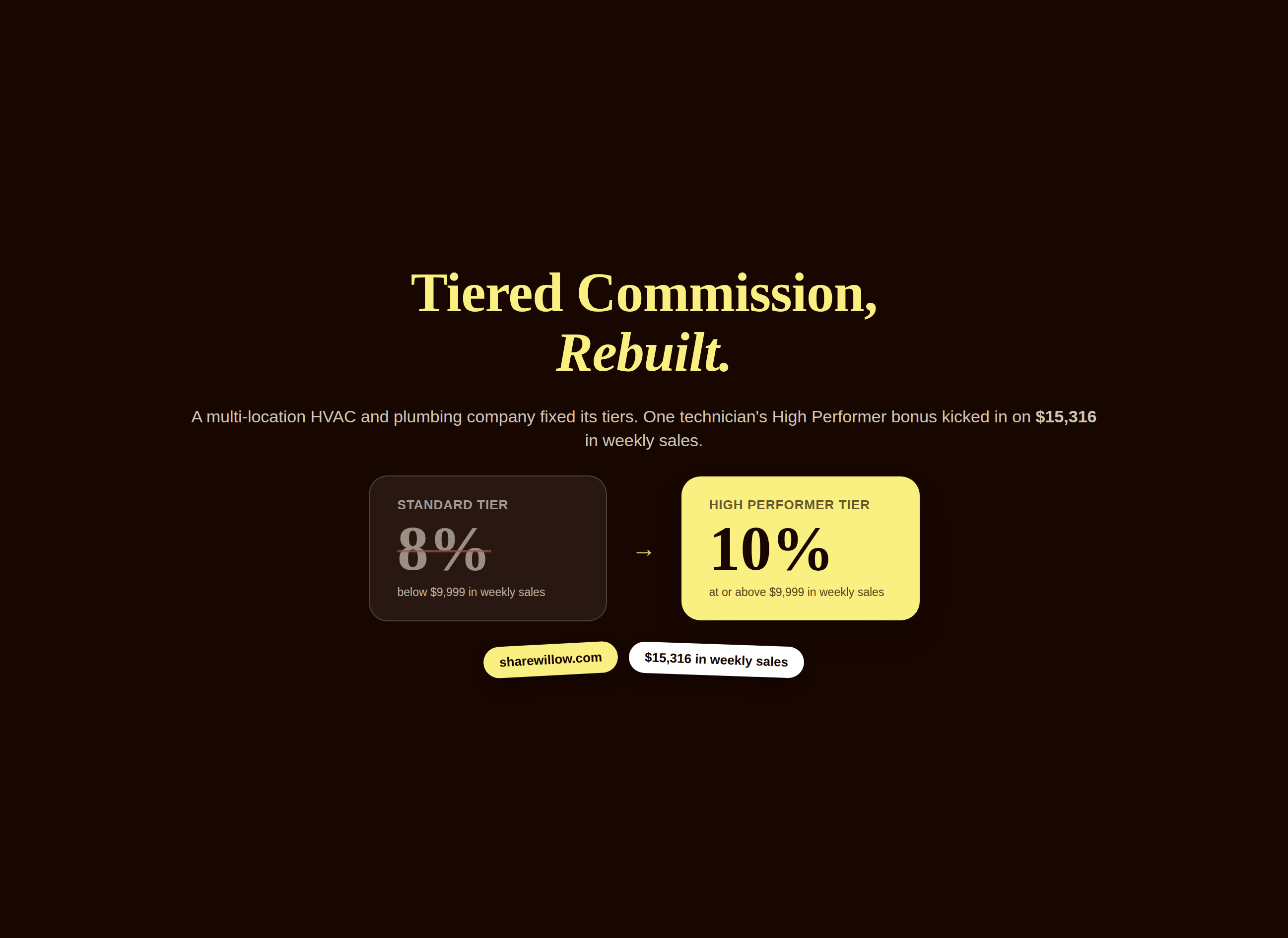
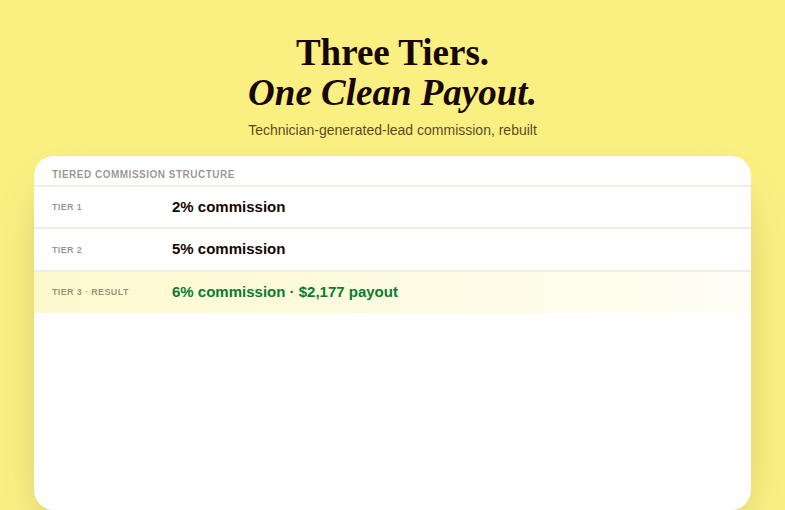
It is tempting to think of a tiered commission structure as purely a rate-design problem: pick your breakpoints, pick your percentages, done. In practice, the rate design is the easy half. The company's technician-generated-lead commission ran on three tiers, 2%, 5%, and 6%, depending on volume, plus a separate "High Performer" tier on top of standard commission: 8% on weekly sales below $9,999, stepping up to 10% on weekly sales at or above that threshold. On paper, that is a clean, motivating structure.
Underneath it, though, the payroll export could not reliably tell hourly pay apart from commission pay. That is a bigger problem than it sounds like. If a payroll system cannot distinguish the two, a technician can end up double-counted, taxed incorrectly, or simply paid the wrong number, and nobody notices until a technician does their own math and asks why their check does not match what they expected. A related sync issue, where one technician's nickname did not match the name in the source system, caused that technician's pay to disappear from a report entirely for a stretch of time.
Rebuilding the tiers so the math actually holds
The fix was not to scrap the tiered commission structure and go back to a flat rate. It was to separate the two problems, rate design and data accuracy, and solve each one on its own terms. On the rate side, the technician-generated-lead tiers stayed at 2%, 5%, and 6%, but the attribution logic that decided which technician got credit for which lead was rebuilt to handle the edge cases that had been slipping through. On the data side, the payroll export was restructured so hourly pay and commission pay are reported as two distinct line items instead of one blended number, which closes the tax classification risk and gives every technician a paycheck they can actually audit against their own job list.
The nickname sync issue got its own fix too: the identity matching between the source scheduling system and the commission engine now accounts for the fact that a technician named "Lucas" in payroll might be "Lukey" everywhere his coworkers actually refer to him. It is a small detail, but it is exactly the kind of detail that quietly erodes trust in a tiered commission structure if it goes unfixed. A technician does not need to understand the technical cause of a missing paycheck line to lose confidence in the whole plan.
What the rebuilt structure actually paid out
Once the fixes landed, the real payout numbers told the story better than the rate table could on its own. One technician's pay for a single period came to $2,177, correctly reclassified as commission rather than hourly once the export was separated. Another technician crossed into the High Performer tier with $15,316 in weekly sales, qualifying for the 10% rate instead of the 8% base rate on that volume, a meaningful jump in take-home pay for hitting a threshold the technician could see coming in real time rather than finding out about after the fact.
The company's own read on the fix, logged directly from the review call: the system is "pretty much working," and the client is "relieved and not worried now." That is not a dramatic growth headline. It is the far more common, far more valuable outcome of fixing a tiered commission structure correctly: the plan stops being a source of anxiety and starts being background infrastructure nobody has to think about.
That shift matters more than it might sound like on the page. A tiered commission structure that technicians do not trust gets ignored, worked around, or quietly resented, no matter how generous the top tier looks on paper. A tiered commission structure that technicians can verify against their own job list, and that pays out the same way every time, is one they will actually chase.
Profit sharing
made simple.
Give your team a stake in the company’s success. ShareWillow helps you create and manage profit-sharing programs that motivate employees and drive business results.
Building a tiered commission structure that holds up
If you are considering a tiered commission structure for your own technicians, whether you run HVAC, plumbing, electrical, or another field service trade, a few lessons from this rebuild carry directly over.
- Design the tiers and fix the data pipeline as two separate projects. A generous tier structure built on top of an export that cannot separate hourly from commission will eventually produce a paycheck nobody can explain.
- Give technicians a threshold they can see coming. An 8%-to-10% jump at a clear weekly sales number is motivating precisely because a technician can watch their own progress toward it in real time, instead of finding out after the fact that they crossed a line.
- Handle identity matching deliberately. Nicknames, shortened names, and inconsistent spelling between your scheduling system and your payroll system are a small technical detail that can make an entire paycheck vanish from a report.
- Let technicians audit their own numbers. A tiered structure builds trust fastest when a technician can compare their own completed jobs against their own commission tier and see the math line up.
- Review the plan on a schedule, not just when someone complains. The nickname bug and the export issue were both the kind of thing that hides quietly until someone goes looking for it.
This same tension between an appealing tier structure and the payroll accuracy underneath it shows up across trades. One HVAC company rebuilt its own tiered plan after realizing the tier nobody was hitting was fixable in a month once the underlying tracking caught up to the rate design. A ten-person electrical company took a similar approach and turned one clean number into real technician pay instead of a formula nobody could reconstruct by hand. Our broader guide to tiered bonus structures walks through how to set breakpoints that motivate every tier of performer, not just your top earners.
Frequently asked questions about tiered commission structures for technicians
What is a tiered commission structure for technicians?
A tiered commission structure pays technicians a higher commission percentage as they cross defined volume or sales thresholds. A technician might earn a lower rate on their first tier of sales in a period and step up to a higher rate once they clear a set dollar amount, which rewards top performers without capping anyone's upside.
How many commission tiers should a technician pay plan have?
Two to three tiers is enough for most field service teams. More tiers than that becomes difficult to track manually and can feel demotivating to a mid-level performer who is nowhere close to the top tier. This company ran three tiers for lead generation commission plus one additional performance bonus tier, which stayed simple enough for technicians to calculate in their heads.
Why does a tiered commission structure fail even when the rates are generous?
Most tiered commission structures fail on data accuracy, not rate design. If the payroll export cannot separate hourly pay from commission, or if lead attribution assigns credit to the wrong technician, even a well-designed tier table produces paychecks nobody trusts. Fix the underlying data pipeline before assuming the rates themselves need to change.
Rebuilding a tiered commission structure by hand, across multiple locations and trades, is the kind of project that eats a payroll manager's week every single pay period. ShareWillow builds and automates tiered commission plans for HVAC and plumbing teams, syncing job and sales data directly so every tier calculates itself correctly, every time.
Related reading
Conclusion
A tiered commission structure only builds trust if the payroll math behind it is airtight; get the tiers right and fix the export before you scale either one.
Create incentives
that
drive results
You shouldn't need complex equity plans to align your team. ShareWillow makes it simple to create transparent profit-sharing programs that motivate employees and grow your business.

Incentive plans to help
small businesses thrive.
.png)
"I was able to leverage the knowledge of the ShareWillow team to learn how other companies were designing their bonus plans. The template was extremely helpful."

Brian Tustin
Owner, First Rate Movers