
A small plumbing company's bonus plan was technically running, but it was paying technicians a few dollars a month. Here's how a rebuilt incentive plan turned it into a $3,000 payout for one tech, and what any field-service shop can borrow from the redesign.
A Bonus Plan That Existed on Paper Only
Picture a small residential plumbing company: five to eight field technicians running repipes, water heater replacements, and tankless installs. Solid work, steady demand, an owner who genuinely wanted his crew to feel rewarded for a good month. On paper, the company already had a bonus plan. In practice, it wasn't doing anything at all.
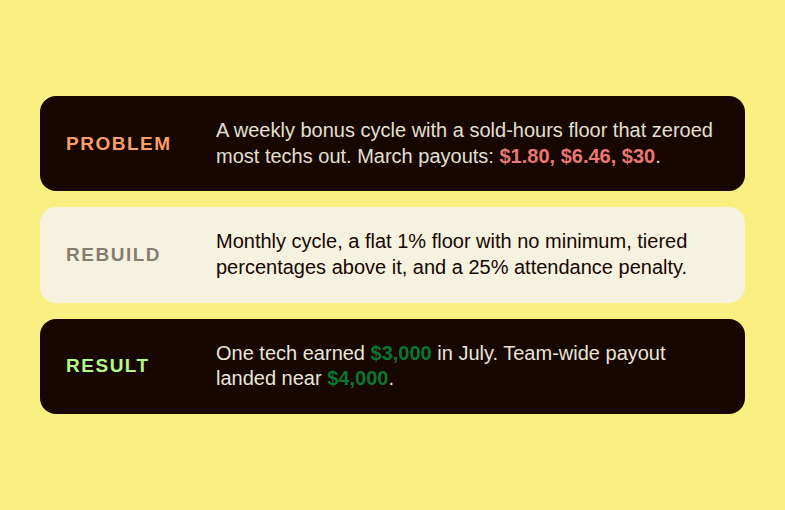
The old system ran on a weekly cycle. To qualify, a technician had to clear a sold-hours floor of 7.5 hours that week, and on top of that sat a handful of flat spiffs: $25 for a repipe, $35 for a water heater, $200 for a tankless unit. It looked reasonable sitting in a spreadsheet. It fell apart the moment you looked at what technicians actually took home.
When the team pulled a full month of real numbers to see how the old plan performed, the results were rough. One month, the entire crew's bonuses added up to this: one tech earned $6.46, another earned $1.80, a third landed $30, and a fourth earned nothing at all. Only one technician on the whole team even cleared the underlying revenue threshold that month.
A bonus plan that pays technicians single-digit dollars isn't a weak incentive. It's no incentive at all.
That's the trap a lot of plumbing and field-service shops fall into without realizing it. Someone built a bonus structure years ago with good intentions, nobody has revisited the math since, and the plan quietly drifts out of sync with how the business actually runs. Techs stop paying attention to it. Owners assume it's working because it exists. Meanwhile it's contributing nothing to retention, motivation, or performance.
This isn't a plumbing-only problem, either. HVAC install crews, facility maintenance teams, and pretty much any field-service business that pays a base wage plus a bonus can land in the same spot. Someone sets thresholds and percentages based on the numbers from a few years back, the business grows or the job mix shifts, and nobody circles back to check whether the plan still makes sense against current revenue and labor costs. The plan keeps running. It just quietly stops doing its job.
Why Weekly Cycles and Hard Floors Quietly Kill Incentive Pay
Two design choices were doing almost all the damage here, and they show up in a lot of broken plans, not just this one.
First, the weekly cycle was too short. Plumbing work is lumpy. A technician might have a huge Tuesday and a dead Thursday, and a single slow week can wipe out an otherwise strong month. When you measure and pay out weekly, you're magnifying noise instead of rewarding real performance. A tech who is genuinely one of your best producers can still post two or three weak weeks in a row purely on scheduling luck, and the bonus plan punishes them for it every single time.
Second, the sold-hours floor was a hard cutoff, not a ramp. Fall short of 7.5 hours in a week and you earned zero, no matter how close you came or how strong your prior weeks looked. Hard floors feel fair to build because they're simple to explain, but they behave terribly in practice. They turn "almost hit the number" and "didn't show up at all" into the exact same outcome: nothing. That's demoralizing for a tech who missed the line by half an hour, and it teaches your team that the bonus plan is a lottery, not a lever they control.
If any of this sounds familiar, you're not alone, and you don't have to guess your way through a fix. This is exactly the kind of plan that benefits from purpose-built incentive pay software instead of a spreadsheet nobody trusts, because the software can actually track sold hours, revenue, and attendance in real time and calculate payouts the same way every single cycle.
Rebuilding the Plan From the Ground Up
Instead of patching the old spiffs, the company rebuilt the plan around four changes. None of them are exotic. All four are the kind of adjustments almost any HVAC, plumbing, or field-service business can make once the math actually gets checked.
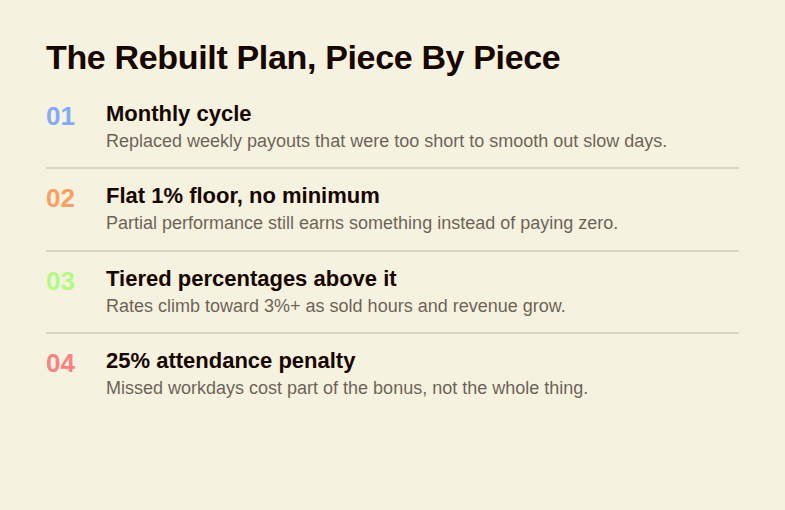
- Switched from a weekly cycle to a monthly one. A month is long enough to smooth out a slow Tuesday or a rained-out job without erasing a technician's real performance.
- Replaced the hard sold-hours floor with a flat 1% of attributed revenue, no minimum. Partial performance now earns something instead of getting zeroed out. Nobody works a full month for a bonus of exactly nothing.
- Layered tiered percentages on top of that floor. As a technician's sold hours and revenue climb, so does their percentage, up into the 3% range and higher for the strongest performers. Sold-hours tiers stayed in place too, so faster job completion is still rewarded.
- Added a 25% penalty on the bonus for any missed workday. Attendance still matters and still costs something real, but a single missed day no longer wipes out the whole payout the way a hard floor would.
Before flipping the switch, the team ran the new formula against a full month of historical data side by side with the old plan. That step matters more than it sounds like it should. Rebuilding a bonus plan without checking it against real payroll history is how you accidentally promise your team more than the business can sustain, or design a plan that looks generous but pays out even worse than the one you're replacing. Only after that validation did the new plan go live.
It's worth sitting with that for a second, because it's the step most owners skip. It's tempting to design a bonus plan around what feels fair and generous on a whiteboard, roll it out, and hope the payroll math works itself out. Running last month's actual numbers through the new formula before anyone gets paid a dime under it catches the surprises early, when they're still just numbers on a screen instead of a promise you already made to your crew.
Advice for Rebuilding Your Own Incentive Plan
A few lessons here generalize well beyond one plumbing shop:
- Match your payout cycle to your job cycle. If jobs and revenue swing hard week to week, a weekly bonus period will feel random to your team even when the underlying formula is fair. Monthly or even a rolling average smooths that out.
- Kill hard floors, or at least soften them. A ramp or a low flat percentage with no minimum keeps the plan motivating for your middle performers instead of only your top ones. Your median technician matters more to your bottom line than your single best one.
- Give top performers somewhere to climb. Tiered percentages reward the tech who's pulling ahead without capping their upside, which is exactly the kind of signal that keeps a strong producer from shopping their resume around.
- Tie a penalty to attendance, not a cliff. A percentage-based deduction still makes the point that showing up matters, without erasing a month of good work over one missed day.
- Keep a consistent point of contact through the rollout. Plans like this touch payroll, scheduling, and morale all at once, and having the same person walk you through every check-in call, rather than a new face each time, makes it far easier to actually fine-tune thresholds instead of re-explaining your business from scratch every month.
None of this requires guesswork if you're already running your operations through ShareWillow. The platform pulls sold hours, revenue, and job data straight from your field service software, runs the formula automatically every cycle, and gives owners a place to review and finalize payouts before they hit payroll, instead of hand-building a spreadsheet every month.
Profit sharing
made simple.
Give your team a stake in the company’s success. ShareWillow helps you create and manage profit-sharing programs that motivate employees and drive business results.
The Result: A Bonus Worth Talking About
The new plan went live in May. By the time the team reviewed a real, closed-out month of payouts in July, the difference wasn't subtle. One technician earned a $3,000 bonus on roughly $100,000 in revenue for the month, landing him in the 3% tier. Total bonus payout across the whole team for that period came in around $4,000.
From bonuses of $1.80 to $30 a month, to a single technician taking home $3,000. Same company, same trade, a plan that actually works.
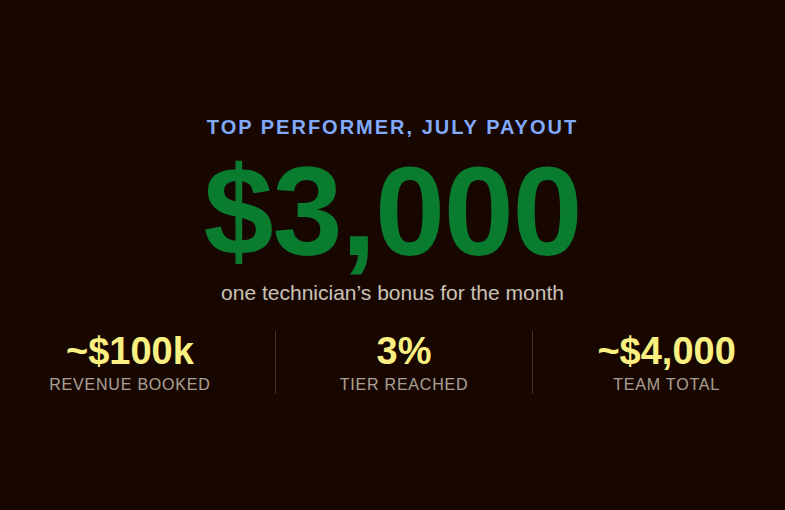
That's not a rounding error anymore. That's a second paycheck-sized number for a top performer, and it's the kind of result an owner wants to show off. The owner in this story actually asked for a photo of the payout to share with a stakeholder, a small detail, but a telling one. A bonus plan that's actually worth bragging about tends to get talked about on the shop floor too, which is exactly the kind of word-of-mouth reinforcement that keeps a good incentive plan compounding on itself.
The rollout didn't stop at go-live, either. In the same review where the July numbers came up, the team tuned a related threshold down from 26 sold hours to 24, specifically to give more of the staff a realistic shot at hitting it. That's a healthy sign for any incentive plan: it isn't a document you set once and forget, it's something you keep checking against real results and adjusting when a threshold turns out to be a little too tight. On the process side, the owner now closes out and finalizes payouts himself each month using a simple workflow, instead of leaning on outside help to hand-hold every single cycle.
What This Means for Your Shop
You don't need a plumbing company's exact numbers to take something useful from this. If your bonus plan is producing payouts that make techs shrug instead of pay attention, the fix usually isn't more spiffs bolted onto a broken structure. It's a smaller set of core decisions, done right: a payout cycle that matches how your revenue actually flows, a floor that doesn't zero people out for a near miss, tiers that reward your best people without capping them, and accountability that costs something without costing everything.
It's also worth remembering that this happened over roughly three and a half months from go-live to a verified real-dollar result, not overnight. A rebuilt plan still needs a full cycle or two of real payroll data before you know it's landed correctly, and a check-in cadence to keep tuning it afterward. Treat the first month's numbers as a starting point, not a verdict, and keep watching how thresholds and tiers play out against your actual team.
Get those four things right and the dollar amounts tend to take care of themselves. Technicians start noticing their paychecks. Owners stop dreading the monthly close-out. And instead of a plan that exists mostly to check a box, you end up with one your team actually plans their month around, which is the entire point of paying for performance in the first place.
Related reading
- The $76,000 Mistake Nobody Caught: How a Multi-Trade Shop Fixed Its Commission Blind Spot
- The Plumbing Commission Plan That Was Quietly Rewarding the Wrong Technician
- 11 Types of Employee Incentives (And How To Use Them)
- 9 Bonus Structure Examples Employees and Employers Love
- How to Pay Plumbing Technicians: The Timing Fix That Closed a $1,700 Payroll Gap
Conclusion
A bonus plan that hasn't been checked against real payroll numbers in a while probably isn't doing what you think it's doing. ShareWillow works with plumbing, HVAC, and other field-service teams to rebuild incentive plans around real revenue and labor data, then runs them automatically every cycle after that. If your team's bonuses look more like this company's March than its July, reach out and see what your own numbers could look like under a plan built to actually pay out.
Create incentives
that
drive results
You shouldn't need complex equity plans to align your team. ShareWillow makes it simple to create transparent profit-sharing programs that motivate employees and grow your business.

Incentive plans to help
small businesses thrive.
.png)
"I was able to leverage the knowledge of the ShareWillow team to learn how other companies were designing their bonus plans. The template was extremely helpful."

Brian Tustin
Owner, First Rate Movers
