
A multi-trade plumbing, electrical, and HVAC company found a $76,000 blind spot in its commission plan, hidden in incomplete price-book tagging on subcontracted work. Here's how they caught it before it ever touched a paycheck.
Three Trades, One Commission Plan, and a Lot of Room for Things to Go Wrong
A well-established plumbing, electrical, and HVAC company running on ServiceTitan had a problem most single-trade shops never have to think about: what happens to a commission plan when one job touches all three trades at once. A homeowner's project might involve a plumber running new lines, an electrician handling the panel work, and an HVAC tech installing the equipment, all on the same invoice. Figuring out who earned commission on what, without anyone getting paid twice for the same dollar, turned out to be much harder than it sounds.
None of this was visible from the customer's side of the invoice, and it was not supposed to be. A homeowner just needed one project done well. Behind that single invoice, though, the company's own system had to correctly attribute revenue across three separate commission pools, each with its own trade, its own technicians, and its own rate, without any of it doubling back on itself.
Most single-trade shops never have to build for this kind of overlap because there is no overlap to build for. A plumbing-only company can write one commission rule and be done. The moment a business operates across plumbing, electrical, and HVAC under one roof, and increasingly more home services companies do, every job that touches more than one trade becomes a small design problem the original plan was never built to handle.
Generators were the clearest example. A generator installation typically involves both selling the job and physically installing it, sometimes by the same technician and sometimes by two different people, occasionally with an apprentice or helper assisting on the install. Left unstructured, that kind of job could easily generate a commission payout larger than the job's own margin could support.
We almost paid commission twice on the same generator job before anyone caught it. Once you're running three trades through one system, that kind of overlap is easy to miss.
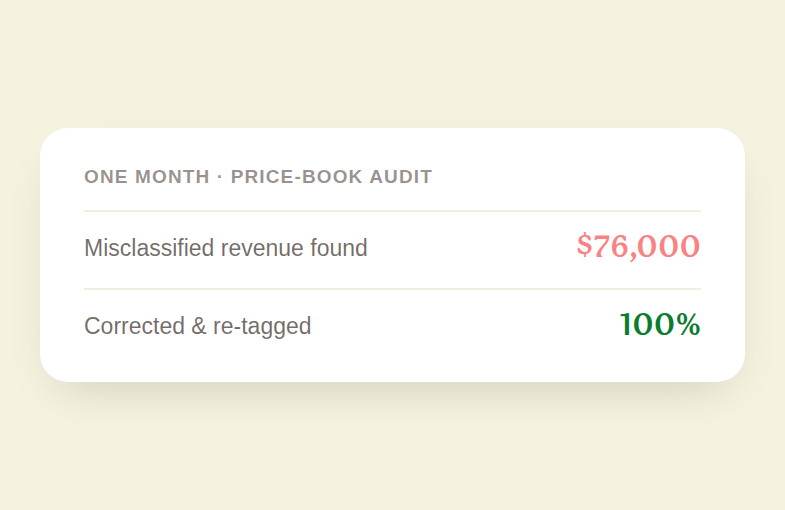
Generators were only the piece of the plan that was easiest to see coming, because everyone involved could picture two people submitting a claim on the same install. The deeper issue surfaced during a routine reporting review. A closer look at one month's numbers, run through ShareWillow, found $76,000 in misclassified revenue sitting in the commission pool, the result of incomplete price-book tagging that had nothing to do with generators specifically. It was a company-wide gap that had been quietly building for a while.
Fixing the Blind Spot Trade by Trade
Fixing a plan like this well means resisting the urge to overcorrect. It would have been easy, after finding a $76,000 gap, to rebuild the entire commission structure from scratch out of an abundance of caution. Instead the fix stayed narrow and specific, aimed at the exact category of work that had actually caused the problem.
The baseline of the new plan was kept simple on purpose: 9% standard commission on completed, sold revenue for both the plumbing and electrical pools. Simple works well as a default, and it also made the plan easy to explain to a crew that had never operated under a unified commission structure before. Technicians in each trade could learn one number, 9%, and trust that it applied consistently to the work they closed, without needing to understand how the electrical pool or the HVAC pool worked to trust their own.
The complexity only needed to show up where the work itself was genuinely more complicated, which is exactly where generators came in.
Solving the Double-Pay Problem on Generators
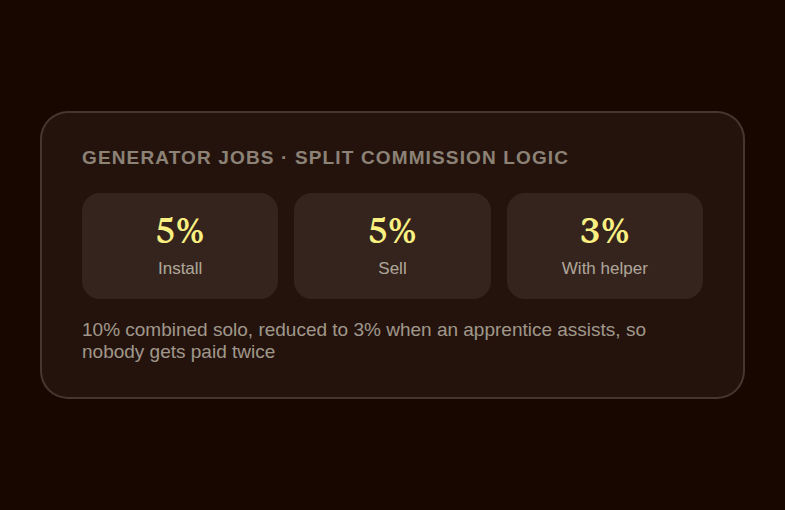
Generator jobs got their own carved-out logic: 5% commission for the sale and 5% for the install, 10% combined when one technician handles both halves of the job solo. When an apprentice or helper assists with the install, that combined rate drops to 3%, which keeps the payout proportional to the experienced technician's actual share of the work instead of splitting a full commission two ways.
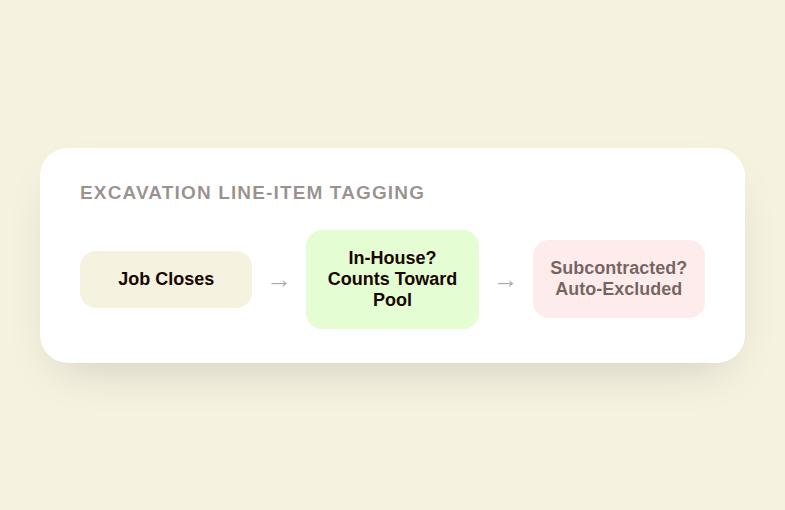
That single rule closed the most visible risk. The $76,000 misclassification, though, traced back to something less obvious: price-book tagging on excavation work. Jobs that involved digging were not consistently flagged as either in-house labor or subcontracted work, which meant subcontracted excavation, work the company paid an outside crew for and never should have owed commission on, was sometimes landing inside the commission pool anyway.
Tagging the Price Book So the System Catches It Automatically
Excavation was an easy category to overlook because it rarely stood alone as its own line item. It usually showed up bundled inside a larger plumbing or electrical job, which meant a piece of subcontracted cost could ride along inside a job that was otherwise entirely in-house, without anyone flagging the split at the point of entry.
The fix was to tag every excavation line item at the price-book level as either in-house or subcontracted, so subcontracted work is automatically excluded from the commission pool the moment a job closes, with no manual review required. The team also tightened up job-closure timing discipline, since jobs closed on the wrong date were quietly shifting revenue into the wrong pay period and throwing off more than one month's numbers at a time. For a multi-trade plumbing and electrical business running dozens of jobs a week, that kind of systemic tagging fix protects far more revenue than catching individual mistakes one at a time ever could.
Profit sharing
made simple.
Give your team a stake in the company’s success. ShareWillow helps you create and manage profit-sharing programs that motivate employees and drive business results.
The Result: $76,000 Caught and Corrected Before It Ever Hit a Paycheck
The number that matters most here is not just the size of the misclassification. It is the timing. The $76,000 in misclassified revenue was found and corrected during a reporting review, before a single dollar of it was paid out as commission on work the company never should have owed a payout on. That is the difference between a costly mistake and an expensive habit. Caught once, it is a data-quality fix. Left unnoticed for a year, it compounds into a real drain on margin, trade after trade, job after job.
It is worth sitting with how ordinary the underlying mistake was. Nobody misused the system. Nobody tried to inflate a payout. A line item just was not tagged correctly, on jobs that blended in-house and subcontracted labor in a way that was easy to miss at the moment the work was scheduled. Multiply one untagged line item by however many similar jobs a busy multi-trade shop closes in a month, and a six-figure gap stops being surprising. It becomes almost inevitable, right up until someone checks.
It is also worth noting what did not have to change. The core 9% rate held. The generator carve-out held. Nobody's base commission structure was torn up and rebuilt to fix this. The company found one specific category of line item that was leaking value and closed that one gap, which is a much easier fix to trust and adopt than a wholesale plan overhaul would have been.
It is worth being precise about what this fix actually protected. It was not new revenue and it was not a productivity gain. It was accuracy: making sure the commission pool reflected exactly the work the company's own technicians performed, no more and no less, across three trades that had never had to share a single pay structure before. For a business running that much complexity through one system, that kind of accuracy is worth as much as any growth initiative.
What This Means for Your Crew
- Multi-trade jobs need their own commission logic, not a bigger flat rate. A single blanket percentage across plumbing, electrical, and HVAC will either overpay complex jobs or underpay simple ones. The complexity has to live in the plan, not get flattened away.
- Carve out double-pay risk wherever two roles touch the same job. Generators were this company's clearest example, but any job that splits a sale from an install, or a lead from a helper, needs an explicit rule before it needs a payout.
- Price-book tagging is commission-plan infrastructure, not just accounting hygiene. An untagged line item does not just make your reports messier. It can actively route revenue you never earned into a bonus pool.
- Job-closure timing affects more than one month. A job closed on the wrong date does not just misstate one period's revenue. It can misstate the commission tier a technician qualifies for in that period, compounding the error.
- Run a periodic audit even after a plan feels settled. This $76,000 gap was not found because something broke. It was found because someone looked closely at a month that otherwise looked normal.
- Fix the specific gap, not the whole plan. The core commission rates here did not need to change at all. Finding and closing one narrow leak was enough, and it kept the rest of a plan the crew already trusted intact.
Running commission across more than one trade is one of the fastest ways for a well-intentioned plan to develop blind spots nobody notices until the numbers stop adding up. If your plumbing, electrical, or HVAC business has grown into multiple trades under one roof, it is worth checking whether your price book is doing the same quiet work this company's now is. For a look at how tightening a commission structure paid off in a very different way, see how one home services company turned a flat, ineffective bonus into a $3,000 paycheck worth chasing.
Related reading
Conclusion
Running commission across more than one trade multiplies the number of places a plan can quietly leak. ShareWillow audits your commission pool against your own price book and job history, so gaps like this get caught before payday, not after. Reach out to see what your plan might be missing.
Create incentives
that
drive results
You shouldn't need complex equity plans to align your team. ShareWillow makes it simple to create transparent profit-sharing programs that motivate employees and grow your business.

Incentive plans to help
small businesses thrive.
.png)
"I was able to leverage the knowledge of the ShareWillow team to learn how other companies were designing their bonus plans. The template was extremely helpful."

Brian Tustin
Owner, First Rate Movers
