
A pool construction and service company had no incentive program at all and didn't trust its own time-tracking data enough to pay one, so it soft-launched a new bonus plan to back-office staff before ever paying a technician.
Ask a pool construction and service company how much it paid out in technician bonuses last year, and the honest answer was zero dollars. Not because the crews weren't earning it. Because there was no program measuring it. No formula, no threshold, no plan of any kind. A technician showed up, logged hours, and got paid for the hours. That was the entire conversation about performance pay.
Fixing that absence turned out to be the easier half of the project. The harder half, the one that nearly stalled everything before a single number got run, was that leadership didn't fully trust the data they already had. You cannot build a bonus plan on numbers you're not confident in, and this company had good reason not to be confident.
A Business Running On Manual Numbers
The company operates two distinct sides of the pool trade under one roof. A construction crew builds pools from the ground up: excavation, gunite, plumbing, decking, the multi-week jobs where a team either beats its labor budget or eats the difference. A service and maintenance crew handles the pools already in the ground: cleanings, chemical balancing, equipment repairs, the recurring stops that fill a daily route. Two very different jobs, two very different definitions of a good week.
Both crews tracked their hours in Workyard, a time-tracking app built to answer a simple question: where was this person, and for how long. It answers that question well. What it does not do is distinguish an hour spent turning wrenches on a job from an hour spent driving to the next one, and that distinction is everything the moment you try to pay someone a share of revenue or a cut of a saved labor budget. Drive time was quietly landing in the same bucket as billable time, inflating the hours attached to jobs. In at least one case, a technician's hours got logged against the wrong customer's project entirely, a simple data-entry mismatch that nobody had caught because nothing downstream depended on catching it.
None of that mattered much when the only thing riding on a time log was a paycheck for hours worked. It would have mattered enormously the moment real bonus dollars started flowing off those same numbers. Leadership knew it. Before they'd sign off on a single formula, they wanted proof that the underlying data could hold up to money being attached to it, and they wanted to find the cracks themselves rather than have a technician find them first.
Two Businesses Needed Two Different Formulas
Because the construction and service sides of the business measure success so differently, a single bonus formula was never going to fit both. ShareWillow built two plans instead of forcing one.
On the construction side, the number that matters is the labor budget. Every job gets estimated with a labor line, and every job either comes in under that line or it doesn't. The new plan pays the crew a team award worth up to 10% of whatever labor budget the job beats, split among the technicians who worked it in proportion to the hours each one actually logged. Save two thousand dollars against the estimate, and the crew is working toward a shared pool of up to two hundred dollars, divided by who showed up and for how long, not divided evenly regardless of contribution.
On the service side, the unit of success looks nothing like a single job with a budget. A service technician runs a route, a full day of stops, and the number that rises or falls with how efficiently they move through it is revenue generated per hour worked. That plan pays up to 5% of revenue once a technician clears a minimum efficiency bar, with the payout rate stepping up through a tier ladder that runs from roughly $110 an hour of revenue produced up past $150. On top of both plans, the company added a flat $15 bonus for every five-star customer review a technician earns, a small and immediate reward for the kind of visit that turns into a referral down the road.
Two well-designed formulas still don't solve the trust problem on their own. A construction team award split by hours worked is only fair if the hours themselves are accurate. A revenue-per-hour tier is only meaningful if the revenue and the hours behind it are both clean. The company had already found one instance of hours logged to the wrong customer and a pattern of drive time bleeding into billable time. Rolling out real payouts on top of data with known holes in it would have meant guessing whether early bonus checks were even correct, and guessing with technicians' money is not a mistake you get to make twice. The first time a tech does the math on their own paycheck and it doesn't add up, the entire program loses credibility, no matter how sound the formula behind it actually is.
Soft-Launching The Plan Before Paying A Single Technician
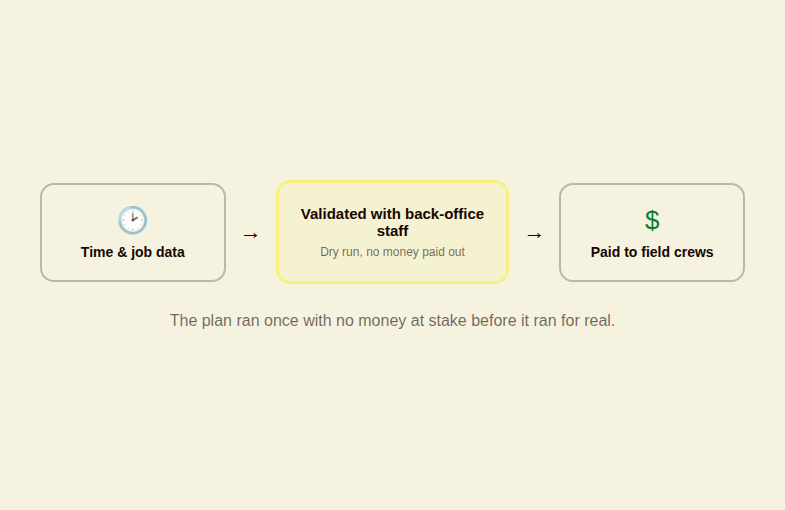
So the company did something most businesses skip entirely: it ran the plan before it ran the plan. Rather than announcing the new bonus structure to the field crews and cutting the first checks, leadership soft-launched it internally to back-office staff first. The office team walked through a live pay period using the actual formulas, the actual job data, and the actual hours pulled from Workyard, and checked whether the numbers that came out the other end made sense against what everyone already knew about how each job had gone.
That step surfaced exactly the kind of problems you'd want caught in a dry run instead of in front of a crew expecting real money. Hours that looked inflated got traced back to drive time. A job with an unusual labor number got traced back to the wrong-customer mix-up. None of it required rebuilding the plan. It required cleaning up how time was being captured and mapped before that data got anywhere near a paycheck. By the time the company was ready to tell technicians about the new program, the numbers behind it had already been stress-tested against real jobs, not just modeled in a spreadsheet.
This is a step a lot of companies skip because it feels like it slows down the launch. It's worth saying plainly: it doesn't slow down the launch, it prevents a false start. A bonus plan that goes live on bad data and then has to be corrected, recalculated, or walked back a month later does more damage to trust than a few extra weeks of validation ever would. Technicians remember the payout that got clawed back far longer than they remember the delay that came before it.
The First Real Number: $208
Once the data held up, the company moved the plan out to the field. The first completed construction job under the new structure came in under its labor budget, and the team award formula did exactly what it was built to do: it turned that saved labor budget into a real, calculated payout. The job produced a $208 team award, split between the two technicians who worked it based on their hours: $104 to one, $104 to the other.
Two hundred and eight dollars is not a headline number. What makes it worth writing about is what it replaced. Before this plan existed, the number attached to a job coming in under budget was zero, every time, on every job, because there was no mechanism to turn efficiency into pay. This was the first time that connection existed at all, and it was auditable. Anyone could trace the $208 back to the specific job, the specific labor budget, the specific hours each technician logged, and the specific formula that turned the difference into a check. That traceability is the entire point. A bonus that nobody can explain is a bonus nobody trusts, no matter the amount.
Profit sharing
made simple.
Give your team a stake in the company’s success. ShareWillow helps you create and manage profit-sharing programs that motivate employees and drive business results.
It's worth sitting with why a $104-and-$104 split matters as much as the $208 total. A lot of team bonuses get divided evenly by headcount because it's simple to administer, and simple administration quietly punishes the technician who put in more hours and rewards the one who put in fewer. Splitting by actual hours worked keeps the incentive pointed at the right behavior: show up, put in the time, get credit proportional to what you contributed. On a two-person crew the math is easy to check by hand, which is exactly why it made a good first test case. Everyone involved could look at the job, look at the hours, look at the check, and agree the number was right.
What Changed On The Service Side
The construction team award got the first live payout, but the service-side plan was running in parallel, gated by the same discipline. A technician doesn't earn a share of revenue just for showing up and finishing a route. They earn it by clearing a minimum revenue-per-hour bar and then climbing through tiers as that number improves, from roughly $110 an hour up past $150. Stack the $15 five-star review bonus on top and a technician now has two separate, visible levers: work efficiently, and take care of the customer well enough that they leave a review. Neither lever requires a manager to make a judgment call about who deserves what. The data decides it, which is exactly the property the company had spent weeks confirming it could trust.
What This Means If You're Starting From Zero
Most trade businesses building their first incentive plan aren't worried about the formula. They're worried, often without saying it out loud, about whether the numbers behind the formula will hold up once real money is riding on them. If that's where you are, a few things from this story are worth taking directly:
- If your time-tracking or job-management data has never had money riding on it before, assume it has errors you haven't found yet. A general time-tracking tool built for scheduling and payroll is not automatically built to isolate billable labor from drive time, and that gap only becomes visible once a bonus formula depends on it.
- Run the plan on real data before you run it for real people. A back-office dry run, using an actual pay period and actual job numbers, will surface mismatched customers, inflated hours, and formula edge cases while the stakes are still zero.
- Different sides of the business often need different formulas. A construction crew chasing a labor budget and a service crew chasing revenue per hour aren't measuring the same thing, and forcing them into one plan usually means one side ends up with an incentive that doesn't fit their actual job.
- Split team awards by contribution, not by headcount. Dividing a bonus evenly is easier to administer, but dividing it by hours worked is what keeps the incentive aligned with the effort.
- Treat your first real payout as proof of concept, not just a paycheck. A small, fully traceable bonus that everyone can audit does more for adoption than a bigger number nobody can explain.
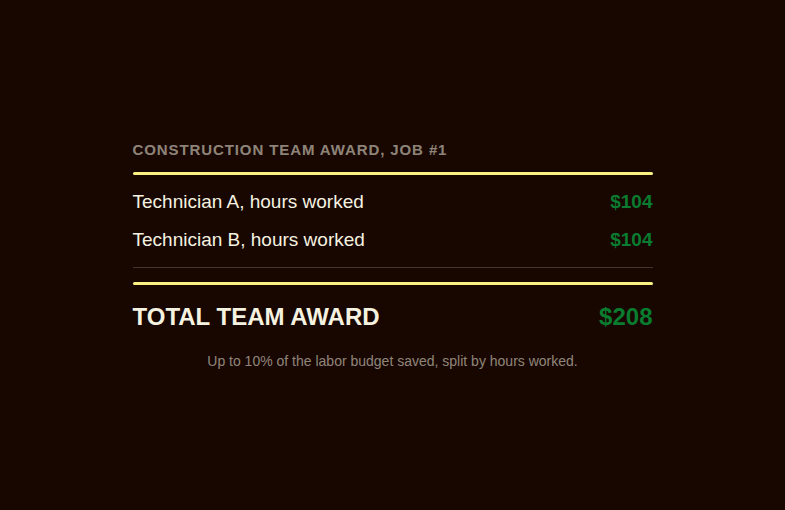
A construction crew earning $104 apiece on a job that came in under budget isn't a dramatic number. But it's the first dollar this company ever paid for performance instead of just attendance, and it arrived with a paper trail strong enough that nobody had to take it on faith. That's a better foundation to build on than a bigger bonus with shaky math behind it.
If you're weighing how to structure something similar for your own crews, ShareWillow's incentive plan design tools are built around exactly this kind of dual structure, team awards on one side, individual performance tiers on the other, without needing a spreadsheet to hold it all together. And if pools are your business specifically, it's worth looking at how other pool service businesses have approached the same problem before you build yours from scratch.
Related reading
Conclusion
The first bonus a company pays is worth less as a dollar amount and more as proof the math behind it can be trusted.
Create incentives
that
drive results
You shouldn't need complex equity plans to align your team. ShareWillow makes it simple to create transparent profit-sharing programs that motivate employees and grow your business.

Incentive plans to help
small businesses thrive.
.png)
"I was able to leverage the knowledge of the ShareWillow team to learn how other companies were designing their bonus plans. The template was extremely helpful."

Brian Tustin
Owner, First Rate Movers
