
A 12-person plumbing, HVAC, and electrical company used real job data to build a performance pay plan. One technician's effective hourly rate went from $32 to $60.64.
The Hourly Trap Most Trade Businesses Don't See
Walk into almost any HVAC, plumbing, or electrical shop and you'll find the same pay structure: a flat hourly rate, maybe a small spiff here or there, and a payroll run every two weeks that looks basically the same no matter who worked the harder week. It feels fair on paper. Everyone gets paid for their time. But talk to the owner long enough and a different picture shows up.
One owner of a 12-person plumbing, HVAC, and electrical company put it simply during a planning call: his best technician and his average technician were earning almost the same amount every month. Same base rate, same schedule, same paycheck, wildly different output. The tech who closed more jobs, sold more replacements, and kept his callback rate near zero was, in effect, subsidizing the tech who did the minimum to get through the day.
That's not a people problem. It's a pay structure problem. Hourly pay was built for a world where the work itself was hard to measure. But that's not the world these businesses operate in anymore. Between ServiceTitan, Housecall Pro, and similar field service platforms, nearly everything a technician does is already tracked: job type, ticket size, time on site, materials used, callbacks, reviews. The data to pay people for what they actually produce has existed for years. Almost nobody uses it.
Instead, most shops treat performance pay as an afterthought, a quarterly bonus check that shows up too late to change anyone's behavior, or a flat commission percentage that was set once, years ago, and never revisited. Neither approach uses the job data that's already sitting in the software these companies pay for every month.
So this particular owner did something different. Rather than guess at what a fair incentive plan might look like, he ran his team's actual job history, real tickets, real hours, real outcomes, through ShareWillow's incentive planning platform to see what performance pay would have looked like if it had been in place all along.
The results weren't theoretical for long.
Before the change, the owner had tried the usual fixes. A round of "we appreciate everyone" raises that didn't move behavior. A vague promise that top performers would be "taken care of" at review time, which meant nothing until it happened, if it happened. A commission plan a competitor mentioned once, copied loosely, that never quite matched how his crew actually worked. None of it stuck, because none of it was built from his own numbers.
This is a familiar pattern for facility managers and small business owners in the trades. You know intuitively who your best people are. You just don't have an easy way to translate that intuition into a pay structure that holds up, is fair across the team, and doesn't take you three hours every payday to calculate by hand. That gap, between knowing and paying accordingly, is where most incentive plans quietly die.

What Performance Pay Looks Like When It's Built On Real Numbers
The plan itself wasn't complicated, and that's kind of the point. It didn't require ripping out the base pay structure everyone already understood. It layered performance pay on top of it.
Here's the shape of it, in plain terms:
- Base pay never drops. Every technician keeps the hourly rate they already count on. Nobody takes home less than they used to.
- Incentives are tied to jobs already in the system. Completed tickets, upsells, membership sales, five star reviews, whatever actually moves the business forward, all pulled straight from the field service software the crew already uses every day.
- The math runs automatically. No spreadsheet reconciliation, no manager doing mental math on a Friday afternoon. The platform calculates what each tech earned on top of base, job by job.
- It's visible in near real time. Techs can see what a job is worth before they even finish it, not two weeks later on a paycheck they've already half forgotten about.
That last point matters more than it sounds like it should. A lot of owners assume the incentive amount is what drives behavior. It's part of it, but visibility does a lot of the heavy lifting. When a technician can see, in the moment, that closing the upsell or hitting the callback-free streak is worth a specific number of dollars, the decision to do the extra five minutes of work stops being abstract. It's not "maybe this helps me at review time." It's "this job is worth $40 more if I do it right."
For facility managers and business owners who've tried incentive pay before and had it fizzle, this is usually the missing piece. Not the incentive itself, the connection between the incentive and the work. A quarterly bonus disconnected from the actual job doesn't change behavior on any individual ticket. A per job incentive, visible and calculated automatically, does.
It's also worth saying what this plan didn't do. It didn't ask the owner to become a compensation analyst. It didn't require a new field service platform or a six month rollout. The data ShareWillow used to build the plan was already sitting in the systems this company runs every day; the platform just connected to it and did the math nobody had time to do by hand.
This is where a lot of DIY incentive plans fall apart. An owner sits down with a spreadsheet, sketches out a commission percentage that feels reasonable, and rolls it out without ever testing it against real job history. Three months later, the numbers don't add up the way anyone expected, a top performer feels shortchanged on a big ticket job, and the whole plan gets quietly shelved. Building the plan from actual historical data first, before a single dollar changes hands, is what let this owner see exactly how the new structure would play out before he ever announced it to his team.
There's a trust dimension here too. When technicians can trace their bonus back to a specific job, a specific number on a specific invoice, they stop wondering if the math is fudged in the company's favor. Pay transparency isn't just a nice value to have on a wall poster. In a trade where techs talk to each other constantly, whether pay feels fair spreads through a crew faster than almost anything else an owner can control.
Profit sharing
made simple.
Give your team a stake in the company’s success. ShareWillow helps you create and manage profit-sharing programs that motivate employees and drive business results.
The Number That Changed The Conversation
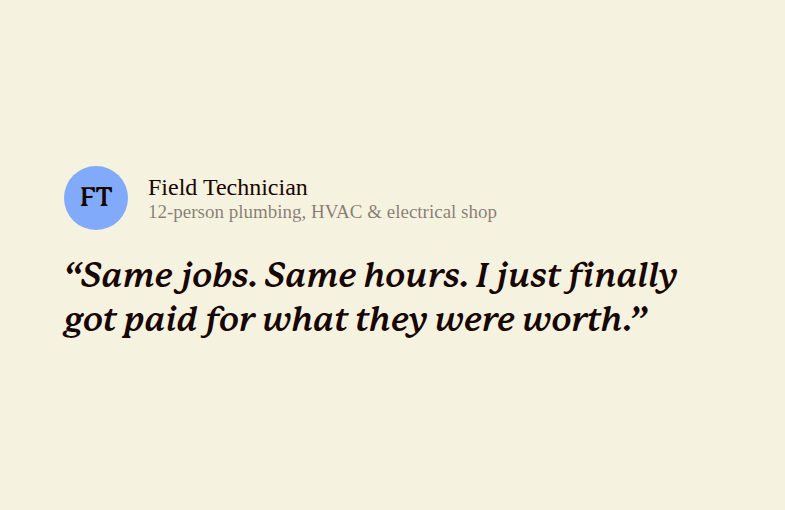
Here's where it gets concrete. When the owner ran one technician's real job history through the new structure, that tech's effective hourly rate, meaning total pay divided by hours actually worked, moved from a flat $32 an hour to $60.64 an hour. Same jobs. Same hours on the clock. Just visibility into what the work was actually worth, and a pay structure that reflected it.
That's an 89 percent increase, without the company raising a single price or adding a single billable hour. The math didn't come from charging customers more. It came from correctly rewarding a technician who was already producing far more value than his hourly rate reflected.
The effect showed up almost immediately. In that technician's very first pay period under the new structure, his total pay came in around $500 higher than his old hourly guarantee, not a projection, not a modeled average, an actual paycheck. No new hours worked. Just credit for jobs he had already closed.
Put yourself in that technician's shoes for a second. You've been doing solid work for years, hitting your numbers, keeping customers happy, and your paycheck has looked almost identical every single pay period regardless. Then one week, without changing a thing about how you work, your check is $500 bigger. That's not a motivational poster. That's proof the system finally sees you.
And for the owner, the business case is just as sharp. Every dollar of that increase was earned through work that was already being done. Nothing was given away. The company simply stopped underpaying its best people relative to the value they created, which is a very different thing than raising costs across the board. Flat commission structures and blanket raises spread the same dollars over everyone, high performers and low performers alike. A data driven performance plan routes the money toward the people actually generating it.
There's a retention angle here too, one that matters even more in a labor market where good technicians have options. A technician who knows his pay is tied directly and transparently to his output has far less reason to look elsewhere for a percentage point more on a flat rate. He's not being paid for showing up. He's being paid for the value he brings, and he can see the receipts.
For a 12-person shop juggling plumbing, HVAC, and electrical work, that kind of clarity changes more than one paycheck. It changes how the owner thinks about growth, how the next hire gets structured, and how the whole team understands what "doing a good job" is actually worth in dollars, not just in a compliment from a manager.
If you're a facility manager or owner reading this and wondering whether your own team has a similar gap hiding in plain sight, the honest answer is: probably. Most shops have at least one technician quietly outperforming their pay grade, and at least one flat rate that's been left untouched for years simply because nobody had the time to rebuild it. The job data to find out is almost certainly already sitting in your field service software right now.
What to look for in your own numbers
You don't need a full incentive plan rollout to start seeing the gap. A few things worth pulling from your own reporting this week:
- Effective hourly rate by technician, total pay divided by hours worked, not just the stated hourly rate on the books.
- Spread between your top and bottom performing techs on comparable jobs.
- How long it's been since your commission or bonus structure was actually rebuilt from current job data, versus just carried forward year after year.
If those numbers surprise you, you're not alone, and you're not behind. Most owners have simply never had an easy way to run the analysis. That's the part software should be doing for you, not the part you should be doing on a Sunday night with a calculator.
Related reading
Conclusion
If a flat hourly rate is quietly capping what your best technicians earn (and quietly telling them their extra effort doesn't matter), the fix isn't a bigger raise across the board. It's a pay structure that already knows what every job is worth, because it's pulling straight from the job data your team creates every day. See how ShareWillow builds that layer on top of the pay your team already trusts, and take a look at how it's helped other HVAC, plumbing, and electrical companies turn job data into pay their best people can feel.
Create incentives
that
drive results
You shouldn't need complex equity plans to align your team. ShareWillow makes it simple to create transparent profit-sharing programs that motivate employees and grow your business.

Incentive plans to help
small businesses thrive.
.png)
"I was able to leverage the knowledge of the ShareWillow team to learn how other companies were designing their bonus plans. The template was extremely helpful."

Brian Tustin
Owner, First Rate Movers
