A 20-person chimney and fireplace company ditched manual Excel commission math for automated ServiceTitan-based pay plans, then renewed the program for year two.
Most trade business owners don't have a pay problem. They have a trust problem that looks like a pay problem. Techs suspect the numbers are wrong. Apprentices don't know what actually moves them up a level. And the owner is the only person who can explain how anyone's check got calculated, which means the owner is also the only person anyone believes.
That was the situation for a 20-person chimney and fireplace service company running on ServiceTitan. The business had real ambitions: a registered apprenticeship program already in place, and a stated goal of growing from 20 people to somewhere between 200 and 300 over the next several years. But the pay and progression systems underneath that growth plan were held together with spreadsheets, memory, and goodwill.
The problem wasn't effort. It was structure.
Before making a change, this company had no formal system for tracking technician performance at all. Reviews weren't logged in ServiceTitan. There was no consistent record of who was hitting what numbers, who needed coaching, or who was ready for more responsibility. Performance data existed, technically, scattered across job records and the owner's head, but it wasn't organized into anything a tech could look at and understand.
That gap hit hardest in the apprenticeship program. Job-level progression, the path from apprentice to journeyman, wasn't tied to any real, tracked metrics. Advancement decisions came down to a manager's judgment call. Maybe that call was usually right. It didn't matter. When a promotion or a pay bump can't be traced back to a number, it reads as arbitrary even when it isn't, and arbitrary is exactly the word that erodes trust on a crew.
The commission side had its own version of the same problem. Every month, the owner sat down and manually compiled commission reports in Excel, pulling numbers out of ServiceTitan by hand and running them through a homemade calculation. And every month, there was a real risk that the dashboard totals wouldn't match what ServiceTitan actually showed. Not because anyone was cutting corners, but because manual processes built on spreadsheets drift. A missed line item here, a formula that didn't update there, and suddenly a tech's commission check doesn't match the job history in front of them.
When the numbers on a paycheck don't match the numbers in the software everyone can see, the problem isn't math. It's credibility.
That kind of discrepancy is corrosive in a small shop. Techs talk to each other. If one person's payout looks off one month, the whole crew starts wondering whether the whole system is off. The owner ends up spending hours every month defending numbers instead of running the business, and even a completely accurate correction doesn't fully repair the doubt that already crept in.
This is a pattern that shows up across field service businesses generally, not just chimney and fireplace companies. Any shop running technicians, installers, and apprentices on a platform like ServiceTitan eventually hits the same wall: the software captures plenty of performance data, but nobody has built a pay and progression system that actually reads from it. So owners default to manual tracking, and manual tracking eventually breaks trust, because it's slow, error-prone, and impossible to audit in real time.
The owner here wasn't looking for a generic bonus program or a flat raise across the board. The ask was more specific: tie pay and advancement to numbers everyone could see and verify, stop the monthly Excel grind, and give the apprenticeship program a real backbone instead of a gut-feel promotion process. That's a harder problem than it sounds, because it means building compensation logic that's specific to each role, technicians, installers, apprentices, sales, and office staff, and connecting all of it directly to live ServiceTitan data instead of a spreadsheet copy of that data from three weeks ago.
Building pay plans that actually match the org chart
The fix wasn't one universal bonus plan slapped across the whole company. A technician's job doesn't look like a sales rep's job, and an apprentice's job doesn't look like an installer's job, so paying them all off the same formula was never going to hold up. ShareWillow built role-specific pay plans for each function inside the business: technicians, installers, apprentices, sales commission, and office incentive, each one tied directly to the revenue and average work-order data already living inside ServiceTitan.
That last part matters more than it sounds like it should. Because the plans pull from ServiceTitan directly, there's no separate manual dataset to keep in sync, no month-end scramble to reconcile a spreadsheet against the platform of record. The number a technician sees on their payout is drawn from the same job and revenue data the owner is looking at inside ServiceTitan. That single change closed the exact gap that had been causing the discrepancies in the first place.
As the program matured, the plans got more precise. What started as a set of role-based plans got split into cleaner, per-role versions: a dedicated plan for installers, a separate one for service techs, and a combo version for people working installer-tech hybrid roles. That kind of refinement only happens when a company is actually using a system and noticing where the categories blur in real operations, not when it's building something once and walking away.
Sold versus commissionable: a distinction that saves headaches
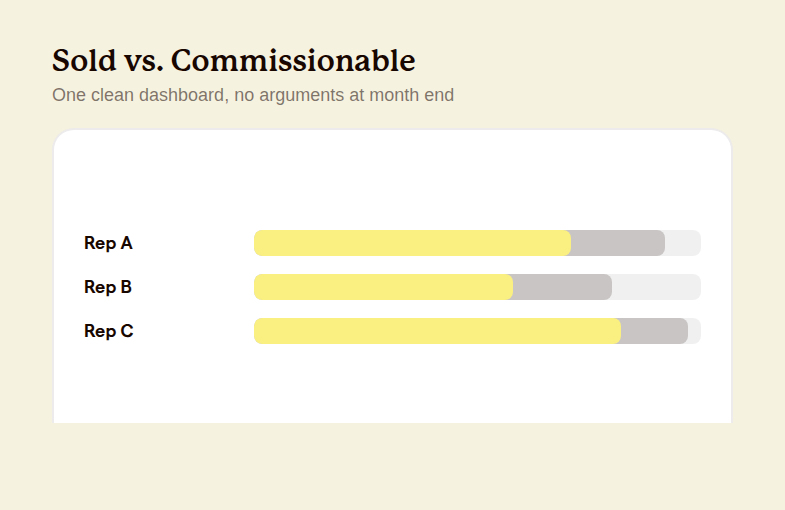
One of the more useful pieces to come out of this build was a dedicated sales dashboard that separates what a rep sold from what's actually commissionable. That's not a trivial distinction. In most field service businesses, not everything that gets sold ends up qualifying for commission, whether because of discounting, bundled pricing, warranty work, or other adjustments that happen between the sale and the invoice. Without a clear split, sales reps see one number, the commission plan calculates off another, and now you've recreated the exact trust problem the whole project was meant to fix, just in a new department.
Separating sold and commissionable amounts up front means everyone is looking at the same definitions. A rep can see what they closed and what portion of that actually feeds their payout, with no ambiguity and no argument at the end of the month. That level of transparency is the kind of thing that's easy to underrate until you've lived through a month without it.
Tying apprenticeship progression to real numbers
The apprenticeship piece is where this project moved from a payroll fix to something closer to a career-development system. Because the company already had a registered apprenticeship program, and because it was actively planning to scale from 20 people toward 200 or 300, job-level progression needed to be defensible at a much larger scale than it had ever needed to be before. A manager's gut feel might work when you know every apprentice personally. It falls apart fast once you're managing progression across a dozen locations and a few hundred employees.
So the pay plan structure was built to support that program directly. Job-level advancement, apprentice to journeyman, now ties to real, tracked metrics instead of a subjective call. An apprentice can see specifically what they need to hit to move to the next level, and that target is drawn from the same live ServiceTitan data driving the rest of the compensation system. It turns advancement into something an apprentice can work toward on purpose, rather than something that happens to them.
This same idea, paying for the behaviors that actually matter rather than a flat rate or a vague sense of "doing good work," shows up in other niche trades too. It's the same logic behind building incentive plans that reward quality over speed in a pest control business, where the easy path is rewarding raw volume and the harder, better path is rewarding the outcomes that keep customers around. Whether it's chimney sweeps, pest control techs, or HVAC installers, the principle holds: if you want a specific behavior, the pay plan has to point at that behavior directly, not at a number that's merely correlated with it. You can see the mechanics of how these automated, role-specific structures come together on ShareWillow's product features page, and the same approach applies broadly across home services trades beyond just chimney and fireplace work.
Profit sharing
made simple.
Give your team a stake in the company’s success. ShareWillow helps you create and manage profit-sharing programs that motivate employees and drive business results.
Six months, six real payouts
Plans and dashboards are easy to promise. What's hard is proving they hold up once real money starts moving every month. This is the part of the story that matters most: the sales commission plan alone has six consecutive confirmed monthly payouts, and the trend line tells you something a single number never could.
The first month paid out $3,084. The next climbed to $5,581, the plan's high point over this stretch. From there it settled into a real, human rhythm: $4,025, then $3,900, then $3,990, then $2,685. That's not a flat number stamped out by a formula that doesn't care what actually happened on the ground. It moves up when sales performance is strong and pulls back when it isn't, which is exactly what a commission plan is supposed to do. A rep who has a great month sees a great payout. A rep who has a slower month sees that reflected too. Nobody has to take the owner's word for why the number changed, because the underlying ServiceTitan data explains it on its own.
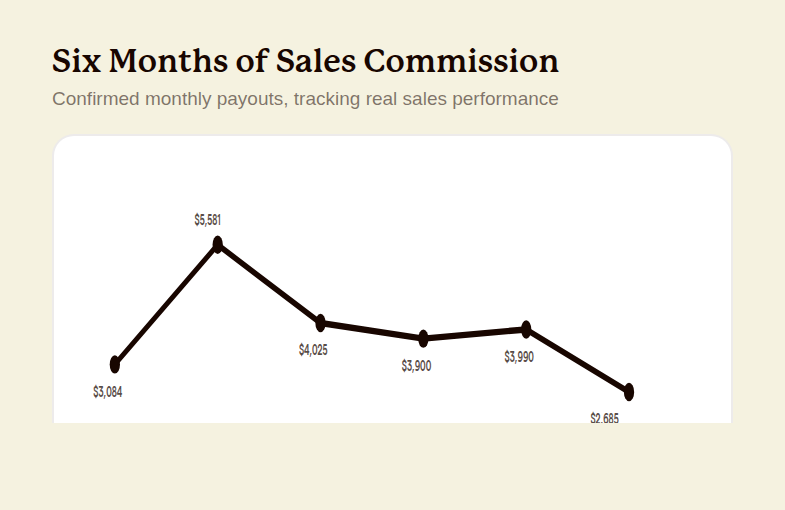
Six months of clean, confirmed data doesn't happen by accident. It happens because the plan is pulling from a real, live data source instead of a spreadsheet somebody rebuilds every 30 days, and because the definitions behind it, like the sold-versus-commissionable split, were sorted out ahead of time instead of argued about after the fact.
Fifteen months in, and still going
Zoom out from that six-month commission window and the bigger picture is even more telling. This program has now been live for more than 15 months. In an industry where incentive programs often get built with enthusiasm and quietly abandoned within a year, that kind of staying power is unusual, and it's the clearest evidence that the system is doing its job.
The strongest signal, though, isn't the length of time it's been running. It's what happened when year one ended. Instead of letting the program lapse or reverting to the old manual process, the company rebuilt and renewed it for a full second year, with updated versions of each plan: a refreshed sales commission plan, a refreshed apprentice plan, and updated versions across the other roles. You don't rebuild and reinvest in a system that isn't working. You rebuild the ones that are actually changing how the business runs, and you take the extra step to make them even sharper the second time around.
That mirrors what tends to happen once a shop gets a real, working payout structure off the ground, similar to what played out in this HVAC spiff program case study, where a small shop replaced guesswork with a real, trackable system and kept it running because the crew could see it working month over month. The apprenticeship and commission problems look different on the surface. Underneath, they're the same problem: pay and progression that people can't verify don't earn trust, no matter how fair they actually are.
What this means for your shop
If you're running a trade business on ServiceTitan, or any field service platform, and you're still compiling commission numbers by hand every month, you already know the version of this story that hasn't been fixed yet. The same is probably true if your apprentices or junior techs can't tell you exactly what it takes to move up a level. Those aren't small operational annoyances. They're the kind of quiet friction that makes good people start looking elsewhere, especially the ones ambitious enough to want a clear path forward.
You don't need to be planning a jump from 20 employees to 300 to benefit from tying pay to real, verifiable performance data. Even a shop with a handful of techs can feel the difference between "the owner says you earned this" and "here's the exact number that earned this, and you can check it yourself." Worth taking an honest look at whether your own pay and progression structure would survive that kind of scrutiny, and if it wouldn't yet, that's simply where the next improvement in your business is waiting.
Related reading
Conclusion
When pay and promotion are tied to real, verifiable numbers instead of gut feel, crews stop questioning the system and start working toward it.
Create incentives
that
drive results
You shouldn't need complex equity plans to align your team. ShareWillow makes it simple to create transparent profit-sharing programs that motivate employees and grow your business.

Incentive plans to help
small businesses thrive.
.png)
"I was able to leverage the knowledge of the ShareWillow team to learn how other companies were designing their bonus plans. The template was extremely helpful."

Brian Tustin
Owner, First Rate Movers