An HVAC flat rate pay plan was quietly paying technicians less than hourly. Here's how one company fixed the formula and got techs to $32 an hour.
An HVAC flat rate pay plan is supposed to reward speed: quote the job once, pay a percentage of it, and let a fast, skilled technician earn more than the clock would ever give them. That is the pitch, and for a lot of home service companies it works exactly that way. But a flat rate plan is only as good as the percentage sitting underneath it, and nobody checks that percentage as often as they should. For one multi-state HVAC and field service company running technicians across four states, a routine payroll question turned into an uncomfortable discovery: on some jobs, the flat rate award was paying technicians less than they would have earned punching a clock.
That is the opposite of what a flat rate plan is supposed to do, and it is a more common failure mode than most owners realize. Because a flat rate percentage feels like a fixed decision made once, at setup, it rarely gets revisited once ticket prices, labor costs, or job mix change underneath it. This company's story is a useful one because the fix was not complicated. It just required doing the arithmetic a technician does in their head every single day.
How an HVAC Flat Rate Pay Plan Can Quietly Fall Below Hourly
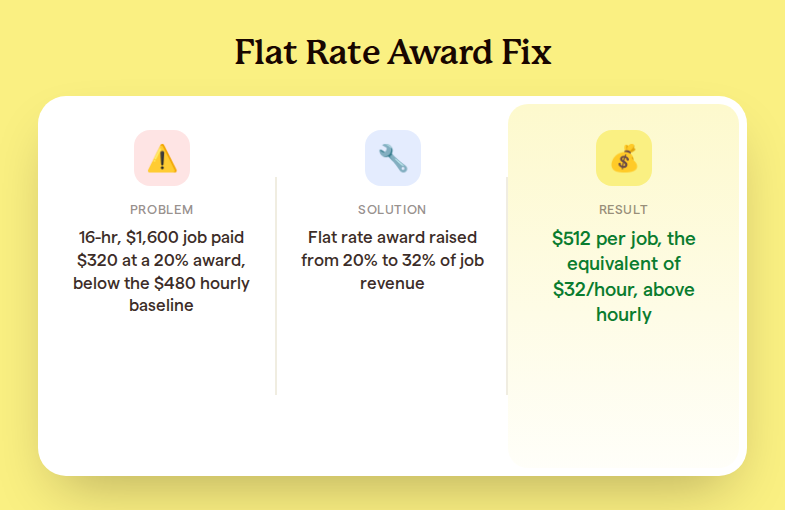
The company's technicians were paid a flat rate award, a percentage of total job revenue, instead of straight hourly pay, on jobs that qualified for performance pay. On paper, the award looked generous. In practice, the owner ran the numbers on a real job and did not like what he saw. A 16-hour job billed at $1,600 should have been a strong day for a technician earning $30 an hour: paid hourly, that is $480. Under the flat rate award in place at the time, set at 20% of job revenue, the same job paid $320, nearly a third less than the technician would have made simply staying on the clock.
That gap is not a rounding error. It means the technicians putting in the longest, most demanding days, the sixteen-hour jobs that keep a business running, were the ones getting penalized hardest by the pay plan meant to reward them. And once a technician notices that pattern once, they start doing the math on every job before they even start it, which is exactly the kind of second-guessing a good incentive plan is supposed to prevent.
The root cause was simple math nobody had rerun. The flat rate percentage had been set at a point in time and never re-tested against current labor rates and job pricing. As wages crept up and job mix shifted, the 20% award quietly stopped covering the hourly baseline it was supposed to beat. Nobody had done anything wrong when the plan was built. The plan had just aged past the point where the math still worked, the same trap covered in how one HVAC company redesigned its install pay split to end recurring pay disputes.
Rebuilding the HVAC Flat Rate Pay Plan Around a Real Wage Floor
Instead of patching the plan job by job, the fix started with a single question: what percentage actually keeps a flat rate technician ahead of hourly pay on a typical job, not just a fast one? Running the same $1,600, 16-hour job through the math, the company raised its flat rate award from 20% to 32% of job revenue. At 32%, that job now pays $512, or the equivalent of $32 an hour, two dollars above the technician's hourly baseline instead of a third below it.
That twelve-point increase did more than fix one bad job. It reset the floor for every job running through the plan, so a technician no longer needed to mentally flag which jobs were worth doing well and which ones the pay plan was quietly working against. A flat rate plan only earns trust when a technician can do the math once and know it holds for every job after that, not just the ones that happen to run long or short in their favor.
The redesign did not stop at the technician rate. The same review looked at every role touching a job before a wrench ever turns, starting with the service coordinators booking the work. Their pay had never been tied to the outcome that actually matters for the business: whether a booked call turns into a completed, dispatched job. The company built a booking-rate incentive instead, paying service coordinators for calls that convert to a scheduled and dispatched technician visit, with awards starting above an 85% booking rate and reaching up to $400 a month at 95% or higher.

Technicians on the metered side of the business, the crews paid by the hour rather than flat rate, got their own layer on top of base pay: a $50 bonus for hitting at least 95% on-time arrivals in a pay period, and a separate $50 bonus for at least 95% first-pass, no-callback completions. Paired with the flat rate fix, the company now had one coherent logic running through every role: pay the base fairly, then add a specific, visible bonus for the specific behavior that role controls, rather than one blended number nobody could trace back to their own actions. That same discipline, building one incentive per controllable behavior instead of one number for everything, is the idea behind a technician pay plan that nearly doubled one HVAC tech's hourly rate without touching base wages at all.
Profit sharing
made simple.
Give your team a stake in the company’s success. ShareWillow helps you create and manage profit-sharing programs that motivate employees and drive business results.
The Result: Pay That Beats Hourly Again, On Paper and On Payday
The headline number is the simplest one: on the same $1,600, 16-hour job that used to net a technician $320, the redesigned plan now pays $512, or $32 an hour, restoring the flat rate award to a real premium over hourly instead of a discount against it. That is the number every technician on the plan can now check for themselves, on any job, without waiting to see how their paycheck lands.
The company also built technicians a side-by-side view showing actual pay against potential pay if every requirement on a job had qualified, so a technician could see exactly which piece of a job cost them money and why, rather than accepting a single number with no explanation behind it. That visibility matters as much as the percentage itself. A pay plan a technician can audit in real time is a pay plan they will actually trust, and a technician who trusts the math stops treating every long job as a risk to be avoided.
How to Check Whether Your Own Flat Rate Pay Plan Still Beats Hourly
This is a five-minute audit any home service owner can run, and it is worth running at least once a year, or any time hourly wages move:
- Pull a real job from the last month, ideally a long one, with its actual hours and actual revenue.
- Calculate what that technician would have earned at their hourly rate for the hours worked.
- Calculate what the current flat rate percentage actually pays on that same job.
- If the flat rate number is lower, do the math on what percentage would put it back above hourly, the way this company moved from 20% to 32%.
- Re-run the check on your longest jobs specifically, since those are where a stale percentage does the most damage.
If the flat rate side of your HVAC commission pay plan has not been re-tested against current wages in the last year, there is a good chance it has drifted the same way this one did. ShareWillow's plan design tools can model a flat rate award against your own technicians' real job data before you change a single paycheck, for HVAC and other field service teams running the same kind of plan.
FAQ: HVAC Flat Rate Pay Plans
What is a flat rate pay plan for HVAC technicians?
A flat rate pay plan pays a technician a percentage of the total job revenue rather than an hourly wage for time worked. The idea is to reward speed and skill: a technician who completes a well-priced job efficiently earns more than the clock alone would pay. The percentage itself typically falls somewhere between 20% and 35% of job revenue, depending on the company and the job type.
How do I know if my flat rate pay plan is underpaying technicians?
Take a real job from the last month, calculate what the technician would have earned hourly for the actual time on site, and compare that to what the flat rate award actually paid. If the flat rate number comes in lower, especially on your longest jobs, the percentage has likely fallen behind current wages and job pricing and needs to be re-tested.
Is flat rate pay better than hourly for HVAC technicians?
It depends on whether the percentage is set correctly. A flat rate plan built on an accurate, regularly re-tested percentage can pay strong technicians meaningfully more than hourly while still controlling labor cost as a share of revenue. A flat rate plan built on a stale percentage can quietly pay less than hourly on the jobs that matter most, which is the exact problem this company found and fixed.
Related reading
- HVAC Commission Structure: How One Company Closed a Hidden Install-Helper Payroll Leak
- Flat Pay, Flat Output: How One HVAC Company Broke a 3-Job-a-Day Ceiling
- How Performance Pay Nearly Doubled a Technician's Hourly Rate
- How a Multi-Trade HVAC and Plumbing Company Cut HVAC Labor Cost From 58.5% of Revenue to Under 40%
Conclusion
A flat rate plan is not broken because technicians dislike it. It is broken when nobody has checked whether it still beats hourly.
Create incentives
that
drive results
You shouldn't need complex equity plans to align your team. ShareWillow makes it simple to create transparent profit-sharing programs that motivate employees and grow your business.

Incentive plans to help
small businesses thrive.
.png)
"I was able to leverage the knowledge of the ShareWillow team to learn how other companies were designing their bonus plans. The template was extremely helpful."

Brian Tustin
Owner, First Rate Movers