
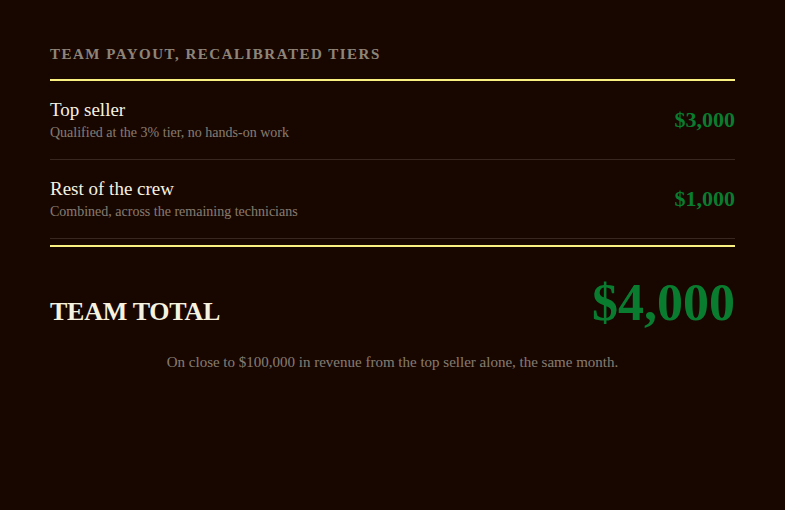
A five-person home services company's bonus thresholds were set so high that almost nobody could qualify, so the owner recalibrated the tiers live during an operations review, retroactive to the current month. The change immediately produced a $3,000 bonus for the team's top seller on close to $100,000 in revenue, with roughly $4,000 paid out across the crew.
Ask a business owner what their incentive plan is supposed to do, and most will say some version of the same thing: give the team something to chase. A five-person home services crew learned the hard way that a plan can quietly work against that goal. The qualifying thresholds had been set high enough that almost nobody could clear them, month after month, and the company had built a bonus program that was technically live but functionally invisible to the people it was meant to motivate.
The company sells and installs home comfort systems and handles the service work that keeps them running, the kind of general home services operation where a handful of technicians carry the entire book of business. With a crew that size, every person's number matters. There's no large pool of average performers to smooth out a rough month, and there's no room for a compensation plan that quietly tells half the team their best effort still won't be enough to see a check.
A Bonus Plan Nobody Could Reach
That's roughly where things stood heading into a routine operations review. The plan on paper looked reasonable enough: a tiered structure tied to sold hours and revenue, the kind of design that's supposed to reward technicians for both productivity and dollars generated. The problem wasn't the shape of the plan. It was where the bar had been set. The qualifying thresholds sat high enough that even solid months weren't clearing them, and the technicians putting in real effort had little to show for it on their bonus line.
The owner walked into the review already uneasy about it. Looking at the trend heading into the conversation, the pattern was hard to ignore: the numbers were going down, not up, and that's exactly the kind of signal that should worry anyone running a small crew on a performance plan. A bonus structure nobody can hit doesn't sit there neutrally. It erodes trust a little more every month it goes unpaid, and on a five-person team, that erosion shows up fast, in attitude, in effort, and eventually in who's still on the crew next quarter.
Watching The Trend Line Before It Became A Retention Problem
What made this case different from a lot of struggling incentive plans is that the owner caught it early and said so plainly, in the room, during the review itself. He wasn't looking for a dramatic overhaul or a plan that suddenly paid out more than the business could support. He wanted something narrower and more honest: a real shot for his guys to hit something for once. That's a modest ask on its face, but it's also the entire point of an incentive plan. If nobody can reach the bar, the bar isn't motivating anyone. It's just decoration on a pay stub.
Fixing a plan like this isn't just a matter of lowering every number until people start getting paid. Set thresholds too low and the bonus stops meaning anything, a rubber stamp instead of a reward. The goal in the review was to find the level where a strong month is genuinely achievable and a mediocre one still isn't rewarded, so the plan keeps doing its actual job of separating real performance from just showing up.
Recalibrating The Thresholds Live
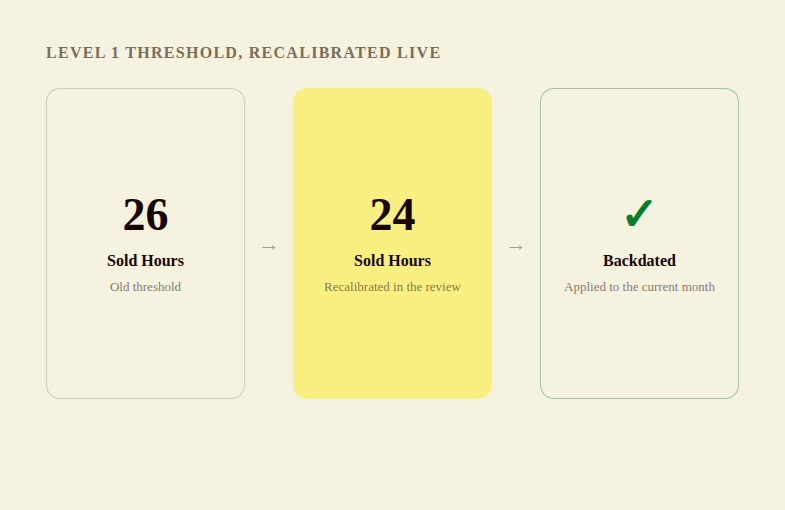
The plan was built around sold hours and revenue, split into three qualifying levels, each with its own bar to clear and its own payout rate once a technician cleared it. Level 1 had been set at 26 sold hours, a number that was proving out of reach for too many technicians in a normal month. During the review, that threshold came down to 24 sold hours, a small adjustment on paper but a meaningful one for a technician sitting right at the edge of qualifying.
Level 2 needed more than a nudge. The original structure left a hard wall where a technician below the line got nothing and a technician just over it got very little, not much of an incentive to push through that middle stretch. The recalibrated version smooths that out: under 28 sold hours still pays zero, but 28 to 30 sold hours now pays 1%, with the rate stepping up through further tiers from there as sold hours climb. That gap between 26 and 30 sold hours used to be dead space on the plan. Now it's the first rung of a ladder a technician can actually see themselves climbing.
None of this was modeled in a spreadsheet weeks in advance and rolled out on a fixed schedule. It happened in the room, during the operations review, as the owner and the ShareWillow team looked at where technicians were actually landing against the old thresholds and adjusted until the tiers matched reality instead of a target that had quietly drifted out of reach. That's a different way of running a comp plan than most companies use, and it's a faster one when the alternative is waiting for a quarterly review to catch a problem that's already costing you morale.
Applying It Retroactively, Not Just Going Forward
The recalibration didn't wait for the next pay period to take effect. It applied retroactively to the current month, which matters more than it might sound like on first read. A technician who'd already put in the hours under the old, unreachable thresholds didn't have to watch a fairer plan start the month after their best effort. The work they'd already done got measured against numbers that actually made sense, not the ones that had been quietly working against them all along.
That single decision is worth calling out on its own. Plenty of companies would have treated the recalibration as a going-forward fix, applied at the start of the next cycle, technically correct and easy enough to defend on paper. Applying it to the month already in progress meant technicians didn't lose a full cycle waiting for the math to catch up to what leadership already knew was true: the old bar had been set wrong, and there was no good reason to make the team pay for that a second time.
Profit sharing
made simple.
Give your team a stake in the company’s success. ShareWillow helps you create and manage profit-sharing programs that motivate employees and drive business results.
The real test of any recalibrated plan is what happens once technicians start hitting the new numbers. For this crew, the clearest answer came from the person furthest from a wrench. The company's top performer for the month wasn't out doing installs or repairs. He's a pure seller, closing the jobs that keep the install and service side of the business running, and under the recalibrated tiers he landed at the top of the ladder: close to $100,000 in revenue for the month, enough to qualify for the 3% payout tier and turn into a $3,000 bonus.
The First Real Numbers Under The New Tiers
Three thousand dollars on close to six figures of revenue is a real number, the kind that changes how a technician thinks about the plan going forward. It's not a token payout designed to make a spreadsheet look generous. It's a direct, calculable result of hitting a specific tier, and it's the kind of math a salesperson can run in their head mid-month to see exactly where another sale would put them. That visibility is worth almost as much as the dollar figure itself. A bonus plan only motivates people who can see the connection between what they do and what they earn, and a $3,000 check that traces cleanly back to a 3% tier on nearly $100,000 in revenue makes that connection obvious.
Across the full crew, the recalibrated tiers produced roughly $4,000 in total bonus payout for the month. That's not a huge number in absolute terms for a small company, but it's the first time in a while that the plan actually reflected what the team had earned instead of quietly falling short of it. The owner's own reaction to the top payout says as much: for someone who isn't touching a wrench, still makes a pretty good bonus, that's a great bonus. It's a small comment, but it's the kind that signals the plan is finally doing the job it was built for.
What This Means For Trust In The Plan
There's a difference between an incentive plan that exists on paper and one a team actually trusts. The first version of this plan, with its 26-hour threshold and its hard wall at Level 2, existed on paper. Nobody was clearing it, so nobody was thinking about it day to day, which meant it wasn't influencing behavior at all. The recalibrated version, tested against real numbers from the month already underway, gave technicians something to check their own performance against in real time, not a target that lived somewhere off in the distance.
The owner was looking forward to presenting the payout to the team himself, which is worth noting on its own. A leader confident enough in the math to hand-deliver the news isn't just paying out a bonus. He's demonstrating that the plan holds up, that the numbers behind it are real, and that hitting the tiers next month is genuinely possible rather than theoretical. That kind of confidence is hard to fake in front of a five-person crew who will find out fast whether the math actually works.
A few things from this recalibration are worth taking directly if a plan on your own team has stopped producing real payouts:
- If a threshold is going unmet month after month, the problem is usually the threshold, not the team. A bar nobody can clear stops functioning as motivation the moment everyone quietly accepts they won't reach it.
- Smooth out hard walls in the middle tiers. A structure that pays zero right up until a cliff, then jumps to a real number, leaves a dead zone where technicians have no reason to push for one more sold hour.
- Apply a fix retroactively when you can. Technicians who put in the work under a broken threshold shouldn't have to wait a full cycle for the correction to reach their paycheck.
- Watch the trend before it becomes a retention problem. A plan that's paying out less and less over time is telling you something before a technician tells you they're leaving.
- Let the numbers do the talking. A bonus that traces cleanly back to a specific tier and a specific revenue figure builds more trust than a bigger, murkier number ever could.
None of this required a new plan built from scratch. It required looking honestly at where technicians were actually landing against the existing thresholds and adjusting until the math matched reality, then trusting that a team performing under a fair plan will hand you real numbers to work with. For a five-person crew where every technician's effort is visible, that kind of plan is worth getting right the first time, and worth revisiting the moment the trend line says it's slipping again.
If you're weighing how to structure incentive pay for your own crew, ShareWillow's incentive plan design tools are built to handle exactly this kind of live recalibration, tiered structures that adjust as real performance data comes in instead of locking a team into thresholds set months before anyone's actual numbers were known. And if you run a similar operation, it's worth seeing how other field service businesses have approached building a plan their team can actually hit.
Related reading
Conclusion
A threshold nobody can reach isn't really a bonus plan, it's a promise the business isn't keeping.
Create incentives
that
drive results
You shouldn't need complex equity plans to align your team. ShareWillow makes it simple to create transparent profit-sharing programs that motivate employees and grow your business.

Incentive plans to help
small businesses thrive.
.png)
"I was able to leverage the knowledge of the ShareWillow team to learn how other companies were designing their bonus plans. The template was extremely helpful."

Brian Tustin
Owner, First Rate Movers
