
A storm-panel and residential security installation company paid every crew flat, with no way to reward its fastest teams. Here is how it tested four different commission rates against real payroll data before rolling out the one that actually worked.
Flat Pay Hides a Real Productivity Gap
A storm-panel installation and residential security company, the kind of business that sends crews out to install hurricane protection and security hardware on tight weather-driven timelines, had a compensation problem hiding in plain sight. Every field crew was paid a flat rate. No commission, no revenue link, nothing that separated a crew putting up panels fast and clean from a crew moving at half the pace.
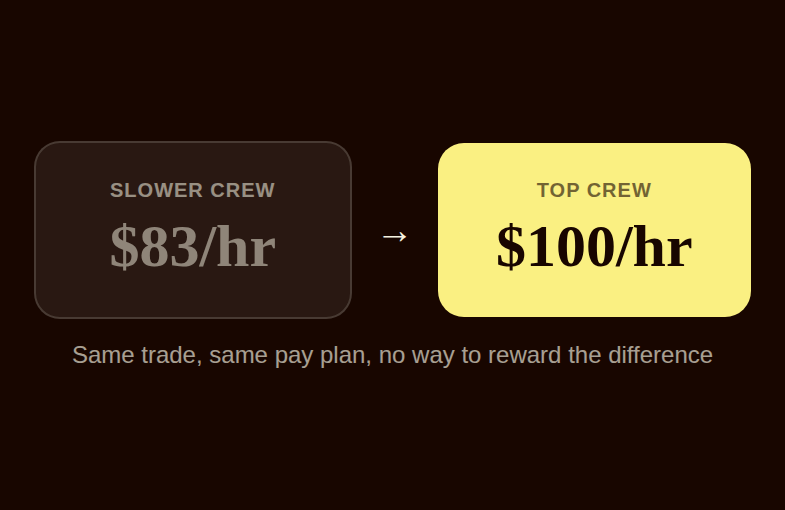
When leadership actually pulled the numbers, the gap was bigger than anyone expected. The company's top-producing crew was generating roughly $100 an hour in revenue. A slower crew was generating closer to $83 an hour. That is not a rounding error. Over a full week, that gap compounds into thousands of dollars of difference in output, and under a flat-pay structure, both crews were taking home exactly the same thing.
The fastest crew in the company and the slowest crew in the company were being paid identically, every single week.
Flat pay does not just fail to reward your best people. It quietly punishes them. A strong crew that could be earning more elsewhere has no financial reason to stay once they notice the math does not favor performance. Meanwhile a slower crew has no financial pressure to improve, because nothing changes for them either way. The incentive structure, or rather the total absence of one, was working against the business in both directions at once.
Two more problems compounded the flat-pay issue. First, callback jobs, the kind where a crew has to return to a site to finish an install that got delayed by missing materials or another logistics snag, had no clear rule for who got credited. That ambiguity turned into real pay disputes. A crew that did the bulk of an install but not the finishing touches felt shortchanged when a different crew got sent to close it out. Second, delivery time, the hours spent physically transporting panels and equipment to a job site, was getting lumped into general labor hours. That distorted the labor-cost math the business relied on to price jobs and plan crew schedules, because non-production time was masquerading as production time in every report.
None of this is unique to storm-panel installation. Any construction and specialty installation business running crew-based work runs into the same trap eventually. Flat pay is simple to administer, which is exactly why so many companies default to it early on. But simple does not mean fair, and it definitely does not mean motivating. Once a business has enough job history to actually see the productivity spread between crews, the flat-pay structure stops looking simple and starts looking like a slow leak.
There is a seasonal wrinkle here too that made the stakes higher than usual. Storm-panel and hurricane-protection work is inherently weather-driven, with demand spiking hard ahead of a forecasted storm and going quiet in calmer stretches. A business that lives on that kind of surge cannot afford to have its fastest, most reliable crews feeling undervalued right when demand peaks. Losing a top crew to a competitor during a slow season is bad. Losing one in the middle of storm-prep season, when every panel installed matters, is a different order of problem entirely.
Testing the Rate Before Betting the Payroll On It
The fix here was not simply picking a commission percentage that sounded fair and rolling it out. It was modeling the decision first, against real numbers, before a single technician's pay changed.
Four Rates, Five Weeks of Real Payroll
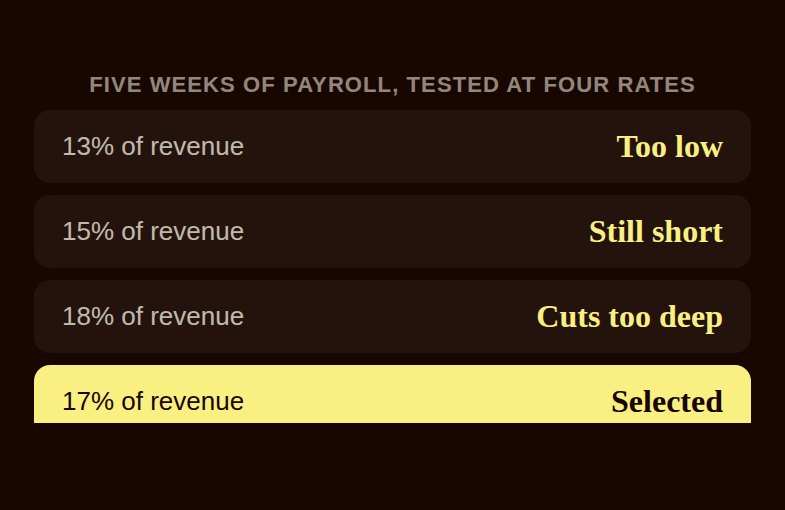
The team pulled five weeks of historical payroll data and ran it against four different commission percentages: 13%, 15%, 18%, and 20% of revenue. The goal was specific: find a rate that would not undercut what crews were already earning under the flat structure, while still creating a real, felt difference for the technicians actually producing more.
- 13% of revenue came in too low. It would have left even strong performers earning less than their existing flat pay in some weeks, which is the fastest way to kill trust in a new plan before it starts.
- 15% of revenue was closer, but still fell short of matching real historical earnings for the crews the business most needed to retain.
- 18% of revenue went too far in the other direction, cutting too deep into margin once modeled against real job costs.
- 17% of revenue landed in the sweet spot: high enough to meaningfully reward the top crew's output, sustainable enough that it did not erode the margin the business needed to stay healthy.
This is the step a lot of businesses skip. It is tempting to pick a commission rate that feels intuitively fair, roll it out, and hope the math works itself out once real paychecks start going out the door. Running historical payroll through several candidate rates first turns that hope into evidence. By the time 17% got selected, the company already knew, with real numbers, that it would not blow up payroll or shortchange its best crews.
Fixing the Data Underneath the Formula
A commission plan is only as fair as the data feeding it, so two structural fixes went in alongside the new rate. First, a callback-tracking mechanism: reworked jobs now get logged as a $0 job tied to an "original team" field, so a callback never accidentally credits revenue to whichever crew happened to finish the punch list. The team that did the original install keeps the credit, and the disputes that used to come with callback jobs mostly disappeared along with the ambiguity that caused them.
Second, delivery time got pulled into its own dedicated time-clock category, separate from production labor. That single change stopped non-production hours from quietly inflating labor-cost calculations, which matters just as much for accurate job pricing as it does for fair technician pay.
Before the company-wide rollout, technicians went through a dedicated training session covering exactly how the new commission plan worked, what counted as a callback, and how delivery time would be tracked separately going forward. Rolling out a new compensation structure without walking your team through the mechanics is how good plans get misunderstood and mistrusted in the first month. A short, direct training session up front heads that off.
Profit sharing
made simple.
Give your team a stake in the company’s success. ShareWillow helps you create and manage profit-sharing programs that motivate employees and drive business results.
The Result: A Rate the Numbers Actually Support
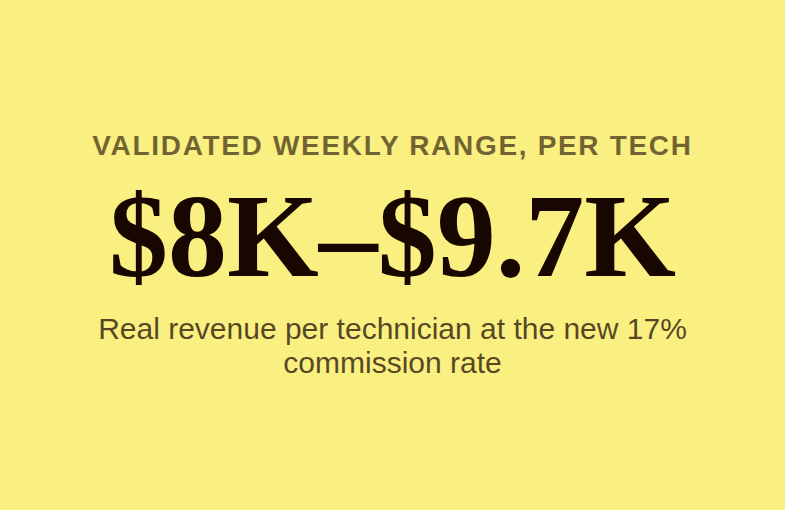
Leadership approved a full-team rollout at 17% commission, and it was not a leap of faith. The rate was validated against real weekly per-technician revenue running in the $8,000 to $9,720 range, meaning the company could see, before go-live, exactly what kind of paychecks the new structure would produce for its actual crews doing actual work.
That is the version of this story worth sitting with. Not every comp-plan case study gets to end with three months of glowing post-launch numbers, and it would not be honest to pretend this one does either. What this company has is something arguably more valuable at the launch stage: a rate that survived real scrutiny against real payroll before a single dollar of it hit a paycheck. The confidence built into that rollout came from the modeling, not from hope.
That distinction matters more than it might seem. A lot of commission-rate decisions get made on instinct, a number that feels generous enough to motivate a crew without feeling reckless to the owner. Instinct is not nothing, but it is not evidence either. Testing 13%, 15%, 18%, and 20% against five real weeks of payroll turned this decision into something the company could defend to its own crews, and to itself, the next time someone asked why the rate landed where it did.
The structural fixes matter here too. A commission plan built on top of messy callback attribution or blended delivery time would have generated exactly the kind of disputes the old flat-pay system already had, just with more math attached. Fixing the data first meant the new incentive could actually do its job: reward the crews producing $100 an hour differently than the crews producing $83 an hour, without a callback dispute or a mispriced job muddying the picture.
What This Means for Your Crew-Based Business
A few things generalize well beyond one storm-panel and security company:
- Flat pay hides your best and worst performers equally. If you cannot look at your payroll and see a real productivity gap between crews, that does not mean the gap does not exist. It means your compensation structure is not built to reveal it.
- Model a rate against real payroll before you commit to it. Testing multiple candidate percentages against historical data turns a guess into a defensible decision, and it protects you from either underpaying your top performers or cutting too deep into margin.
- Solve attribution problems before you add commission on top of them. Callback jobs, split credit, and blended non-production time will corrupt a commission plan just as badly as they corrupted a flat one. Fix the data, then build the formula.
- Separate production time from everything else. Delivery time, travel time, and other non-billable hours deserve their own category, both for accurate labor costing and for a commission plan technicians can actually trust.
- Train your team on the mechanics before launch. A commission plan that nobody fully understands generates the same kind of disputes a flat-pay plan does, just dressed up in a new formula.
You do not need to run a storm-panel installation company in a hurricane-prone market to have some version of this problem. Any construction or specialty trade business running crew-based work is sitting on the same kind of productivity gap, waiting to be measured and rewarded properly.
Related reading
- From Zero Incentive to $2,100 Paychecks: A Multi-Trade Company's Van Bonus Plan
- The $3,000 Paycheck: How One Home Services Company Turned Sold Hours Into a Bonus Worth Chasing
- Incentives, Commissions, and Bonuses: What’s the Difference and Why It Matters
- 7 Profit Sharing Plan Examples for Your Small Business
- Overtime Pay for Commissioned Employees: How One Installer Company Pays the Greater of Base or Performance Pay
Conclusion
If your crews are still paid flat while their actual output tells a very different story, the fix does not have to be a guess. ShareWillow works with construction and specialty installation companies to model commission rates against real payroll history before a single paycheck changes, then keeps the data clean enough for the plan to hold up long after launch. Reach out to see what a properly modeled rate could look like for your crews.
Create incentives
that
drive results
You shouldn't need complex equity plans to align your team. ShareWillow makes it simple to create transparent profit-sharing programs that motivate employees and grow your business.

Incentive plans to help
small businesses thrive.
.png)
"I was able to leverage the knowledge of the ShareWillow team to learn how other companies were designing their bonus plans. The template was extremely helpful."

Brian Tustin
Owner, First Rate Movers
