
A multi-trade home services company had no pay plan tied to how its vans actually performed. Here is how a three-part van incentive rebuilt that link, and what four technicians took home in the very first live cycle.
A Fleet of Vans With No Reason to Push Harder
Picture a home services company running HVAC installs, plumbing, and handyman work out of a shared fleet of service vans. Every van has its own revenue target, its own technician, its own day full of decisions about which job to prioritize and how fast to move. And for a long time, none of that hustle connected to a paycheck in any real way.
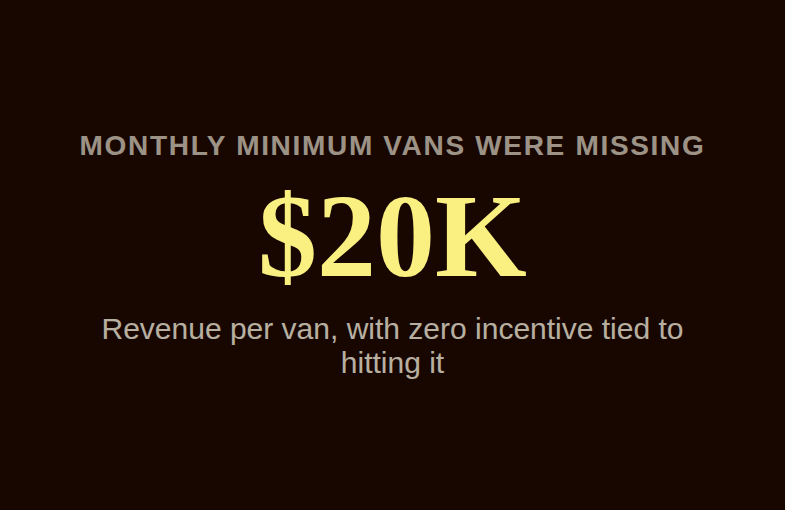
The company had set a simple internal benchmark: each van should be generating at least $20,000 a month in revenue. It was a reasonable number, grounded in what the business needed to stay healthy. The problem was that hitting it, missing it, or blowing past it all paid technicians exactly the same. There was no bonus, no commission, no tiered reward sitting on the other side of that number. A van pulling in $18,000 a month and a van pulling in $24,000 a month were functionally identical from a compensation standpoint.
That gap showed up in more than just revenue. Techs had almost no visibility into their own performance metrics day to day, which meant accountability was more of an idea than a habit. Nobody could look at a dashboard and see how their week was actually shaping up against the number that mattered.
A van running 20 percent under target and a van running 20 percent over target were paying the exact same technician the exact same way.
Job efficiency was an even murkier picture. The company wanted to reward technicians who finished jobs faster than budgeted, the kind of speed that comes from real skill rather than cutting corners. But the data behind that idea was shaky. Job and estimate records were frequently misclassified inside Housecall Pro, and technicians often simply forgot to clock in or out on individual jobs. You cannot pay someone fairly for saving two hours on a job if the system cannot reliably tell you how many hours the job actually took.
None of this is unusual. A lot of multi-trade field service businesses get to a certain size and realize the compensation plan never grew up alongside the operation. Revenue targets get set in a planning meeting once, everyone nods, and then the actual mechanism for rewarding people who hit those targets never gets built. The target becomes wallpaper. Everyone knows the number exists. Nobody feels it in their paycheck.
This is especially common once a business mixes trades under one roof, the way this company mixed HVAC installs, plumbing, and handyman work across a shared van fleet. Each trade has a different rhythm, different job lengths, different margins. It is tempting to leave compensation flat and simple precisely because building something trade-aware feels complicated. But that simplicity comes at a real cost. A technician doing consistently strong plumbing work has no way to distinguish themselves financially from a technician coasting through easier handyman calls, and over time the strongest performers notice that distinction is missing long before management does.
What made this company's situation worth fixing quickly was that the underlying signal was already there. Revenue per van was trackable. Budgeted versus actual hours were trackable, once the clock-in habit got cleaned up. Close rate on estimates was trackable. The company had the ingredients for a real incentive plan sitting in its field service software the whole time. It just had not been assembled into something a technician could look at and understand in one sentence: do this, get paid that.
Fixing that gap did not require a bigger budget or a company-wide overhaul. It required three specific mechanisms, synced automatically from the data the business already generated, and a payout cycle short enough that a technician could actually feel the connection between a good week and a good check.
Three Mechanisms, One Van, One Paycheck
The rebuilt plan did not try to reward everything at once. It picked three specific behaviors that actually mattered to the business and built a clean mechanism for each one, all synced automatically out of Housecall Pro so nobody had to hand-build a report every pay period.
1. A Tiered Van Revenue Commission
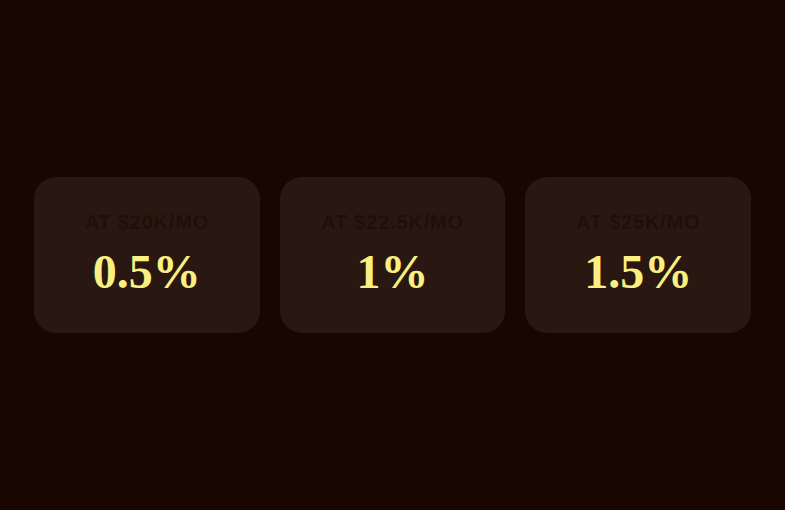
Instead of a single flat bonus for clearing $20,000, the plan introduced three tiers that scale with how far a van pushes past the baseline:
- 0.5% commission once a van crosses $20,000 in monthly revenue
- 1% commission once a van crosses $22,500
- 1.5% commission once a van crosses $25,000, the real stretch goal
The tiering matters more than the percentages themselves. A flat bonus at one threshold gives a technician no reason to keep pushing once they clear it. Tiers turn every additional dollar of revenue into a reason to keep going, all the way up to the $25,000 stretch goal the business actually wants vans reaching.
2. A Job-Efficiency Bonus With a Real Floor
The second mechanism rewards speed without punishing anyone for a hard job. Technicians earn 50% of net hours saved, calculated as budgeted hours minus actual hours, multiplied by their hourly rate. Critically, the bonus has a floor of zero. If a job runs long, nobody loses money on it. The plan only pays out on time saved, it never claws back time lost. That distinction is what makes an efficiency bonus feel like an opportunity instead of a trap.
Making this mechanism trustworthy required cleaning up the underlying data first. Job records that had been misclassified in the field service system needed to be corrected, and the team reinforced the habit of clocking in and out on every job. An efficiency bonus is only as fair as the hours it is built on.
3. A Conversion-Rate Tier Bonus
The third piece ties a bonus to close rate on estimates, giving technicians a reason to care about the sales side of the job, not just the labor side. Someone who does excellent work but never gets the estimate signed is leaving revenue on the table that the whole van incentive depends on.
Payout Cadence Is Half the Plan
All three mechanisms run on a biweekly cycle, not monthly and certainly not quarterly. A technician who has a strong two weeks sees that reflected in their next check, not a number they have to remember from six weeks earlier. The company reviews and finalizes each period through a self-serve portal, which keeps the whole process from turning into another manual spreadsheet exercise every pay period.
This is the part of a compensation rebuild that owners tend to underestimate. The formula matters, but the rhythm matters just as much. A perfectly designed commission plan that pays out once a quarter barely registers with a technician's day-to-day decisions. A good plan on a fast cadence changes behavior almost immediately, because the feedback loop is short enough for someone to notice.
Profit sharing
made simple.
Give your team a stake in the company’s success. ShareWillow helps you create and manage profit-sharing programs that motivate employees and drive business results.
The First Live Cycle: Real Numbers, Fast
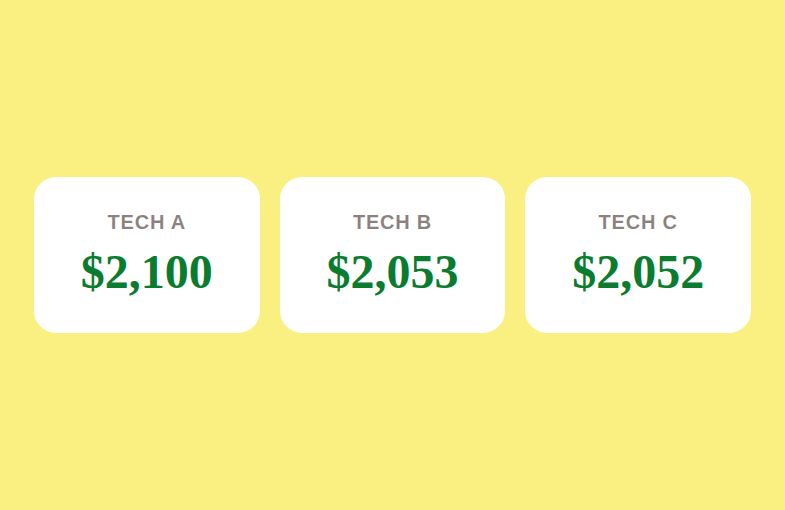
The plan went live and the very first biweekly pay period produced real, meaningful payouts, not a token amount meant to prove the concept worked. Four technicians earned incentive pay directly from the new system:
- $2,100
- $2,053
- $2,052
- $1,506
Layered into those totals were a $300 overtime bonus for one technician and a 10-hours-saved efficiency award for another, concrete proof that the job-efficiency mechanism was already doing its job. The company also tracked close rate at 20% for the first time in its history, a number that simply did not exist as a management tool before the rebuild.
What stood out most was not just the dollar figures. It was the shift in how the owner talked about the business afterward. In a review call following that first cycle, the owner's own read on the new system was refreshingly plain:
"Now it seems like it's collecting data, and we're starting to get a bigger picture of how it's looking."
That is not a dramatic before-and-after growth story. It is something more foundational: a business that finally has a real, trustworthy signal on van performance, technician efficiency, and close rate, all flowing automatically instead of getting reconstructed by hand every couple of weeks. Once that signal exists, everything downstream gets easier, from staffing decisions to figuring out which van needs coaching and which one needs a stretch goal.
It is also worth flagging what this story is not. It is not a claim that every van jumped straight to its $25,000 stretch goal in one cycle, or that every technician on the roster suddenly outperformed. Four technicians earned real, meaningful bonuses in the very first live period, which is a strong early signal, not a finished transformation. The tiers exist precisely so that vans still ramping toward $20,000 have somewhere to go next, and the next few cycles will show whether the close-rate mechanism moves that 20% baseline in the right direction. Treat an early result like this as proof the mechanism works, not as the end of the story.
What This Means If You Run a Multi-Van Operation
A few lessons here travel well beyond one HVAC and plumbing fleet:
- A revenue benchmark without a mechanism is just a wish. If your team has an internal number they are supposed to hit, but nothing changes in their paycheck whether they hit it or not, that number is not actually driving behavior.
- Tier your commission instead of flattening it. A single threshold bonus caps out someone's motivation the moment they clear it. Tiers keep the incentive alive all the way to your real stretch goal.
- Reward speed without punishing hard jobs. A floor of zero on an efficiency bonus is a small design choice with a big effect on how the plan feels to the people earning it.
- Fix your data before you build the formula. Misclassified jobs and missed clock-ins will quietly wreck a fair plan. Clean data is not a nice-to-have, it is the foundation the whole incentive stands on.
- Shorten the cycle wherever you can. Biweekly payouts, reviewed through a simple self-serve process, keep the plan connected to real behavior instead of becoming an abstraction technicians have to trust blindly.
None of this required guesswork, and it did not require a bigger bonus budget than the company already had. It required turning data that was already sitting in field service software into three clear mechanisms and a payout rhythm fast enough for technicians to actually feel it. Get that right, and the dollar amounts tend to take care of themselves.
Related reading
Conclusion
If your team has a revenue target that lives in a planning doc but never shows up in a paycheck, that gap is costing you more than you think. ShareWillow works with HVAC, plumbing, and multi-trade field service companies to turn the data already sitting in your job management software into real, fast-paying incentive plans. Reach out and see what your own vans could be earning under a plan built to actually pay out.
Create incentives
that
drive results
You shouldn't need complex equity plans to align your team. ShareWillow makes it simple to create transparent profit-sharing programs that motivate employees and grow your business.

Incentive plans to help
small businesses thrive.
.png)
"I was able to leverage the knowledge of the ShareWillow team to learn how other companies were designing their bonus plans. The template was extremely helpful."

Brian Tustin
Owner, First Rate Movers
