How to pay glass installation technicians: how a 50-year family company is fixing 15 hours of weekly overtime with a completion bonus, not a pay cut.
If you're wondering how to pay glass installation technicians without either overpaying for slow work or burning out your best people on overtime, you're not alone. It's one of the least-discussed pay problems in the trades, mostly because most glass companies still run on straight hourly pay: a system that was fine when the crew was three guys and a truck, and starts breaking down once overtime becomes a permanent line item instead of an occasional one.
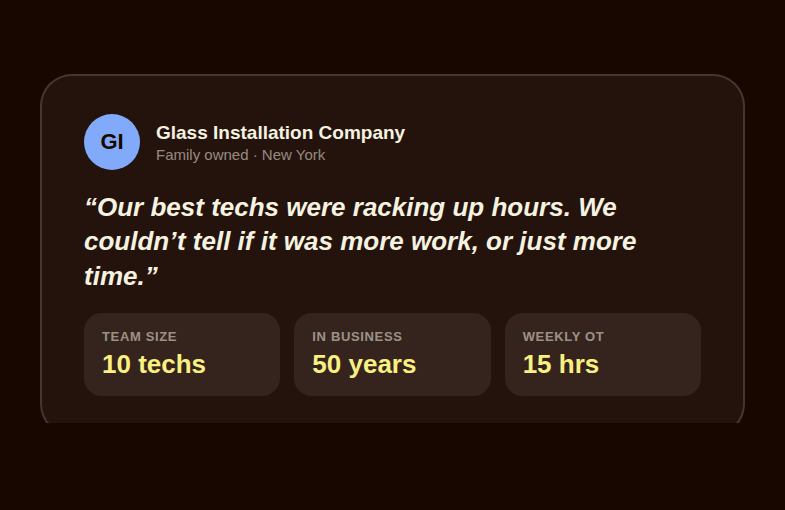
That's exactly where a 10-person, family-run glass installation company in New York found itself. Fifty years in business, five two-person install teams (a lead and a helper on each), and a payroll built entirely on hours logged in QuickBooks. No commission, no bonus, just a clock. And lately, that clock had started telling a story the owner didn't fully trust.
How to Pay Glass Installation Technicians When Hourly Stops Working
The number that started the conversation was simple: technicians were logging roughly 15 hours of overtime a week, per tech, company-wide. Not one bad month. A pattern.
On paper, that's a straightforward payroll problem. In practice, it's a trust problem. The owner had a nagging suspicion that some of his longest-tenured techs, the ones who knew every trick in a decades-old install process, were stretching jobs rather than finishing them. Not clocking fraudulent hours exactly, just... taking their time. And because straight hourly pay rewards hours worked, not jobs completed, there was no way to tell the difference between a genuinely hard install and a slow one.
That distinction matters more than it sounds. A two-person team paid purely by the hour has zero financial incentive to move faster once the job is underway; if anything, the incentive runs the other way. It's the same root issue covered in this case study on a company that discovered 28 of its "worked" hours were never actually worked: when pay is tied only to time, time is what you get more of.
The glass company's dispatch software (Jobber) tracked which job was assigned to which team, but it wasn't tied to labor cost or actual time-per-job in any way the owner could act on. Payroll ran through QuickBooks, completely separate from the job data. There was no dashboard, no per-job cost, no way to compare Team A's average install time to Team B's. The owner was flying on instinct, and instinct said something wasn't adding up.
The Fix: Pay for the Job, Not Just the Hours
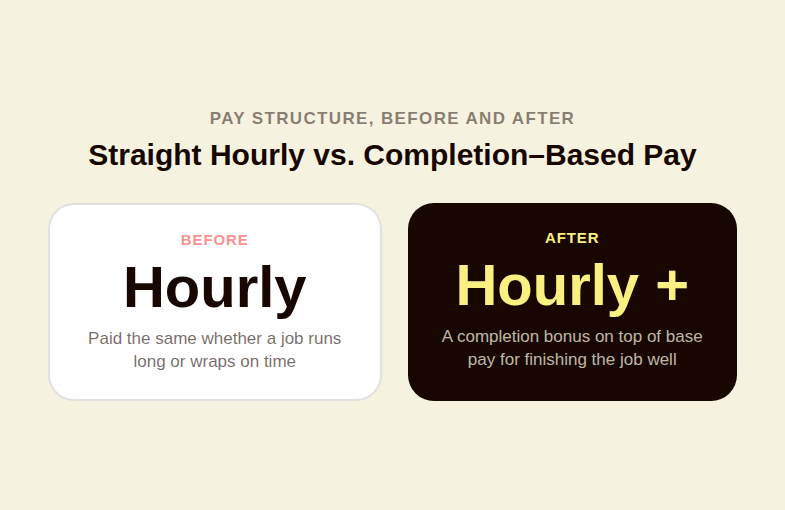
Rather than ripping out hourly pay and replacing it with straight commission, which tends to spook long-tenured techs used to a predictable paycheck (one senior tech had already said he'd quit if the company moved to pure incentive pay), the plan kept a full hourly base and layered a completion bonus on top.
The mechanics are simple on purpose:
- Every technician keeps their hourly rate. Nobody's base pay goes down.
- A bonus pool is tied to jobs finished within their budgeted install window, not jobs finished fast for the sake of speed. Quality holds, because rework doesn't count.
- The bonus is visible in near real time through the technician's ShareWillow app, pulling directly from Jobber job data instead of a separate spreadsheet somebody has to update by hand.
- Overtime is still paid when a job genuinely runs long (a stuck frame, a measurement issue, a customer who wasn't home), but it stops being the default way techs earn more.
That last point is the one that tends to get missed in conversations about how to pay glass installation technicians. The goal was never to eliminate overtime outright; some overtime is legitimate and necessary. The goal was to stop overtime from being the only lever a technician had for a bigger check. Once finishing well pays as much as, or more than, staying late, the incentive to stretch a job quietly disappears.
This same "pay for the outcome, not the clock" logic shows up across trades in different forms. A pest control company solved a nearly identical problem by moving away from a plan that accidentally rewarded technicians for taking longer between stops, replacing it with a compliant bonus plan built around real productivity instead of hours on the clock.
What This Means for Other Glass and Home Service Companies
Glass installation is a small enough trade that there isn't much written specifically about how to pay glass installation technicians. But the underlying math is identical to any home service business where a two-person team controls its own pace: garage door install, fencing, flooring, even parts of roofing. If pay is purely hourly, and the crew controls how long a job takes, you will eventually see overtime creep. It's not a character problem. It's an incentive design problem.
A few principles carried over from this rebuild, regardless of trade:
Keep the base, add the incentive
Techs who've worked hourly for years, especially longer-tenured ones, are (rightly) wary of a pay change that feels like a pay cut. Layering a completion bonus on top of a full hourly base removes that objection almost entirely. Nobody has to bet their paycheck on a new system to try it.
Tie the bonus to something the technician actually controls
A two-person install team controls how efficiently they work a job, not how many leads the company generates or what the average ticket size is company-wide. The bonus has to sit close to what the tech can influence, or it just feels like noise.
Make the number visible before payday, not after
One of the biggest shifts wasn't the math, it was the visibility. Technicians could see, job by job, what a completion bonus was tracking toward, instead of finding out what they'd earned when the check showed up. That single change tends to do more for trust than the compensation plan itself.
For companies still calculating pay by hand or in a spreadsheet, it's worth reading through this step-by-step guide to calculating bonus pay before building a plan like this one; getting the math transparent from day one avoids the trust problems that sink most first attempts at incentive pay.
If you're building your own plan, ShareWillow's platform can pull directly from job management software like Jobber, Housecall Pro, or ServiceTitan to calculate completion-based bonuses automatically, so technicians see their number update in real time instead of waiting for the next payroll run.
Profit sharing
made simple.
Give your team a stake in the company’s success. ShareWillow helps you create and manage profit-sharing programs that motivate employees and drive business results.
The Mistake Most Small Glass Companies Make First
When a small glass company decides to move off pure hourly pay, the most common first draft is also the one most likely to fail: too many rules. A points system for every possible job type, separate rates for residential versus commercial, deductions for callbacks, bonuses for upsells, all stacked into one spreadsheet formula nobody but the owner fully understands.
It fails for a predictable reason. A five-team, ten-person company doesn't have the administrative bandwidth to maintain a complicated plan, and technicians won't trust a number they can't reconstruct themselves. If a tech can't look at their own week and roughly guess what their bonus will be, the plan has already lost its motivational power, no matter how well-intentioned the design.
The version that held up in this glass company's case had exactly one bonus lever: complete the job within its budgeted window, get the bonus. No tiers, no separate residential and commercial rates, no callback penalty layered in at launch. Simplicity was the point, not a limitation. A company can always add complexity later once techs trust the base mechanic; it's much harder to walk complexity back once a crew feels burned by a plan they never understood.
There's a compliance angle here too, and it's worth taking seriously even for a small, family-run company. Overtime rules under the Fair Labor Standards Act don't disappear just because part of someone's pay is a bonus; a nondiscretionary completion bonus generally has to be factored into the regular rate used to calculate overtime pay. It's a detail that's easy to miss when building a plan on a spreadsheet, and one more reason payroll and job data benefit from living in the same system rather than two disconnected tools.
FAQ: Paying Glass Installation Technicians
Should glass installation technicians be paid hourly or on commission?
For most small and mid-sized glass companies, a hybrid works best: a full hourly base, protected, with a completion bonus layered on top for jobs finished within their budgeted window. Pure commission tends to unsettle experienced techs used to a predictable check, while pure hourly gives no incentive to work efficiently. The hybrid keeps the safety net while still rewarding good work.
How do you know if a glass installation technician's overtime is real work?
The only reliable way is to compare job-level time data (from your dispatch or job management software) against payroll hours, ideally in one connected system rather than two separate tools like Jobber and QuickBooks. Without that link, you're guessing. Once overtime and job data live in the same place, patterns like consistently long install times on one team versus another become obvious fast.
What's a fair bonus for a two-person glass installation team?
There's no single universal number, but the structure matters more than the size at first: start with a modest bonus pool tied to on-time, on-quality job completion, split between the lead and helper, and let the plan run for a full pay cycle or two before adjusting the amount. A bonus techs can predict and trust beats a bigger one they don't understand.
Related reading
- The GPS Bug That Turned 36 Hours of Work Into 64 Hours of Overtime
- The Pest Control Company That Stopped Paying Techs to "Milk the Clock" and Built a Compliant Bonus Plan Instead
- How to Calculate Bonus Pay: A Step-by-Step Guide to Fair and Motivating Compensation
- 9 Bonus Structure Examples Employees and Employers Love
Conclusion
Pay technicians for the work they finish, not just the hours they log, and overtime stops being the only way to earn more.
Create incentives
that
drive results
You shouldn't need complex equity plans to align your team. ShareWillow makes it simple to create transparent profit-sharing programs that motivate employees and grow your business.

Incentive plans to help
small businesses thrive.
.png)
"I was able to leverage the knowledge of the ShareWillow team to learn how other companies were designing their bonus plans. The template was extremely helpful."

Brian Tustin
Owner, First Rate Movers