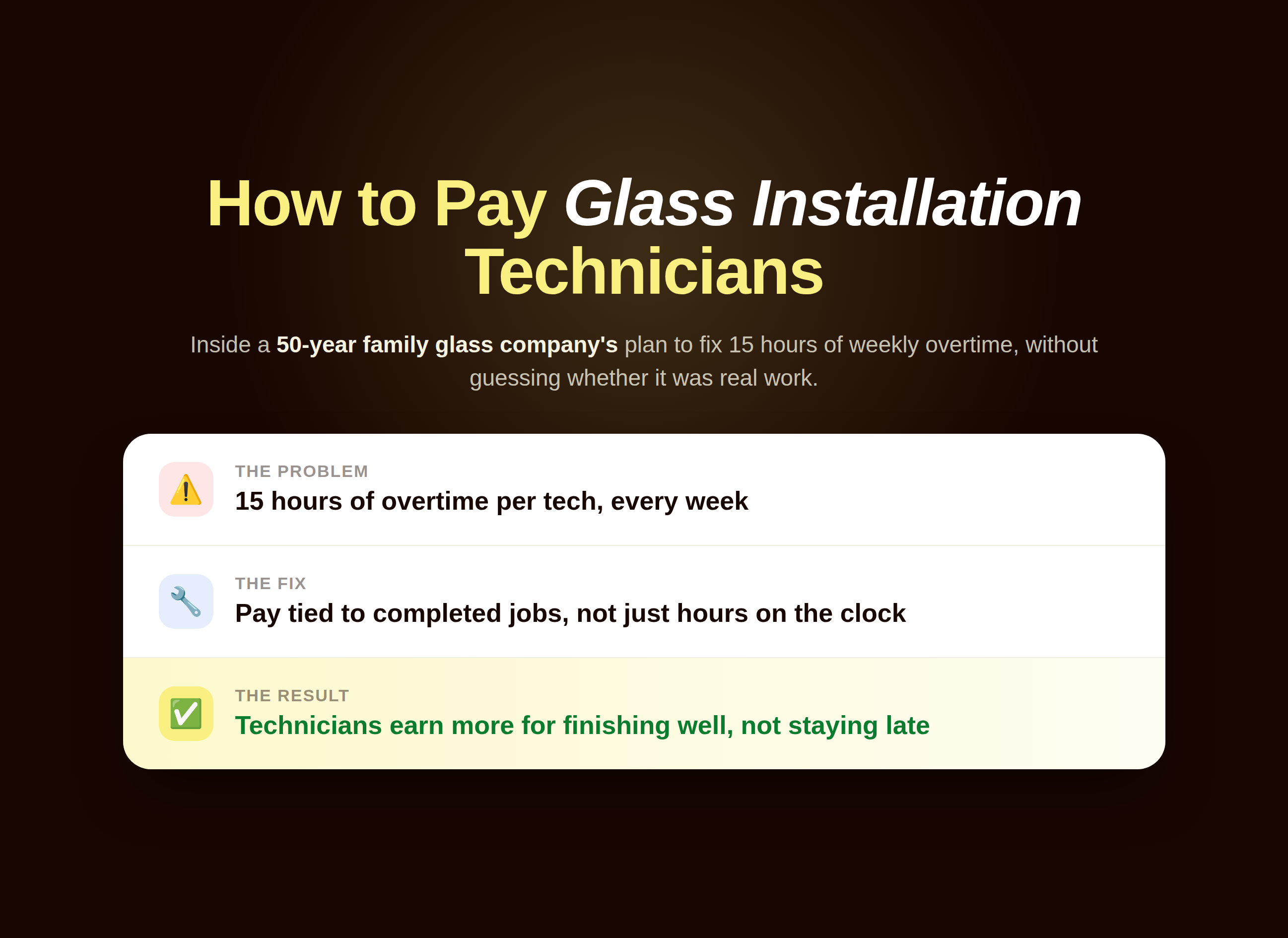
Electrical labor cost percentage benchmarks and a real fix: how a 20-tech multi-trade company is turning $40K in monthly overtime into growth.
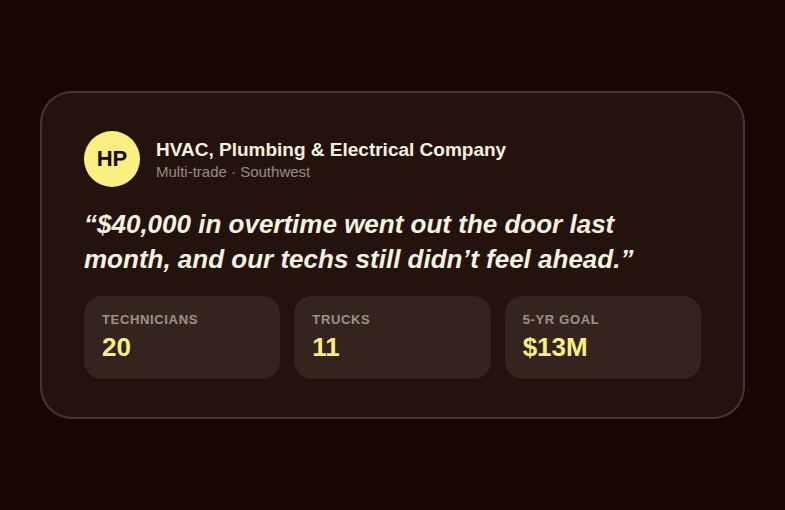
Electrical labor cost percentage is one of those numbers most home service owners can feel is wrong before they can prove it. You look at the P&L, you see payroll eating more of revenue than it should, and overtime is usually the first suspect. That was exactly the situation for a 20-technician HVAC, plumbing, and electrical company in the Southwest running 11 trucks and burning roughly $40,000 a month in overtime, while trying to figure out how to scale from about $6.5 million to a $13 million revenue target over the next five years.
The company brought in an outside consultant specifically to fix the P&L before that growth push, and overtime was the first line item that didn't add up. Techs were earning real money in overtime pay, but somehow nobody, not the owner, not the techs themselves, felt like the extra hours were actually paying off.
Why Electrical Labor Cost Percentage Gets Out of Control
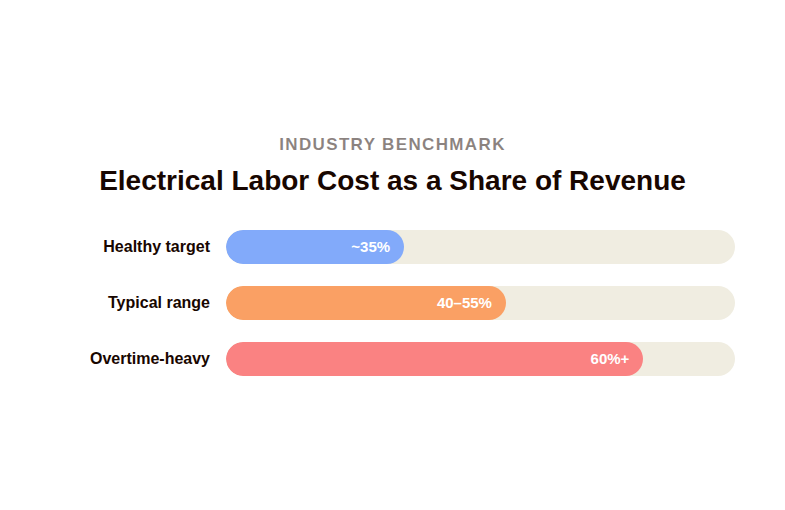
Labor is the single biggest expense for most electrical and multi-trade contractors, typically consuming somewhere between 40 and 55 percent of revenue once payroll taxes, workers' comp, and benefits are factored in on top of base wages. A healthy target sits closer to 35 percent; once a company drifts into the 60 percent-plus range, overtime is almost always doing a lot of the damage.
That's the trap this company had fallen into. Overtime pay isn't inherently a bad thing, techs who work more should earn more, but when overtime becomes the default way technicians grow their paycheck, two things happen at once. Labor cost as a percentage of revenue creeps up because time-and-a-half is expensive, and the company's ability to actually complete more jobs doesn't necessarily grow with it, because the same techs are just working longer hours instead of the team getting more efficient.
There was a retention angle too, and in this company's market it mattered as much as the payroll math. Competitors in the area were poaching electricians and HVAC techs for as little as one or two dollars more an hour. When overtime is the only lever a technician has to earn more, a competitor offering a flat raise looks like an easy win, even a small one. A visible, well-designed incentive structure is one of the few things a company can offer that a straight hourly raise can't easily match, because it rewards the kind of performance an hourly raise doesn't touch: speed, quality, and consistency.
This isn't a problem unique to electrical work. The same dynamic shows up across trades; a multi-trade home services company cut its HVAC labor costs from 58 percent of revenue to under 40 percent using the same core idea: replace pay that scales with hours worked with pay that scales with results delivered.
Turning Overtime Into Visible Incentive Pay
Rather than trying to cut overtime with a policy memo, which tends to just push the same problem underground, the plan being built for this company replaces overtime-dependent pay with a daily, visible incentive structure tied directly into ServiceTitan, the job management software the company already runs on.
A few design choices mattered more than the others:
- Incentive pay covers more than just electricians and HVAC techs in the field. CSRs and dispatchers are included too, since booking rate and scheduling efficiency directly affect how much overtime the field team ends up needing.
- Pay updates daily rather than at the end of a pay period, so a technician can see how a specific day's work moved their number, not just find out two weeks later.
- The rollout started small on purpose: four of the company's strongest performers adopted the new plan first, building internal buy-in before it went company-wide. Incentive pay that arrives top-down, with no input from the people earning it, tends to get resisted. Incentive pay that a company's own best people are already using tends to sell itself.
- Because the plan runs off ServiceTitan data that already exists, there's no second system for the office to maintain, and no separate spreadsheet that quietly falls out of date after a few months.
The company's electrical labor cost percentage in this new structure isn't targeted to fall through wage cuts or headcount reductions. It's targeted to fall because the same or slightly higher total payroll dollars produce more completed, on-time, quality work per hour, with overtime becoming the exception again instead of the norm. That distinction matters for team morale as much as it matters for the P&L: nobody has to take home less to make the number look better.
What Counts as a Healthy Electrical Labor Cost Percentage
There's no single number that fits every electrical or multi-trade company, crew mix, service area, and whether a company leans residential or commercial all move the target. But a few reference points are useful when you're checking your own numbers against the market:
- Healthy target: roughly 35 percent of revenue, fully burdened (base wages plus payroll taxes, workers' comp, and benefits).
- Typical range: 40 to 55 percent for most electrical contractors, which still leaves room for a healthy margin if overhead is controlled.
- Overtime-heavy: 60 percent or more, which is usually a sign that overtime, not headcount or wages themselves, is the real driver.
Overhead for electrical contractors typically runs another 13 to 20 percent of revenue on top of labor, which means a company sitting at 60 percent labor cost has very little room left for a healthy net margin, usually cited in the 8 to 15 percent range for well-run companies in this trade. When a company's electrical labor cost percentage is high specifically because of overtime, that's actually good news: it's one of the more fixable versions of the problem, because the fix is a pay structure change, not a hiring freeze or a painful round of layoffs.
For a broader look at building incentive structures that scale across a full team, not just field technicians, this guide to tiered bonus structures is a useful starting point before building a plan specific to your own numbers.
Electrical-specific commission structures matter here too. A separate 18-person electrical contractor unified five different pay plans into one standard for exactly this reason: when every crew or region runs its own informal pay rules, nobody, including the owner, can actually see what's driving labor cost up.
If you're evaluating your own numbers, ShareWillow's platform connects directly to ServiceTitan, Housecall Pro, and similar job management systems to calculate incentive pay automatically from real job data, without adding a second manual process for the office to run.
Profit sharing
made simple.
Give your team a stake in the company’s success. ShareWillow helps you create and manage profit-sharing programs that motivate employees and drive business results.
Why This Matters More at $6.5M Than It Will at $13M
It's tempting to treat electrical labor cost percentage as a problem to revisit once a company is bigger and has more back-office support to manage it. In practice, the opposite is true. At $6.5 million in revenue with 20 technicians, a labor cost percentage that's a few points too high is a real but manageable drag. At $13 million with 50 to 60 technicians and 30 trucks, the same percentage-point overage compounds into a much larger dollar figure, and a pay structure that was never designed to scale becomes far harder to unwind once dozens of people are used to it.
That's part of why this company chose to fix its incentive structure before the growth push, not after. A visible, ServiceTitan-connected incentive plan that works cleanly for 20 technicians and a handful of CSRs and dispatchers can scale to 50 or 60 without a redesign, because the mechanics don't change, only the number of people running through them. A spreadsheet-based overtime system, by contrast, gets harder to manage with every technician added, right up until it breaks entirely.
There's a simpler way to think about the $40,000-a-month figure too. Over a year, that's roughly $480,000 in overtime pay, on a company doing about $6.5 million in revenue, which works out to nearly 7.5 percent of total revenue going to overtime alone, before counting anyone's regular hours. Redirecting even a portion of that into a visible incentive structure, rather than an open-ended overtime line, gives the company a predictable number to plan around instead of a monthly surprise on the P&L.
FAQ: Electrical Labor Cost Percentage
What is a good labor cost percentage for an electrical contractor?
Most well-run electrical contractors target roughly 35 percent of revenue in fully burdened labor cost, with a typical range of 40 to 55 percent depending on service mix and region. Above 60 percent usually signals a specific, fixable problem rather than a structural one, most often overtime.
How does overtime affect electrical labor cost percentage?
Overtime is paid at 1.5 times the regular rate, so every overtime hour costs more per hour of output than a standard hour. When overtime becomes routine rather than occasional, it inflates labor cost percentage faster than headcount growth or wage increases do, often without a matching increase in completed work.
How do you lower labor cost percentage without losing technicians to competitors?
Cutting overtime with a flat policy usually just caps technician pay, which makes it easier for competitors to poach with a small raise. Replacing overtime-dependent pay with a visible incentive structure, tied to speed, quality, and completed jobs, tends to hold or grow take-home pay for strong performers while still bringing labor cost percentage down.
Related reading
- How a Multi-Trade Home Services Company Cut HVAC Labor Costs From 58% to 40%
- Five Pay Plans, One Standard: How an 18-Person Electrical Contractor Unified Its Sales Commission Plan
- Plumbing Labor Cost Percentage: How a Leak Detection Company Held Payroll at 25%
- How to Maximize Employee Performance with Tiered Bonus Structures
Conclusion
Every dollar of overtime that becomes visible incentive pay is a dollar that pays a technician for finishing well, not just for staying late.
Create incentives
that
drive results
You shouldn't need complex equity plans to align your team. ShareWillow makes it simple to create transparent profit-sharing programs that motivate employees and grow your business.

Incentive plans to help
small businesses thrive.
.png)
"I was able to leverage the knowledge of the ShareWillow team to learn how other companies were designing their bonus plans. The template was extremely helpful."

Brian Tustin
Owner, First Rate Movers