
Learn how to pay HVAC technicians fairly on multi-person install jobs: see how one HVAC company's lead/helper split resolved a $3,468 dispute.
If you're trying to figure out how to pay HVAC technicians fairly when more than one person touches the same job, you're dealing with one of the trickiest parts of running an install crew. Commission is easy to explain when a single technician sells and completes a job alone. It gets complicated fast the moment a lead technician brings a helper along, and neither of them is quite sure how the payout is supposed to split. A multi-technician HVAC install company ran into exactly this problem when one disputed job forced them to finally write the rule down.
The job itself wasn't unusual: a routine installation staffed with one lead technician and one helper. What was unusual was the argument it caused. Nobody could agree on how much of the commission belonged to the lead versus the helper, and the office ended up recalculating the payout by hand after the fact. Once the dust settled, the corrected commission on that single job came out to $3,468.45, split between the two technicians under a formula that, until that day, had never actually existed anywhere except in people's heads.
How to Pay HVAC Technicians When More Than One Person Works the Job
Most home service companies eventually run into this exact scenario. A job that used to be one-technician work now regularly gets staffed with a lead and one or more helpers, and the pay plan built for solo installs never had a rule for it. The fix this company landed on was a defined split: the lead technician earns the larger share of the job's commission, and the remainder is divided evenly among whichever helpers worked that specific job, calculated automatically instead of negotiated after the fact.
Similar to the approach in this HVAC install commission plan built around technician retention, splitting pay by role rather than by guesswork keeps top performers from feeling like their production is getting diluted every time they train someone newer. The lead still earns a lead's share. The helper earns something real for the work they did, without either technician needing to negotiate it after the invoice is already closed.
What actually ended the disputes wasn't landing on a universally "fair" percentage. It was making the split automatic, consistent, and visible before the job closed, so nobody was doing mental math about what they thought they were owed three weeks later when the paycheck looked different than expected.
How to Handle Callback Deductions Without Playing Favorites
The second half of the dispute wasn't about the split ratio at all. It was about a callback on that same job, and whether the technician who caused it should still collect full commission as if nothing had gone wrong. Before this rebuild, that call was made case by case, which meant it was also made inconsistently, and inconsistent rules are their own kind of dispute waiting to happen.
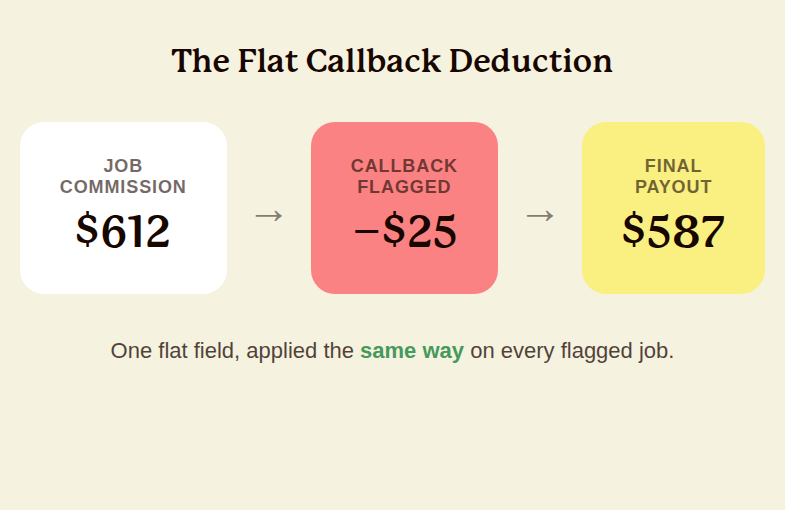
The fix was deliberately simple: a flat $25 deduction, applied the same way every time a job gets flagged with a callback, regardless of which technician is involved or how sympathetic the circumstances seem in the moment. A $612 commission becomes a $587 payout. No manager has to decide whether this particular callback "really" counts, and no technician can reasonably argue they were singled out, because the rule doesn't change based on who's asking.
Why a Written, Automatic Split Beats a Judgment Call
The pattern underneath both fixes is the same one that shows up anywhere commission gets contested: a rule that lives in someone's head isn't a rule, it's an opinion that changes depending on the day and who's asking. The lead/helper split and the flat callback deduction both work for the same reason. They're written down, they're applied the same way every time, and a technician can check the math themselves instead of taking the office's word for it.
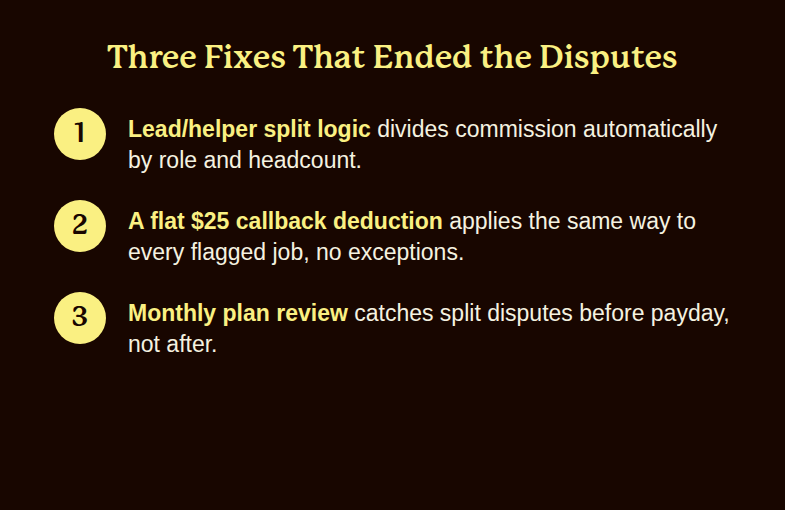
The company added one more piece on top of the two formulas: a monthly review of how the plan is actually paying out, before payday, not after a technician calls in confused. That habit is what caught the next several edge cases, like a job with two helpers instead of one, before they turned into the same kind of dispute that started this whole rebuild. Companies figuring out how to pay plumbing technicians through a similar commission rebuild have found the same thing: the review cadence matters almost as much as the formula itself, because pay plans drift out of sync with how the work actually gets staffed if nobody's checking.
None of this requires a complicated compensation philosophy. It requires picking a split, picking a deduction rule, writing both down somewhere every technician can see, and reviewing the results on a schedule instead of waiting for the next disputed job to force the conversation. If you're still deciding on the percentages themselves, this guide to designing HVAC commission pay that drives profit instead of problems is a solid place to start, and ShareWillow's plan-building and payout tracking tools can apply splits and deductions like these automatically instead of leaving them to a spreadsheet.
Profit sharing
made simple.
Give your team a stake in the company’s success. ShareWillow helps you create and manage profit-sharing programs that motivate employees and drive business results.
Building Pay HVAC Technicians Can Actually Predict
The $3,468.45 dispute turned out to be the best thing that could have happened to this company's pay plan, because it forced a conversation that should have happened long before a job needed to be recalculated by hand. Once the lead/helper split and the flat callback deduction were written down and automated, the same job today would settle in seconds, with both technicians able to see exactly how their number was calculated.
That's really the whole answer to how to pay HVAC technicians fairly on multi-person jobs: pick a split that reflects the actual work, apply deductions consistently, put it in writing, and review it regularly enough that small gaps get caught before they become the next dispute.
How should commission be split between a lead technician and a helper?
There's no single required ratio, but a common approach gives the lead technician the larger share, since they typically carry more responsibility for the job's outcome, while the remainder is divided evenly among any helpers who worked it. What matters more than the exact percentage is that the split is written down and calculated automatically, so it doesn't get renegotiated after every job.
Should a callback affect a technician's commission?
Many companies apply some form of deduction when a job generates a callback, since it signals the original work needed correcting. A flat deduction, applied the same way regardless of circumstances, tends to create fewer disputes than a case-by-case judgment call, because technicians can predict it and no one feels singled out.
How often should an HVAC company review its technician pay plan?
A monthly review is enough to catch most drift, such as new job types or staffing patterns the original plan didn't anticipate, before they turn into disputed paychecks. Reviewing before payday, rather than after a technician raises a concern, is what actually prevents the disputes instead of just resolving them faster.
Related reading
- The Install Commission Plan Built to Put a $10,000 Bonus in Front of an HVAC Company's Best Techs
- How to Pay Plumbing Technicians: The Timing Fix That Closed a $1,700 Payroll Gap
- HVAC Commission Pay: How to Design a Plan That Drives Profit (Not Problems)
- How to Maximize Employee Performance with Tiered Bonus Structures
Conclusion
A written split formula and one flat deduction rule turned a $3,468 dispute into a repeatable process.
Create incentives
that
drive results
You shouldn't need complex equity plans to align your team. ShareWillow makes it simple to create transparent profit-sharing programs that motivate employees and grow your business.

Incentive plans to help
small businesses thrive.
.png)
"I was able to leverage the knowledge of the ShareWillow team to learn how other companies were designing their bonus plans. The template was extremely helpful."

Brian Tustin
Owner, First Rate Movers
