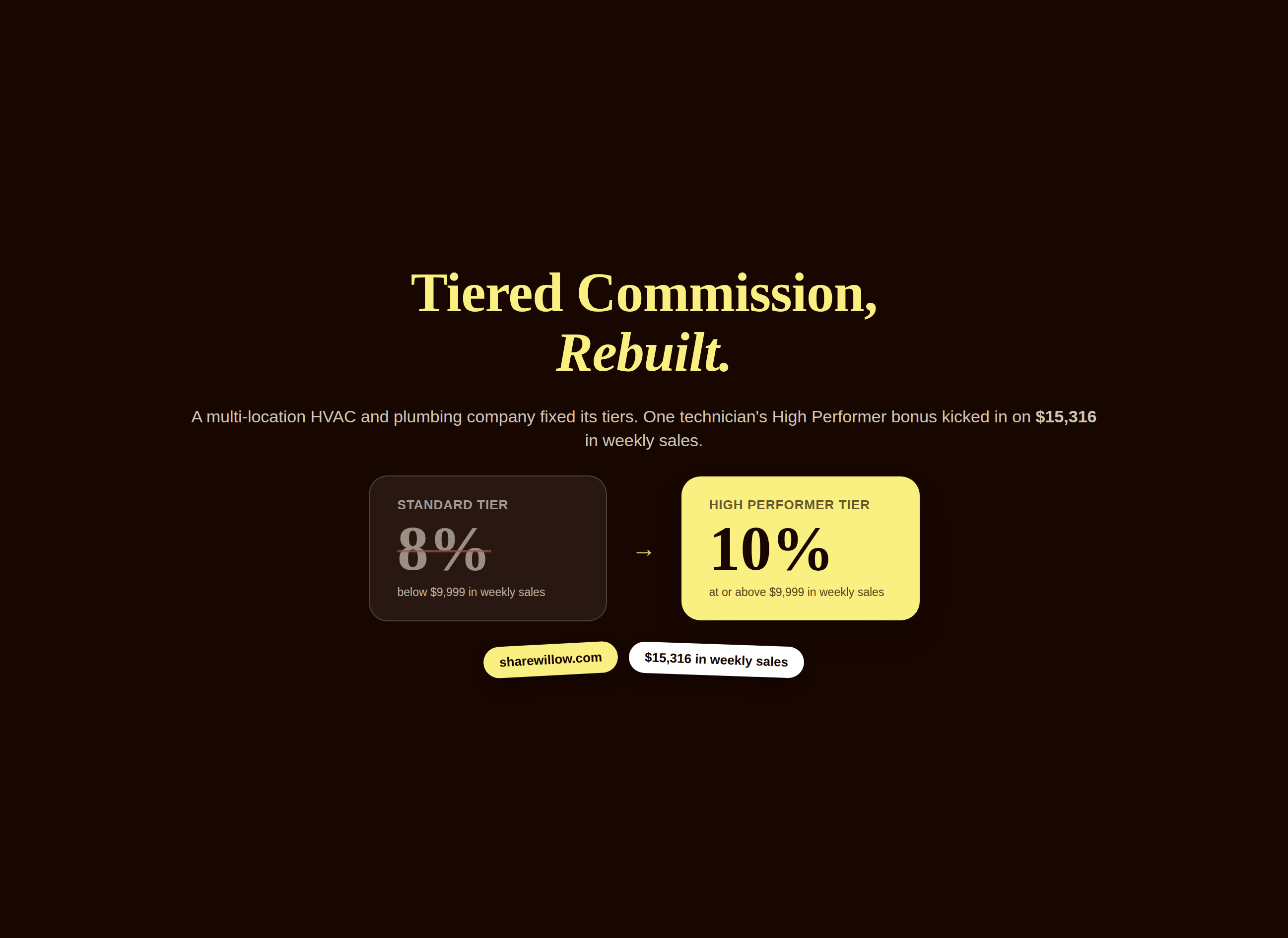
A 7-person HVAC company in South Florida was weeks from cancelling its technician bonus plan over manual payroll errors and a travel-time bug that risked $30,000 a year. Fixing the formula instead of blaming the techs turned it into $74,000 in accurate, automated commission payouts.
Three weeks. That is roughly how long a small HVAC company in South Florida gave its new technician bonus plan before pulling the plug on it entirely. Not because the idea of paying technicians for performance was wrong. Because the math behind it kept coming out wrong, and the person responsible for catching those errors was doing it by hand, every single week, on top of everything else her job already required.
The company runs seven people total, four of them technicians in the field every day. Like a lot of shops that size, the owner had moved to a weekly commission plan to reward the techs who were actually driving revenue rather than just clocking hours. The idea was sound. The execution was not. Every week, the office manager downloaded job records from the field service system and re-entered them one by one to check the numbers before payroll went out. A duct-cleaning job would occasionally get filed under the wrong job type and misclassified as a full install, throwing off the commission calculation attached to it. An after-hours emergency call, the kind that is supposed to trigger a flat on-call bonus, would sometimes get logged as ordinary same-day residential service and the bonus would just never fire.
None of that showed up as one dramatic failure. It showed up as a slow drip of small discrepancies that someone had to catch by hand, week after week, with no guarantee she would catch all of them. And underneath the small stuff sat a bigger, quieter problem: a travel-time calculation error in how the plan handled drive time between jobs. Left alone, the exposure on that single bug was projected at roughly $30,000 a year, money that would have either quietly overpaid the company or quietly shortchanged the technicians, depending on which direction the error leaned in any given week. Either outcome erodes trust. By the time the account reached a churn-risk conversation with ShareWillow, the frustration was not subtle. The plan had become more work than the manual system it was supposed to replace, and the owner was ready to walk away from performance pay altogether rather than keep fighting it.
The Problem Was Never the Idea. It Was the Plumbing Underneath It.
This is a pattern worth naming because it shows up constantly in small field service shops: the incentive concept is right, and the underlying data plumbing is what breaks it. A commission plan is only as good as the job data feeding it, and job data in a busy HVAC shop is messy by default. Techs are moving fast between calls. Job types get mislabeled under pressure. A dispatcher fills in a code that is close enough to describe what happened, not the exact category a commission formula needs to calculate the right number. None of that is anyone doing something wrong on purpose. It is just what happens when four techs are running a full board every day and nobody has time to audit every line for a pay plan that runs underneath the actual work.
The fix ShareWillow built was not a lecture about data hygiene. It was a plan structure that assumed messy inputs and corrected for them automatically, every week, without anyone needing to remember to check. That distinction matters. A rule that lives in a training document gets followed until someone is busy, tired, or new. A rule built into the formula itself gets applied the same way every single time, whether anyone is watching or not.
What Actually Changed: Deduplication, Detection, and a Cleaner Split
The rebuilt weekly commission plan for the four-technician team did three specific things the original manual process could not do reliably.
First, it added deduplication logic directly into the commission calculation, so a service line that accidentally posted twice, a real and recurring failure mode in busy field service systems, no longer produced a duplicate payout. Second, it built in auto-detection for emergency after-hours service jobs, the ones that had been slipping through mislabeled as routine same-day residential calls. Once the system could reliably identify the job type on its own, the $25 on-call spiff attached to it started firing every time it was earned instead of only when someone happened to catch the mislabel by hand. Third, it separated fee logic so that credit-card processing fees applied only to unit sales commission, not to service commission, closing a blending error that had been quietly distorting technician payouts on service-heavy weeks.
None of these three fixes is complicated in isolation. Deduplication logic, job-type detection, and separating two fee categories are not exotic engineering problems. What made the difference was building all three directly into the weekly calculation that runs the plan, rather than leaving them as things a busy office manager was expected to catch by eye, one job record at a time, every single week for as long as the company ran technician commissions. A performance pay system built to run itself instead of one that depends on a single person's manual review is the difference between a plan that survives a busy season and one that quietly falls apart the first week that person is out sick or swamped with something else.
From a Three-Week Ultimatum to a Trend Line Worth Trusting
The turnaround did not happen overnight, and it should not have. Trust in a pay system gets rebuilt one accurate paycheck at a time, not with a single announcement that everything is fixed now. What actually happened was a steady tightening of the gap between what technicians were owed and what the system calculated automatically, week over week, until the discrepancies that used to require a manual audit shrank down to genuinely small numbers.
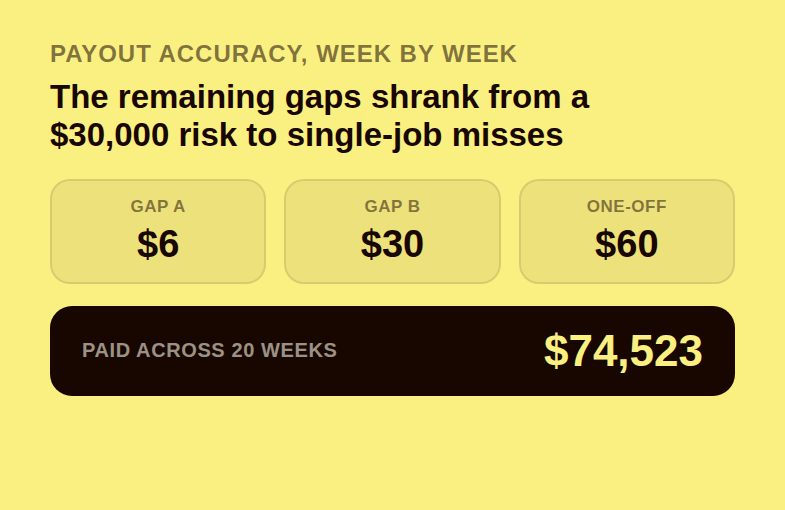
By the most recent check-in on the account, the remaining payout differences being caught were down to single-digit and double-digit dollar amounts, a $6 gap here, a $30 gap there, and one $60 miss that traced back to a single job that had not synced yet. That is a different category of problem entirely than a travel-time bug carrying a projected $30,000 annual exposure. Small, explainable, one-off differences are what a healthy commission system looks like in production. Large, silent, systemic ones are what a plan looks like right before a customer decides it is not worth the trouble anymore.
Over roughly twenty confirmed weekly pay periods since the plan went live, the four-technician team has been paid more than $74,000 in weekly commission, averaging somewhere in the neighborhood of $3,700 a week across the crew. That is real money moving through a system that, a few months earlier, its own operator did not trust enough to stop manually re-checking by hand. The number that matters most here is not the total dollar figure by itself. It is what that figure represents: a plan that ran, week after week, without requiring anyone to catch its own mistakes before the paychecks went out.
What Weekly, Accurate Pay Actually Buys a Small Shop
It is worth being specific about why weekly commission matters here, not just monthly or quarterly. A technician who has to wait a month to find out whether a bonus calculation was right has a month to lose trust in the plan before anyone notices something is off. A technician getting paid weekly finds out almost immediately whether the math matched the work, and so does the owner. That shorter feedback loop is part of what let this account catch its remaining errors while they were still small, single-job discrepancies instead of a month's worth of accumulated mistakes landing all at once in a single paycheck.
There is a retention angle here too, and it is easy to underweight. Four technicians is not a large crew. Losing even one to a competitor over pay confusion, or over a growing sense that the bonus plan cannot be trusted, is a meaningfully bigger hit to a seven-person company than the same loss would be to a fifty-person shop with a deeper bench to absorb it. A technician who has been shorted on a bonus twice, even by a small amount, starts doing the math on their own, comparing what the plan promised against what actually showed up, and that kind of quiet skepticism spreads through a small crew fast. Getting the weekly number right, consistently, is not just an accounting nicety. It is one of the more direct levers a small shop has for keeping the technicians it already has.
Why "Fix the Formula, Not the Blame" Is the Right Instinct
It would have been easy, and understandable, for this to become a story about holding technicians or office staff accountable for data entry errors. That is the wrong lesson to take from it. Every mislabeled job type, every duplicate service line, every travel-time miscalculation in this story traces back to the plan's design, not to any one person's carelessness. A four-tech HVAC crew running a full schedule is never going to produce perfectly clean data by hand, and expecting them to is a losing bet for any owner who tries it.
The better bet is designing the commission formula to expect messy inputs from the start and correct for them automatically. A dispatcher under pressure will occasionally file a job under the closest available code rather than the perfectly correct one. A system serving four technicians across dozens of calls a week will occasionally post a duplicate line. Those are not character flaws. They are the normal operating conditions of a busy field service business, and a pay plan that cannot survive normal operating conditions was never going to hold up for long regardless of how good its underlying commission rates were on paper.
What This Means If Your Own Bonus Plan Feels Like More Work Than It's Worth
If your shop's incentive plan currently depends on someone manually re-checking every job record before payroll goes out, that is not a sign performance pay does not work for a small team. It is a sign the plan is missing the automated guardrails that let it run on its own. The specific fixes that turned this account around, deduplication built into the calculation, automatic detection of job types that trigger different pay rules, and a clean separation between fee categories that should never have been blended together, are not unique to a seven-person HVAC shop in South Florida. They are the kind of structural fixes almost any small field service team running HVAC technician commissions off a field service system will eventually need, whether the trigger is a travel-time bug, a misclassified job type, or some other data quirk specific to how a particular team runs its board.
The company in this story did not fix its bonus plan by finding better technicians or a more diligent office manager. It fixed the plan by building the corrections into the math itself, the same way another HVAC team discovered a travel-time miscalculation quietly overpaying its crew by $30,000 a year and closed the gap at the formula level rather than asking anyone to catch it by hand. If your own performance pay plan is generating more manual review work than it is saving, the fix almost certainly is not a stricter process. It is a plan built to be right automatically, every week, whether anyone is checking or not.
Profit sharing
made simple.
Give your team a stake in the company’s success. ShareWillow helps you create and manage profit-sharing programs that motivate employees and drive business results.
Conclusion
A weekly technician commission plan that once risked $30,000 a year in silent overpayment now runs on its own, has paid out more than $74,000 accurately, and gave a 7-person HVAC shop a reason to stay instead of walking away.
Create incentives
that
drive results
You shouldn't need complex equity plans to align your team. ShareWillow makes it simple to create transparent profit-sharing programs that motivate employees and grow your business.

Incentive plans to help
small businesses thrive.
.png)
"I was able to leverage the knowledge of the ShareWillow team to learn how other companies were designing their bonus plans. The template was extremely helpful."

Brian Tustin
Owner, First Rate Movers