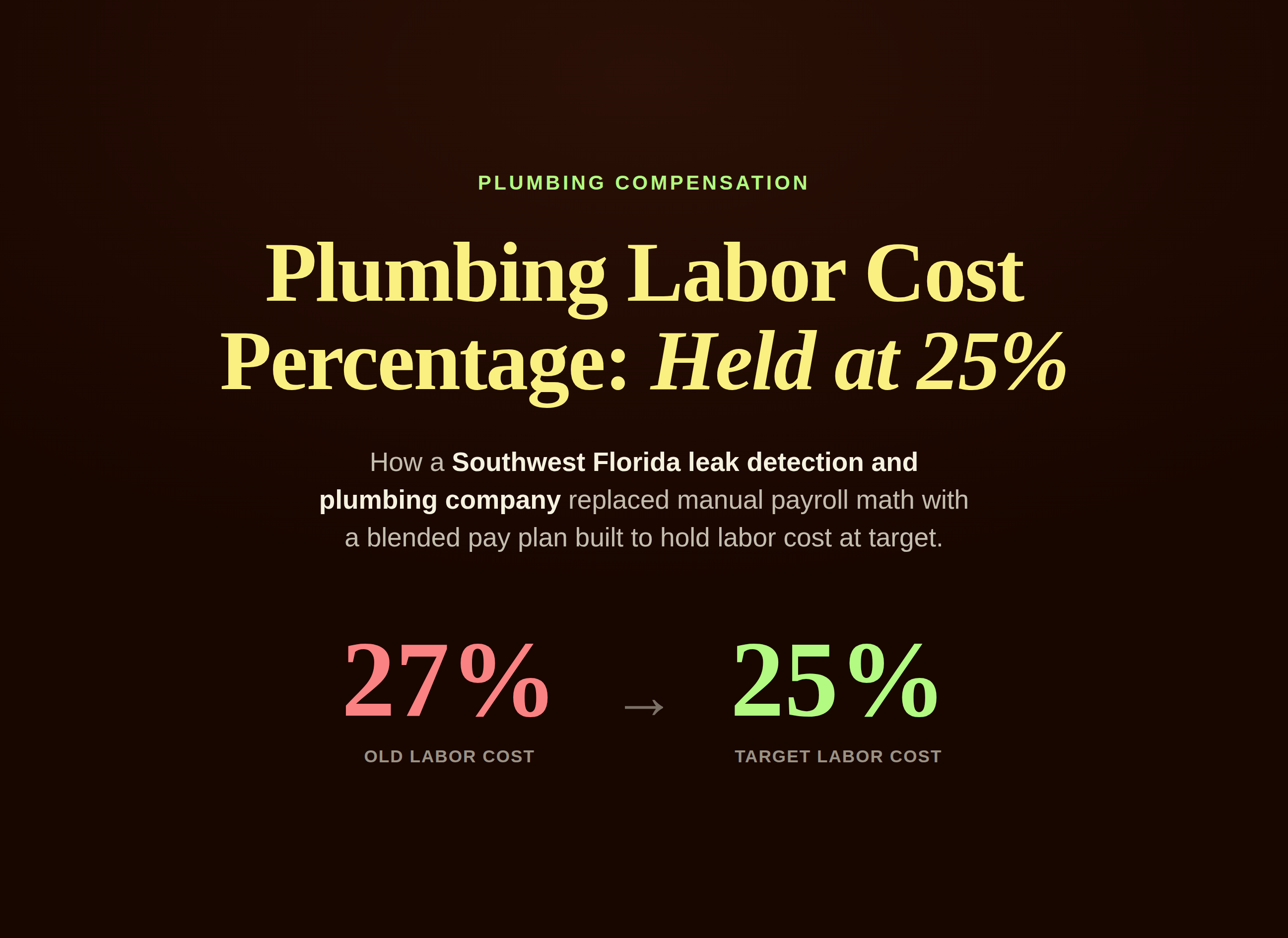
A multi-trade HVAC and plumbing contractor running install and service crews across two branches had a flat 0.5% bonus that almost nobody ever reached. Here is how splitting the plan by trade and branch, and adding a real revenue floor, turned a bonus nobody trusted into a payout that lands every single month.
A Bonus Structure That Was Quietly Doing Nothing
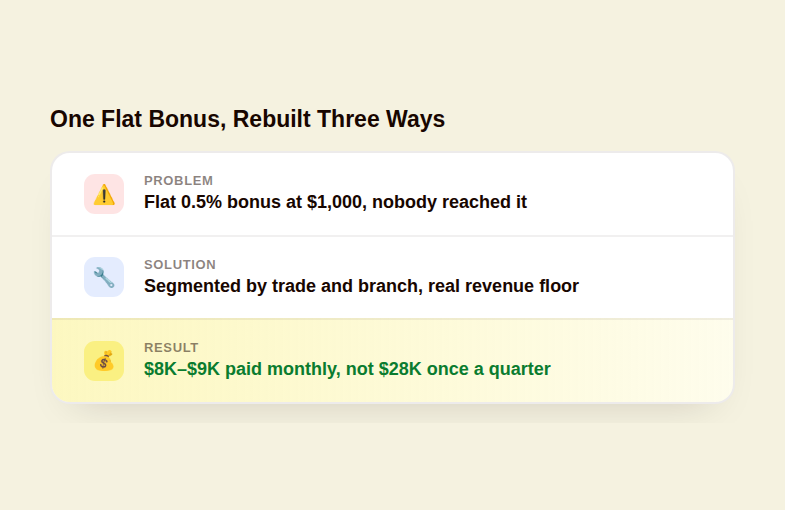
Picture a multi-trade contractor running HVAC installation, HVAC service, and plumbing crews split across two branch locations in the Northeast. Steady call volume, a good reputation in both markets, and a bonus plan that had been sitting untouched for years: a flat 0.5% bonus, paid out once a technician crossed $1,000 in some underlying metric each month.
When leadership actually sat down and looked at who was hitting that threshold, the answer was almost nobody. Not because the technicians were underperforming. The threshold and the percentage had simply drifted out of sync with real job sizes and real labor costs over time, the way most flat incentive structures do if nobody revisits them for a few years. A bonus that technically exists but that essentially nobody ever qualifies for is worse than having no bonus at all, because it still shows up on paper as an incentive plan while doing zero actual incentivizing.
There was a second, quieter problem underneath the first. The plan paid out monthly with no revenue floor attached, which meant a technician who had a genuinely strong month and one who barely got by could land close to the same payout, as long as both cleared the same flat $1,000 line. And because the company runs both install and service work, and some technicians are cross-trained across both, there was no reliable way to credit a technician who split their time between a service call in the morning and an install crew in the afternoon. ServiceTitan natively supports crediting one technician per job, which works fine for a shop that keeps trades cleanly separated, but breaks down fast for a cross-trained crew working across both install and service in the same week.
None of this is a story about a lazy workforce or a careless owner. It is what happens to almost every HVAC and plumbing incentive plan eventually: it gets built once, works reasonably well for a while, and then slowly stops matching the business as job sizes, labor rates, and crew structures shift underneath it. The fix is rarely to abandon incentive pay. It is almost always to rebuild the plan around the business as it actually runs today.
There is also a subtler cost to a bonus plan that quietly stops working: the technicians stop mentioning it at all. Leadership can go months assuming a compensation program is functioning normally simply because nobody is complaining, when the real explanation is that everyone has already priced the bonus at zero and stopped factoring it into how hard they push on a given job. By the time an owner notices the silence, the plan has usually been dead in every practical sense for a long time before anyone bothers to say so out loud.
Segmenting Pay by Trade and Branch
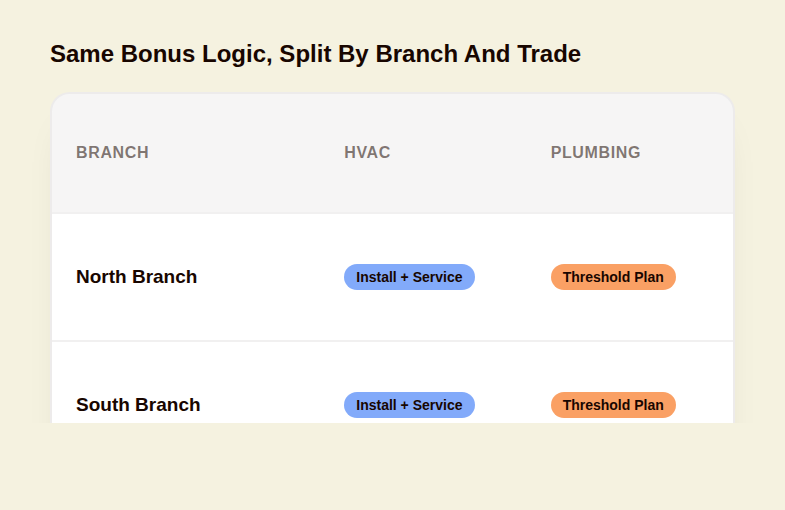
The rebuild started by breaking the single flat bonus into separate, ServiceTitan-integrated incentive plans segmented two ways: by trade, HVAC install, HVAC service, and plumbing, and by branch, since the two locations run different job mixes and different local labor markets. A technician's plan now reflects the specific trade and location they actually work in, instead of one generic percentage applied company-wide regardless of what the job actually looked like.
A Revenue Floor Built From a Real Labor-Rate Target
The more important change was adding a minimum monthly revenue threshold, roughly $21,000, before any commission applies at all. That number was not picked arbitrarily. It was derived directly from a 25% labor-rate target, working backward from what the business needed a technician to generate in revenue to keep labor cost at a healthy percentage of that revenue. A technician has to clear that floor before the incentive turns on, which means the plan only pays out on genuinely productive months instead of rewarding a technician for simply showing up and doing the minimum.
Two additional qualifiers were layered on top of the revenue floor. An attendance component can deduct from the payout, which keeps the incentive tied to a technician actually being present and reliable, not just productive on the days they choose to show up. And a CompanyCam job-photo compliance qualifier ties the bonus to documentation discipline, whether a technician is actually taking and uploading the before-and-after job photos the company needs for warranty claims, insurance documentation, and quality control. A technician can be revenue-productive and still miss a qualifier, which keeps the plan honest about more than just the top-line number.
Solving for the Cross-Trained Technician
The trickiest design problem was the cross-trained technician who splits time between service and install work in the same week. Since ServiceTitan only natively credits one technician per job, the company built a hybrid service-and-install revenue plan specifically for these employees, one that tracks and credits both categories of work instead of forcing a single lead-technician assignment that would erase half of what that person actually did.
The plan proved its worth almost immediately. One technician's incentive calculation needed to be manually backfilled to include a single $51,000 install job that the default crediting rules would have otherwise left completely uncounted, because the job had been logged under a workflow that did not automatically flow into that technician's hybrid plan. Without someone catching that gap, a technician would have done $51,000 worth of real, credited install work and seen none of it reflected in their bonus. That is exactly the kind of silent leak that erodes trust in an incentive plan faster than almost anything else: a technician doing the work, watching the number, and finding out later the system simply never counted it.
Profit sharing
made simple.
Give your team a stake in the company’s success. ShareWillow helps you create and manage profit-sharing programs that motivate employees and drive business results.
From a Quarterly Afterthought to a Monthly Number Techs Can Plan Around
The clearest before-and-after in this story is cadence and consistency. The old bonus structure had effectively become a quarterly afterthought paying out around $28,000 across a full quarter, when it paid out at all. Under the new segmented plans, one branch's HVAC install team alone is now generating a monthly incentive pool of roughly $8,000 to $9,000, every single month, calculated automatically from the same ServiceTitan data the company already had.
That shift from quarterly to monthly matters more than the raw dollar figures suggest. A technician who has to wait three months to see whether their hard work translated into a bonus has almost no ability to connect a specific week of strong performance to a specific payout. A technician who sees that connection every thirty days can actually adjust behavior in response to it. Frequency is itself a design choice, and in this case it is arguably doing as much work as the revenue floor or the trade segmentation.
A Rollout With No Complaints, From Either Side
As of the most recent rollout check-in, roughly half of the install technician workforce has been fully migrated onto the new segmented plans, with the rest following in planned phases rather than all at once. According to the office manager overseeing the transition, no major rollout issues had been reported, installs and service teams had generally adopted the change without complaints, which is a genuinely rare outcome for a compensation change that touches how every technician's paycheck gets calculated.
Part of that smooth reception likely traces back to how the plan was scoped from the start. Nobody's guaranteed pay was cut. The segmentation, the revenue floor, and the qualifiers were framed and built as ways to make an existing, mostly-dormant bonus actually reachable and fair across two branches and three trade categories, not as a stealth pay reduction dressed up as a redesign. Technicians can tell the difference, and it shows up directly in how a rollout like this actually lands in the field.
If your own company runs more than one trade or more than one location and you are still running a single flat bonus percentage across all of it, this is usually where the cracks start to show first: a threshold nobody hits, a cross-trained technician nobody can credit correctly, and a payout schedule too slow for anyone to connect their effort to their paycheck. All three are fixable with the data most field service companies already have sitting in ServiceTitan or a comparable platform. The work is in segmenting it correctly and picking a floor that reflects your real labor-cost target instead of a round number nobody ever revisited.
Why the Labor-Rate Target Matters More Than the Percentage
It is tempting, when redesigning a bonus plan, to focus on the commission percentage: is it half a percent, two percent, five percent. This story suggests that is usually the wrong variable to obsess over first. The percentage barely matters if the threshold underneath it is disconnected from what the business actually needs a technician to produce. A 0.5% bonus at a $1,000 threshold and a 2% bonus at a $4,000 threshold can pay out almost identically depending on how the underlying job sizes are distributed. What actually changes behavior is whether the floor reflects a real, defensible labor-cost target the owner can explain in one sentence, in this case, a 25% labor rate translated directly into a $21,000 monthly revenue floor.
That kind of floor does two things a flat percentage alone cannot. It gives the owner a plain-language answer when a technician asks why the threshold is what it is, instead of "that's just the number we picked." And it automatically adjusts the pressure on the plan as the business's own cost structure shifts, since the floor is derived from a ratio, not a fixed dollar figure that quietly goes stale as material costs, wages, and job pricing all move over time.
Qualifiers Are Not Bureaucracy, They Are Guardrails
It would be easy to look at the attendance deduction and the CompanyCam photo-compliance qualifier and read them as extra red tape layered onto a bonus plan that should just be about revenue. The opposite is closer to true. A pure revenue-based bonus with no other qualifiers eventually teaches technicians that the only thing that matters is the top-line number, which can quietly erode the behaviors that protect the business in ways revenue does not capture: showing up reliably, documenting the job correctly for warranty and insurance purposes, following the workflow that keeps the next technician on that job from walking in blind. Building those qualifiers directly into the incentive plan, rather than treating them as separate compliance issues to be handled through discipline, keeps the plan honest about what a genuinely good month actually looks like on a job site, not just what it looks like on a revenue report.
Related reading
Conclusion
A single flat bonus that almost nobody could reach became three segmented plans, by trade and by branch, built around a real 25% labor-cost target instead of a round number nobody remembers picking. The result is a monthly install-incentive pool outperforming what the old plan paid out per quarter, rolled out to two branches and three trade categories without a single major complaint from the field.
Create incentives
that
drive results
You shouldn't need complex equity plans to align your team. ShareWillow makes it simple to create transparent profit-sharing programs that motivate employees and grow your business.

Incentive plans to help
small businesses thrive.
.png)
"I was able to leverage the knowledge of the ShareWillow team to learn how other companies were designing their bonus plans. The template was extremely helpful."

Brian Tustin
Owner, First Rate Movers