
HVAC commission chargeback explained: a fixed $50 callback charge follows the original install crew, and commission waits until the job is paid in full.
An HVAC commission chargeback is what happens when a callback costs the company money and the pay plan decides who carries it. Most plans never decide. The callback lands wherever the repair ticket happens to land, and that is usually the wrong person's pay stub. An HVAC company with install and service technicians, one salesperson, CSRs, and a service manager sat down at its ShareWillow kickoff and decided to fix that before the first payout, not after the first argument.
This is a plan-design story, not a results story. The company was still building its plans at the time of the call. But the choices it made are specific, and they answer two questions that trip up almost every HVAC pay plan: who pays when an install comes back, and when exactly does a commission count as earned?
The Problem: Callbacks Landed on the Wrong Pay Stub
The company runs two kinds of work through the same service department. Install crews put in new systems. Residential service technicians handle repairs. When an installed system has a problem later, a service technician is the one who gets sent to fix it.
That is where the attribution breaks. The repair is done by a service technician, so a callback metric that follows the repair ticket pins the callback on the service technician who showed up to help. The install crew that created the problem never sees it. The technician who fixed it carries a number they did not cause.
The team ran into exactly this when mapping the plan. Callbacks were being misattributed whenever residential service did the repair on a job that began as an install. If you penalize the person who fixes the problem, you teach every technician to avoid fixing problems.

HVAC Commission Chargeback: A Fixed $50, Traced to the Original Job
The company's answer is a flat rule. An install callback carries a fixed $50 deduction, and the deduction is traced back to the original job and charged to that job's lead technicians. The service technician who runs the repair is not charged.
Three details make this work:
- It is a fixed amount. The charge is $50 regardless of the cause of the callback. A flat number is easy to explain, and it avoids a debate about how bad a particular callback was.
- It follows the original job. The deduction is traced to the install the callback came from, so the people who did the work are the people who answer for it.
- It hits the lead technicians. The leads on the original job carry the charge. The technician doing the repair stays out of it.
A fixed chargeback is not meant to make anyone rich or poor. At $50 it is a signal. It tells install crews that quality after the install has a price, and it tells service technicians that fixing someone else's work will not cost them. Companies that track callbacks at a larger scale often tie them to a rate target, as in the story of an HVAC company that tied pay to a 3% callback quality bar. The flat chargeback is the simpler version for a company that wants a rule technicians can recite from memory.
When a Commission Counts as Earned
The second question the company answered was about timing. Commercial jobs at this company can take 30 to 60 days to get paid. If commission is calculated at the sale or even at completion, the company is paying out money it does not yet have, and any later dispute over the invoice turns into a clawback.
So the plan keys every metric to the last-paid date and requires a zero balance before anything pays. A job that is installed but not paid in full does not count. When the final dollar arrives, the job lands in the next pay period.
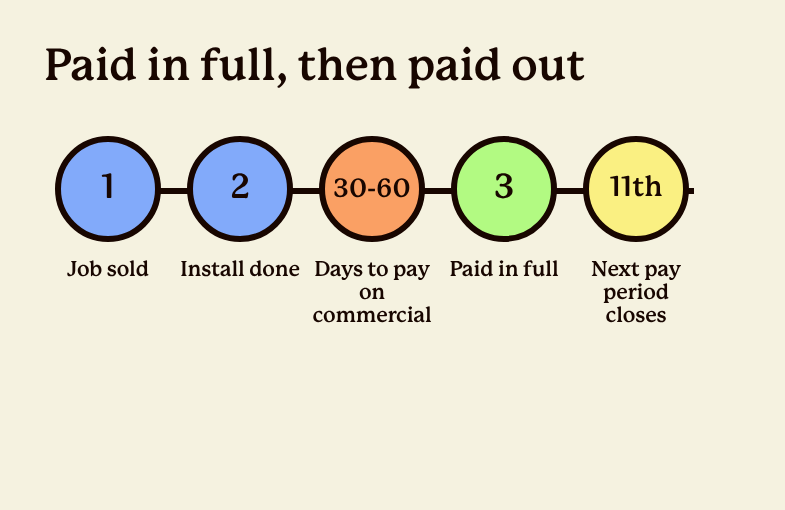
Plan periods run twice a month, closing on the 11th and the 26th. Anything paid in full before a close date is picked up in that period. Anything paid after waits for the next one, at most about two weeks. On the commercial side, the wait is the point: nobody collects commission on an invoice that is still open.
This is the same logic behind a story we covered about when to pay technician commission, where open balances forced the question of completed date versus paid date. Here the company simply chose paid date from the start.
The Salesperson: 10% Above a 50% Margin
The plan for the company's one salesperson follows the same pay-when-paid rule. The salesperson earns 10% on sales that clear a 50% gross profit margin, and the commission is released only when the job is paid in full.
Two features stand out. First, the margin gate means a discounted job that barely makes money does not earn a commission, which protects the company from a sale that looks good on a report and thin on the bank statement. Second, tying the payout to full payment aligns the salesperson with collections, so a long-running commercial invoice is a shared problem and not just the office's problem.
It is also the part of the plan that is easiest to get wrong without a system. Margin has to be calculated on the final job cost, and payment status has to be checked job by job. Doing that in a spreadsheet twice a month, for every open job, is the kind of work that quietly turns into errors.
Why a Kickoff Is the Right Time to Decide This
This plan was designed at kickoff, before the first payout. That is the cheapest moment to make these rules. Changing a chargeback or a payment trigger after technicians have seen their numbers is much harder, as another company found when it had to cap bonuses that were already running.
Kickoff is also when data problems surface. On the same call, one CSR's calls-booked count looked unreliable because some calls had been misclassified, a reminder that plan inputs need checking before payday, not after.
Profit sharing
made simple.
Give your team a stake in the company’s success. ShareWillow helps you create and manage profit-sharing programs that motivate employees and drive business results.
What Is Still Unproven
The company was at the kickoff stage, so there are no payout totals to report. We do not know yet how many callbacks the $50 rule will catch in its first month or how technicians will react to seeing a chargeback on their own numbers. Those are the things worth watching in a follow-up.
What is already clear is the shape of the plan: a flat, traceable charge for callbacks, a rule that commission follows cash, and a twice-monthly rhythm that gets technicians paid without paying ahead of the customer.
How to Set Up a Callback Chargeback
If you want to try the same approach, here is a short checklist:
- Link every callback to its original job. Without that link, you cannot charge the right crew. Make it a required field when dispatch books the return visit.
- Charge the lead technicians, not the repair tech. The person who fixes the problem should never be penalized for it.
- Use a flat amount. A fixed number, such as $50, is easy to remember and impossible to argue with.
- Define "earned" as paid in full. Pick one date, the last-paid date, and require a zero balance on the job.
- Set two pay periods a month. Closing on fixed dates, such as the 11th and the 26th, keeps payroll predictable.
- Tell the team before the first payout. A rule everyone has seen in advance is not a surprise deduction.
For broader context on structuring technician pay, see our guide to HVAC commission pay. If you want to see how chargebacks, margin gates, and paid-date triggers are calculated from your field service data, the ShareWillow product features page has the details. Another install-side example, where labor is subtracted from an award before anything is paid, is in how an HVAC company subtracts job labor from an $800 install spiff.
A chargeback is not a punishment. It is a promise about who owns the quality of the work, written down before it is tested. This company made that promise at kickoff.
What is an HVAC commission chargeback?
It is a deduction taken from technician pay when a job comes back, such as a callback or a refund. In this story, a fixed $50 is charged to the lead technicians of the original install, not to the service technician who runs the repair.
Should HVAC commission be paid before the customer pays?
It is safer not to. Commercial jobs here can take 30 to 60 days to pay, so the company releases commission only when the job reaches a zero balance. That avoids paying out money that later turns into a dispute.
How often should HVAC technicians be paid commission?
Twice a month is a common rhythm. This company closes pay periods on the 11th and the 26th, so anything paid in full before a close date is included in that period.
Related reading
- When to Pay Technician Commission: Completed Date vs. Paid Date, and the $6,600 in Open Balances That Forced the Question
- Same Bonus, Any Callback Rate: How an HVAC Company Tied Pay to a 3% Quality Bar
- HVAC Installation Spiff: How an HVAC Company Subtracts Job Labor From an $800 Award and Pays Only the Remainder
- Technician Bonus Cap: How an Epoxy Flooring Company Capped Crew Bonuses at $400 Per Job After 3 Techs Passed It
Conclusion
Charge callbacks to the crew that did the install, and release commission only when the job is paid in full.
Create incentives
that
drive results
You shouldn't need complex equity plans to align your team. ShareWillow makes it simple to create transparent profit-sharing programs that motivate employees and grow your business.

Incentive plans to help
small businesses thrive.

"I was able to leverage the knowledge of the ShareWillow team to learn how other companies were designing their bonus plans. The template was extremely helpful."

Brian Tustin
Owner, First Rate Movers
