An HVAC installation spiff that subtracts job labor first: see how one company pays only the remainder of an $800 award, after the job is paid in full.
An HVAC installation spiff is easy to design and easy to get wrong. Pay a flat bonus for every system installed and you will get more systems installed. You may also get jobs that ran long, burned labor, and left almost nothing for the company. One HVAC company onboarding onto ShareWillow this week built its install spiff to avoid that trap, and the rule is simple enough to copy: subtract the job's labor from the award first, and only pay out what is left.
The company runs installation, service, sales, service management, and CSR roles out of ServiceTitan. Its plans cover installers, service technicians, one salesperson, and a service manager, and about eleven people had not yet been invited to the platform when the setup call happened. Here is how the install plan works, why each rule exists, and where an owner can borrow from it.
The Problem With a Flat Installation Spiff
Most install spiffs look like this: complete a system, earn a set amount. It is clean and technicians understand it. The weakness shows up on the jobs that go sideways.
- A long install pays the same as a fast one. If the crew spends extra days on a system, the spiff does not shrink.
- The company carries the labor risk. The award is a fixed cost layered on top of hours that may already have eaten the margin.
- Nobody has a reason to protect the clock. Without a link between the spiff and labor, there is no pull toward efficient installs.
For a broader look at how spiffs fit into HVAC pay, our guide to using HVAC SPIFFs to boost business profit is a good starting point.
The Rule: Award Minus Total Job Labor
This company's complete-system installation award is $800. Before anyone is paid, the plan subtracts the total labor on the job from that amount. If a positive remainder exists, it is split among the technicians assigned to the install. If labor meets or exceeds the award, the spiff is zero.
Here is a hypothetical to show the shape of it. These numbers are for illustration, not from the company. Suppose a system install has $500 of total job labor. The award is $800, so $300 remains. With two assigned technicians, each earns $150. If the same install had $850 of labor, nobody earns a spiff on it.
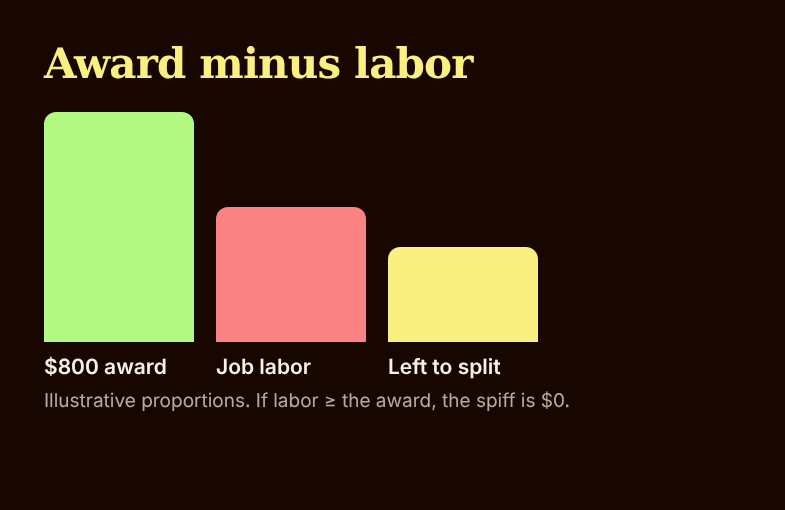
The effect is that the award works like a margin guardrail. The faster and cleaner the install, the bigger the remainder. The more hours the job eats, the smaller it gets. The technicians who care about the spiff now have a direct reason to care about the clock.
If you want to see how another company set install awards by job type before its first payout, read about HVAC installer bonuses from $300 to $1,000.
Callbacks Follow the Install, Not the Repair
The second rule deals with quality. Each installation callback carries a fixed $50 deduction. The interesting part is who absorbs it.
When an installed system comes back with a problem, the repair is often handled by residential service, not the install crew. A plan that charges the callback to whoever fixes it would penalize the wrong person. This company traces every callback to the original installation job, uses that job's department, and applies the $50 deduction to the lead technicians assigned to the original install.
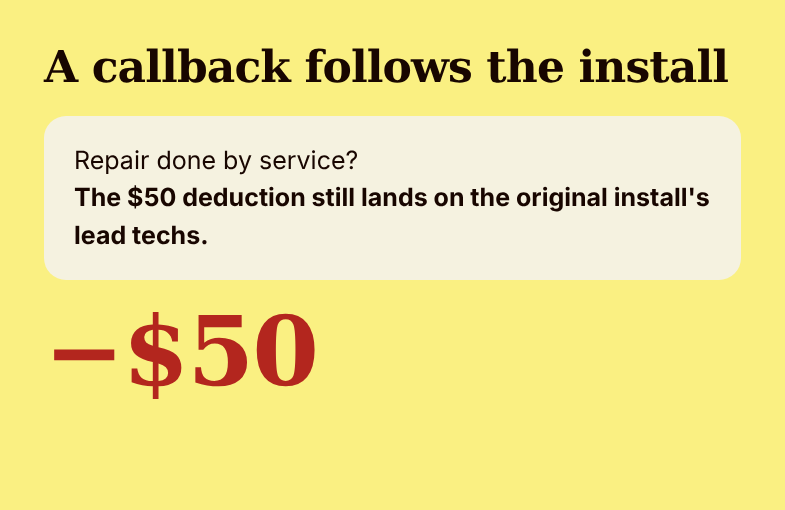
That keeps accountability where the work was done. It also protects service technicians from carrying a penalty for fixing someone else's job. If you are thinking about how to tie pay to quality, see how another HVAC company tied a bonus to a 3% callback bar.
Pay Only After the Job Is Paid in Full
The third rule is about timing. The owner's long-standing practice is to hold commission until the company has the money, including on commercial jobs that can take 30 to 60 days to pay. In ShareWillow, every plan metric now uses the last-paid date as the payout date and requires a zero balance on the job.

Two things follow from this choice:
- The payout period matters less than the payment date. The company pays on twice-monthly periods starting on the 11th and the 26th, but a job only counts in the period when it is fully paid.
- Technicians need to see why a job has not paid out. A visible balance beats a surprise.
The same question has come up elsewhere. One company found $6,600 in open balances before it settled on completed date versus paid date, and a plumbing company built a spiff program that holds credit until the job is paid.
The Rest of the Plan Set
The install spiff is one piece of a larger setup. Other rules from the same onboarding show how a company can protect profit across roles:
- Tech-generated leads: technicians earn 1% of job revenue on leads they generate.
- Sales: the company's sole salesperson earns 10% on sales above a 50% gross profit margin.
- Memberships: membership sales are eligible for a spiff under the CSR plan.
- Transparency: the owner prefers a full numerical leaderboard so employees can see how performance connects to pay. That decision is pending employee agreement at an upcoming company meeting.
Before moving to ShareWillow, the company reviewed about 20 metrics each quarter in an Excel sheet shared with the team. Moving those rules into one system lets the team check each metric against its ServiceTitan reports for jobs, memberships, and invoice items instead of rebuilding the math by hand. You can see what the platform covers on the ShareWillow product features page.
Profit sharing
made simple.
Give your team a stake in the company’s success. ShareWillow helps you create and manage profit-sharing programs that motivate employees and drive business results.
Common Mistakes With an HVAC Installation Spiff
Even a well-meant spiff can backfire. These are the mistakes worth avoiding before you launch.
- Paying on the completion date. A job can close in the field and sit unpaid for weeks. If the spiff is already out the door, you are funding a bonus with money you do not have yet.
- Ignoring labor. A flat award treats a two-day install and a four-day install as equal. Only one of them was profitable.
- Charging callbacks to the wrong person. If the repair crew absorbs the penalty, your service technicians will start avoiding callback work.
- Leaving the rules in a spreadsheet. When the formula lives in one person's file, every question becomes a debate. Written rules, calculated from field data, end most of those debates.
- Launching without a preview. This company is validating every metric against ServiceTitan reports and sharing a calculator at a company meeting before go-live. Technicians who can check the math tend to trust it.
None of these mistakes are about generosity. They are about sequence: define the margin, subtract the cost, wait for the money, and then pay.
How to Build an HVAC Installation Spiff That Protects Margin
You do not need this exact plan to use the idea. Here is a short sequence any HVAC owner can follow.
- Set the award by job type. A complete system, a replacement, and a repair each deserve their own number.
- Subtract total job labor. Use real labor from your field system, not an estimate.
- Split only a positive remainder. Decide in advance how you divide it between lead and helper.
- Trace callbacks to the original job. Charge the quality deduction to the people who installed it.
- Wait for payment. Use the last-paid date, and require a zero balance.
Most of the friction in spiff programs comes from rules that live in a notebook or a spreadsheet. When the rules are written down and calculated from the same data your payroll uses, disputes shrink and technicians can trust the number.
Frequently Asked Questions
What is an HVAC installation spiff?
It is a bonus paid to technicians for completing an installation, often a fixed amount per system. Better versions tie the amount to job labor, quality, and payment so the company only pays when the job was profitable.
How much should an HVAC installation spiff be?
It depends on your margins and job mix. This company uses $800 for a complete system, minus total job labor, with any positive remainder split among the assigned technicians. Start with the margin you want to protect and work backward.
Should callbacks reduce an installation spiff?
Yes, if you want installers to own quality. Charge the deduction to the lead technicians on the original install, even when a service technician makes the repair, so the penalty lands on the right person.
Related reading
- HVAC Installer Bonus: How One Company Set $300 to $1,000 Awards by Job Type Before Its First Payout
- When to Pay Technician Commission: Completed Date vs. Paid Date, and the $6,600 in Open Balances That Forced the Question
- The Paper Spiff Form That Turned Into a 5X Payout System for a Six-Tech HVAC Shop
- How to Use HVAC SPIFFs to Boost Business Profit
Conclusion
An HVAC installation spiff protects margin when it subtracts job labor, charges callbacks to the original install, and pays only after the customer has paid in full.
Create incentives
that
drive results
You shouldn't need complex equity plans to align your team. ShareWillow makes it simple to create transparent profit-sharing programs that motivate employees and grow your business.

Incentive plans to help
small businesses thrive.

"I was able to leverage the knowledge of the ShareWillow team to learn how other companies were designing their bonus plans. The template was extremely helpful."

Brian Tustin
Owner, First Rate Movers